Introduction
Quick question every growing business eventually asks: why do the most trusted brands in America still answer the phone with an 800 area code? The answer is older than most of your customers. The 800 area code went live in 1966 as the very first toll-free prefix in North America, and nearly six decades later it remains shorthand for "this company is the real deal." In this guide you will learn exactly how an 800 number works, how it differs from newer toll-free codes, what it costs, how to claim one, and how to protect yourself from the scams that hide behind familiar digits. By the end, you will know whether a toll-free number belongs in your growth plan.
- The 800 prefix launched in 1966 as North America's first toll-free code
- Non-geographic — it routes anywhere, tied to no city or state
- 800, 888, 877, 866, 855, 844, and 833 are all equally toll-free
- Toll-free lines have been linked to ad response lifts of up to 30%
- Watch for spoofing, callback traps, and lookalike prefixes
What Is the 800 Area Code?
The 800 area code is not really an "area" at all. Unlike a 212 or a 415, it is not tied to a city, a state, or a time zone. Instead, it was the first non-geographic prefix ever created, designed so that a single number could ring anywhere across the continent.
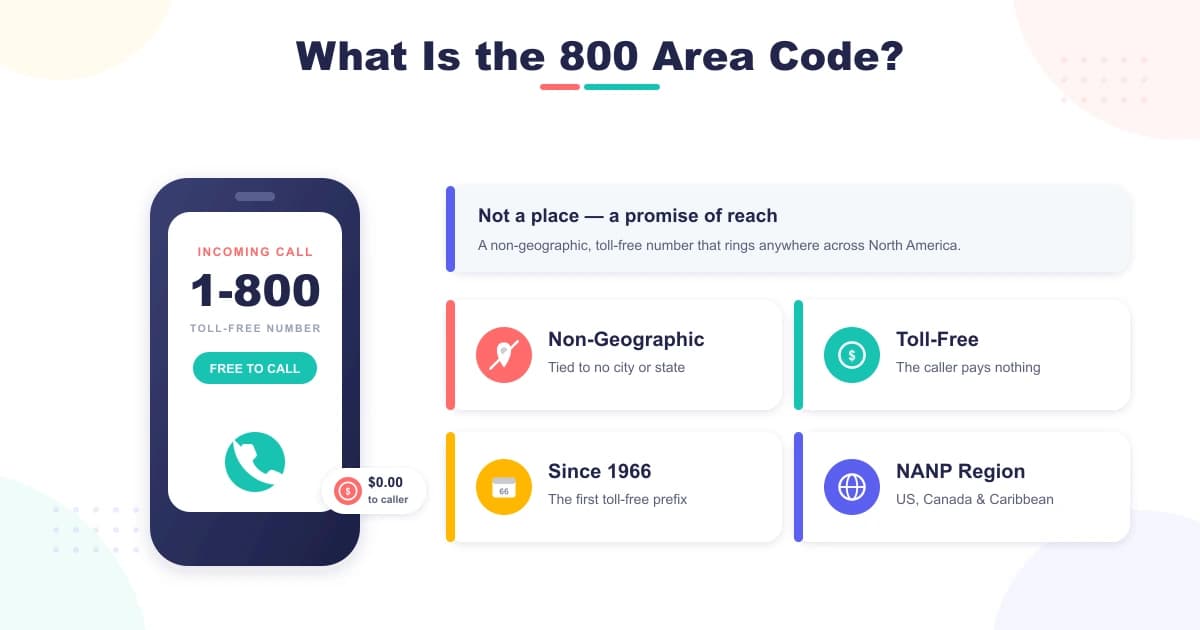
When AT&T introduced it in 1966, the goal was simple: let customers call a business for free, with no operator and no long-distance charge required. That idea reshaped customer service. A national retailer could print one number on every catalog, and a caller in Maine paid the same as a caller in California: nothing.
Today the 800 area code sits inside the North American Numbering Plan (NANP), which covers the United States, Canada, and parts of the Caribbean. So when you dial an 800 number, you are not reaching a place — you are reaching whichever phone line the business has chosen to point it toward.
That distinction matters more than it first appears. A geographic area code quietly tells the caller where you sit; a toll-free number says nothing about location and everything about reach, which is precisely why national brands, support desks, and fast-growing startups gravitate to it.
- The first non-geographic area code, launched in 1966
- Not tied to any city, state, or time zone
- Part of the NANP — US, Canada, and the Caribbean
- Routes to any line the business chooses
- Signals national reach rather than a location
How Toll-Free 800 Numbers Actually Work
The defining feature of any toll-free number is who pays. With a normal call, the person dialing covers the cost. With an 800 number, that charge flips: the business receiving the call foots the bill, and the caller dials for free.
Behind the scenes, toll-free numbers are managed through a shared database that routes each call to the correct destination line. That routing is flexible — pairing an 800 number with a cloud-based business phone system lets a company send daytime calls to an office and after-hours calls to a mobile phone or a voicemail box, all under the same number.
Because the code is non-geographic, an 800 number can follow a business when it relocates. You could move your headquarters across the country, keep the same toll-free number on every business card you ever printed, and never lose a single returning customer. That permanence is part of why these numbers became a marketing staple.
- The business pays; the caller dials for free
- A shared database routes every call
- Send calls to office, mobile, or voicemail
- One number works across all locations
- Keep the same number even if you relocate
800 vs. Other Toll-Free Prefixes
The original 800 prefix proved so popular that available combinations ran out. To keep up, regulators released additional toll-free prefixes over the years: 888, 877, 866, 855, 844, and most recently 833.
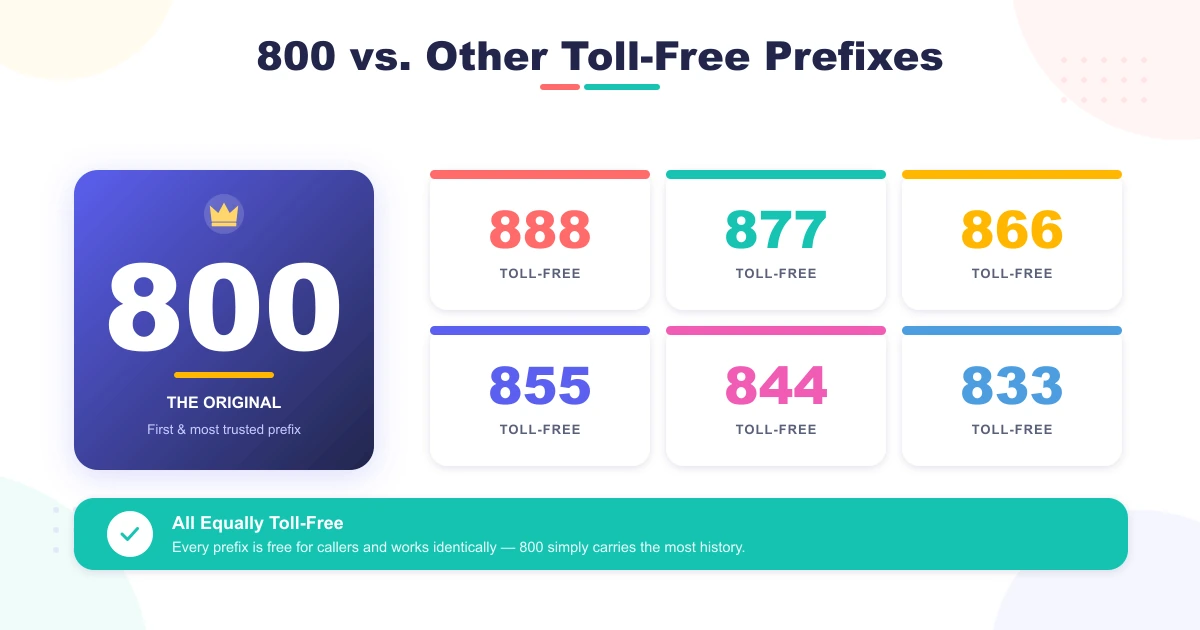
Here is the important part: all of these are equally toll-free and work in exactly the same way. As the FCC explains, a call to an 833 number is just as free as a call to an 800 number.
The real difference is perception. Because 800 came first and dominated decades of advertising, many customers instinctively trust it most. Newer prefixes carry the same function but slightly less brand history. For that reason, true 800 numbers are now harder to find and often more sought-after, while a fresh 833 or 844 line is easier to secure for a new venture.
If a specific prefix is unavailable, you lose nothing functional by choosing another — you simply trade a sliver of nostalgia for instant availability.
- Toll-free prefixes: 800, 888, 877, 866, 855, 844, 833
- All are free for callers and work identically
- 800 carries the most brand recognition
- True 800 numbers are scarcer and in higher demand
- Newer prefixes are easier to secure for a new venture
Why an 800 Area Code Still Wins for Business
Even in an era of texting and live chat, a toll-free number pulls real weight. An 800 number for business signals that you are established and national in scope, even if you operate from a single room. Removing the cost barrier encourages more people to call — some studies have linked toll-free numbers to ad response lifts of up to 30 percent.
A vanity number such as 1-800-FLOWERS turns your phone line into an advertisement that customers can recall without writing it down. And because toll-free calls are easy to measure, you can tie specific campaigns to specific call volumes and prove what is working.
This is also where the right platform matters. A modern provider like Teloz, which has focused on business communications since 2005, can pair an 800 number with AI-driven contact center tools so that every inbound call is routed, answered, and analyzed intelligently rather than simply ringing into a void.
- Instant credibility and a national presence
- Wider reach — response lifts of up to 30%
- Memorable vanity numbers like 1-800-FLOWERS
- Built-in call tracking and campaign analytics
- Pairs with AI-driven contact center tools
How to Get an 800 Number
Claiming a toll-free line is faster than most people expect. With a cloud-based provider, the whole process usually takes less than an hour and follows four steps.
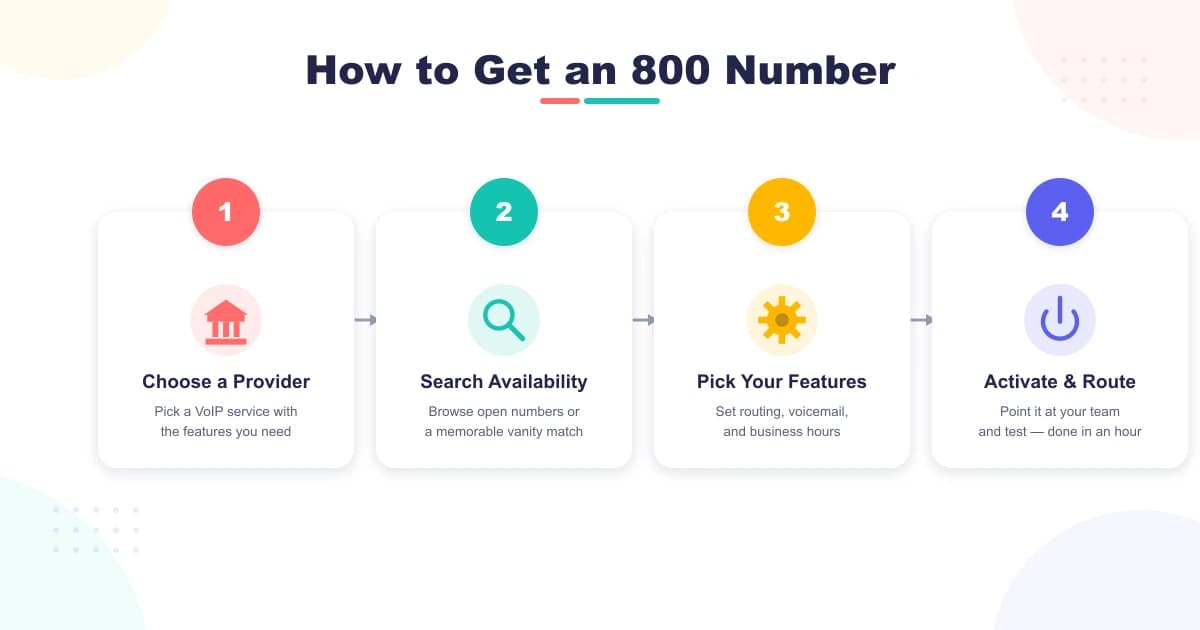
First, choose a provider — look for a VoIP or contact center service that offers toll-free provisioning along with the features you actually need, such as call routing, IVR menus, and analytics. Second, search availability: browse open toll-free numbers, or check whether a memorable vanity number is free in your preferred prefix. Third, pick your features — decide on call forwarding rules, voicemail, business hours, and whether you want SMS or call recording attached. Finally, activate and route: point the number at your team and test it.
On cost, expect roughly $10 to $25 per month for a small-business plan, with per-minute rates often landing between $0.06 and $0.30 depending on volume. Heavier call centers negotiate wholesale rates, which is one reason platforms that serve both retail and wholesale customers can scale pricing as you grow.
- Choose a provider with the features you need
- Search open numbers or a vanity match
- Pick routing, voicemail, and add-ons
- Activate, point it at your team, and test
- Plans run about $10–$25/month plus per-minute
“The 800 area code went live in 1966 as the very first toll-free prefix in North America — and nearly six decades later it still says, "this company is the real deal."”
800 Number Scams and How to Stay Safe
Trust cuts both ways. Because people instinctively believe toll-free numbers, scammers try to borrow that credibility. A few patterns are worth knowing.
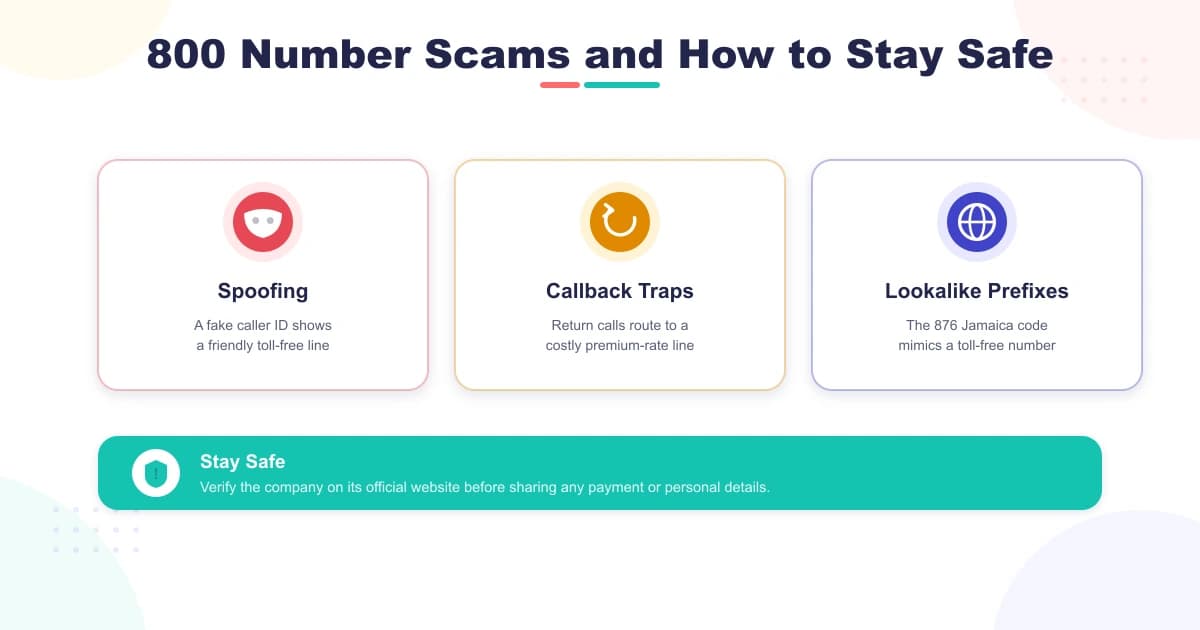
Spoofing disguises a fraudster's real number so your caller ID shows a friendly-looking toll-free line — the display is fake even when the format looks right. Callback traps prompt you to call back a number that quietly routes to a premium-rate line, leaving you with surprise charges. And lookalike prefixes, such as the 876 country code for Jamaica, can be mistaken for a domestic toll-free prefix, tricking victims into expensive international calls.
The safest habit is simple: never trust a number based on its format alone. Verify the company through its official website before sharing payment details or sensitive information, and let unexpected "you've won" calls go to voicemail.
For businesses, the responsibility runs the other way too. Your real 800 number earns credibility through consistency — the same number on your website, your invoices, and your marketing reassures callers that they have reached the genuine company rather than an imitation.
- Spoofing fakes a trusted toll-free caller ID
- Callback traps route to premium-rate lines
- Lookalike prefixes (e.g., 876 Jamaica)
- Verify via the official website first
- Keep one consistent number everywhere
Conclusion
The 800 area code has outlasted fax machines, pagers, and a dozen communication fads because it solves a timeless problem: it makes calling your business effortless and your brand more trustworthy. Whether you want a classic 800 number or a newer toll-free prefix, the value lies in pairing it with smart routing, analytics, and a provider that grows with you. Just stay alert to the scams that exploit that same trust — a toll-free line is only as trustworthy as the consistency behind it.