Introduction
No area code in North American telephone history has been divided more aggressively than 213.
Split five times between 1951 and 1998, it gave birth to 714, 805, 818, 310, and 323 — and still, what remains is the most commercially loaded prefix in the western United States: Downtown Los Angeles, the entertainment capital of the world and the anchor of a metropolitan economy worth $1.295 trillion.
Today, the 213 area code operates as part of a triple-overlay system alongside 323 and the newly activated 738, covering Downtown LA, Hollywood, East Los Angeles, and a dense corridor of Southeast Los Angeles County cities.
Whether you're launching a media company, a financial services firm, a legal practice, or a healthcare operation in the heart of LA — a 213 number is the most historically recognized local signal available.
This guide covers everything: the full split history, current coverage, how 213 relates to 323, 738, 310, and 818, and how to claim a 213 area code number for your business.
- What Is the 213 Area Code?
- The History of the 213 Area Code
- 213, 323, and 738: Los Angeles's Triple-Overlay System
- Key Cities and Industries in the 213 Region
- Why Businesses Choose a 213 Area Code
What Is the 213 Area Code?
The 213 area code is a North American Numbering Plan (NANP) geographic code assigned to Downtown Los Angeles and surrounding communities.
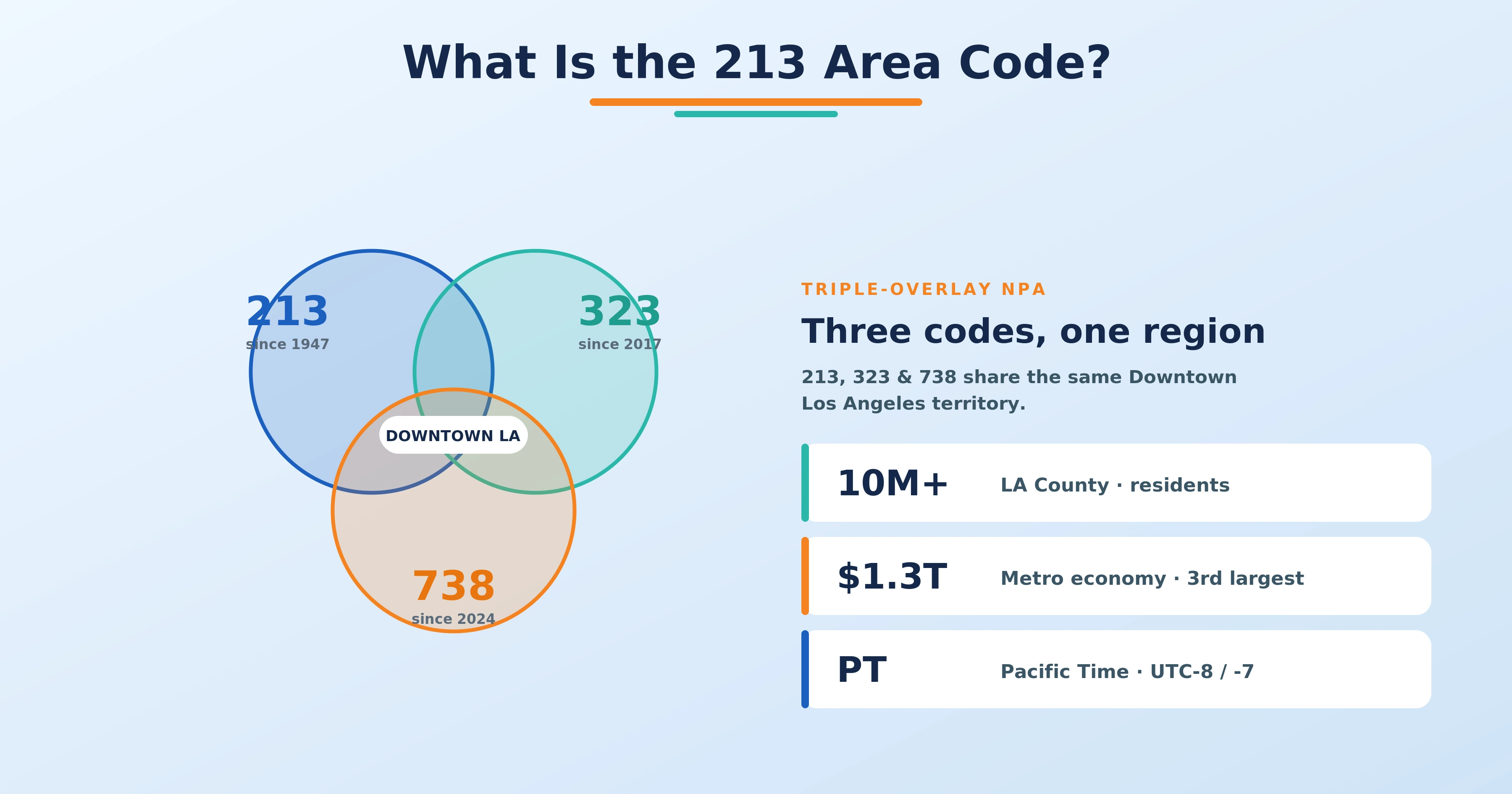
Since July 2017, it has operated as an overlay with the 323 area code — and since November 2024, also with the newly introduced 738 area code — forming a triple-overlay numbering plan area across the Los Angeles urban core.
The 213/323/738 overlay complex covers the following neighborhoods and cities:
Businesses that want to activate service right away can start with local phone numbers.
- Downtown Los Angeles — the financial, civic, and commercial core
- Koreatown and Westlake — one of LA's densest commercial corridors
- Hollywood and East Hollywood — the global hub of the entertainment industry
- Silver Lake, Echo Park, Los Feliz — creative and media districts
- East Los Angeles and Boyle Heights — the historic eastside
- Pico-Union — a high-density commercial neighborhood
- Southeast LA County cities — Bell, Huntington Park, Maywood, Cudahy, Commerce, Vernon, South Gate, Lynwood, Gardena
The History of the 213 Area Code
The 213 area code's story is the story of California's explosive 20th-century growth.
When NANPA introduced the North American Numbering Plan in 1947, the entire southern half of California — from the Central Coast to the Mexican border — was assigned a single area code: 213.
For just four years, one code served Los Angeles, San Diego, Orange County, the Inland Empire, and everything in between.
Then came five successive splits over the next five decades:
1951 — Area Code 714. San Diego and most of Orange County were split off, forming the new 714 area code.
1957 — Area Code 805. Northern and western portions of the remaining 213 territory — what are today Santa Barbara and Ventura County areas — were split off as 805.
1984 — Area Code 818. The San Fernando Valley and San Gabriel Valley — among the fastest-growing suburban regions in the US — were removed from the 213 NPA and reassigned to the new 818 area code.
1991 — Area Code 310. West Los Angeles, the Westside, and the South Bay were split off as the new 310 area code.
1998 — Area Code 323. The fifth and final split carved Hollywood, East Hollywood, East Los Angeles, and Southeast Los Angeles County cities out of 213, assigning them to the new 323 code.
2017 — The 213/323 Overlay. Rather than a sixth split, the California Public Utilities Commission eliminated the boundary between 213 and 323.
From July 8, 2017, both codes became overlays covering the entire former 213/323 territory simultaneously, with mandatory 10-digit dialing for all local calls.
November 2024 — Area Code 738. As the 213/323 number pool continued filling, NANPA introduced 738 as a third overlay to the same territory.
For a detailed numbering history, see Wikipedia's overview of the 213 area code.
213, 323, and 738: Los Angeles's Triple-Overlay System
Los Angeles is one of the most complex area code environments in the United States, with multiple overlays across different zones of the metro. Here's how the codes covering the urban core compare to the wider LA landscape:
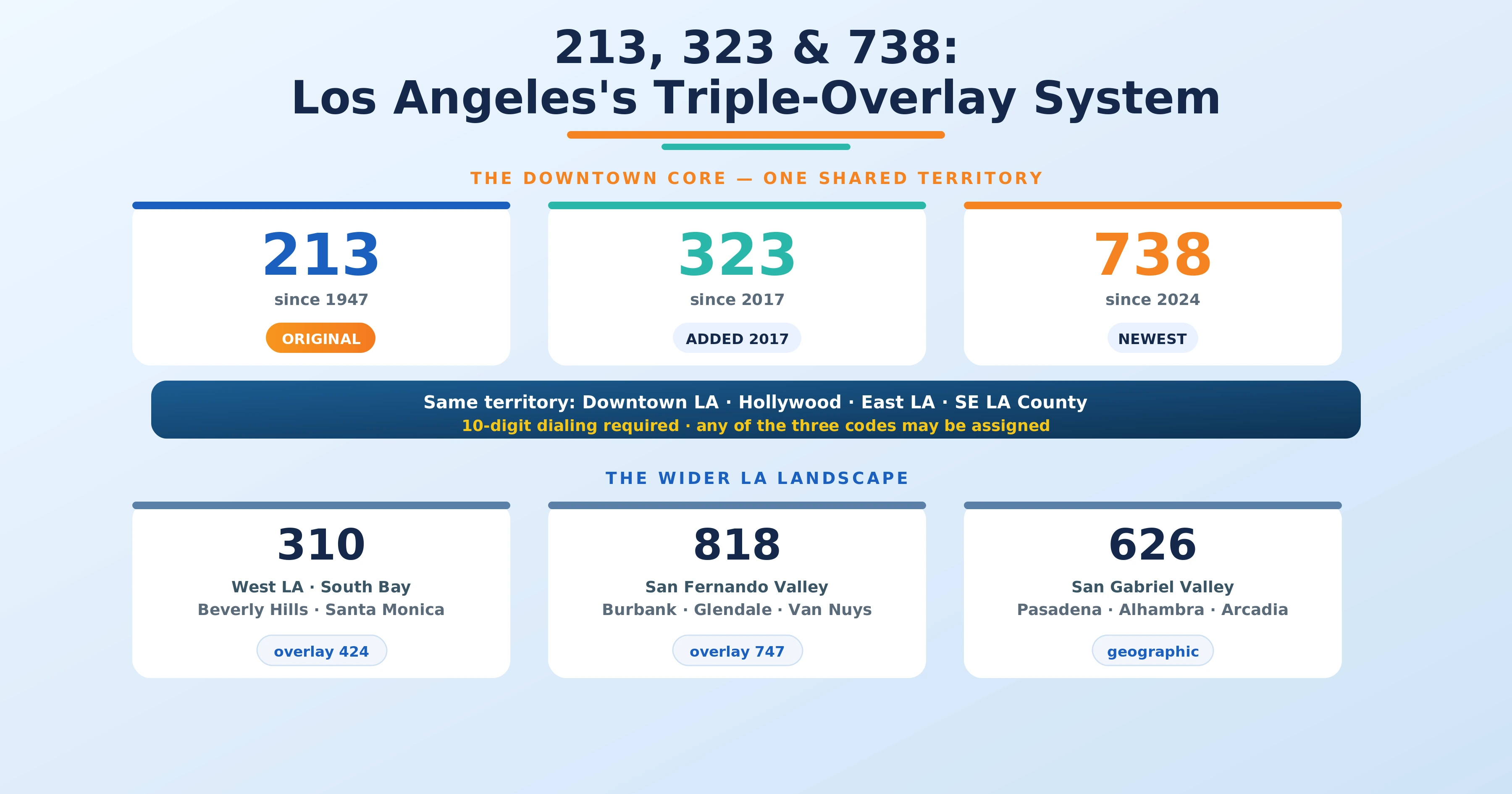
| Area Code | Territory | Status |
|---|---|---|
| 213 | Downtown LA, Hollywood, East LA, SE LA County | Active — triple overlay with 323 + 738 |
| 323 | Same as 213 (overlay since July 2017) | Active — triple overlay with 213 + 738 |
| 738 | Same as 213/323 (overlay since November 2024) | Active — newest, numbers still available |
| 310 | West LA, South Bay, Beverly Hills, Santa Monica | Active — overlay with 424 |
| 818 | San Fernando Valley (Burbank, Glendale, Van Nuys) | Active — overlay with 747 |
| 626 | San Gabriel Valley (Pasadena, Alhambra, Arcadia) | Geographic |
Because 213, 323, and 738 all cover the same territory, every local call within the overlay zone requires 10-digit dialing — even calls between neighbors on the same block. For businesses, the key distinction is legacy value. A 213 number is the original Los Angeles code — carried by entertainment studios, financial institutions, law firms, and civic organizations for over seven decades. The 323 code entered in 1998; 738 only launched in November 2024. Among the three, 213 carries unmistakable historic weight.
Key Cities and Industries in the 213 Region
The 213 area code region is the economic and cultural engine of the American West.
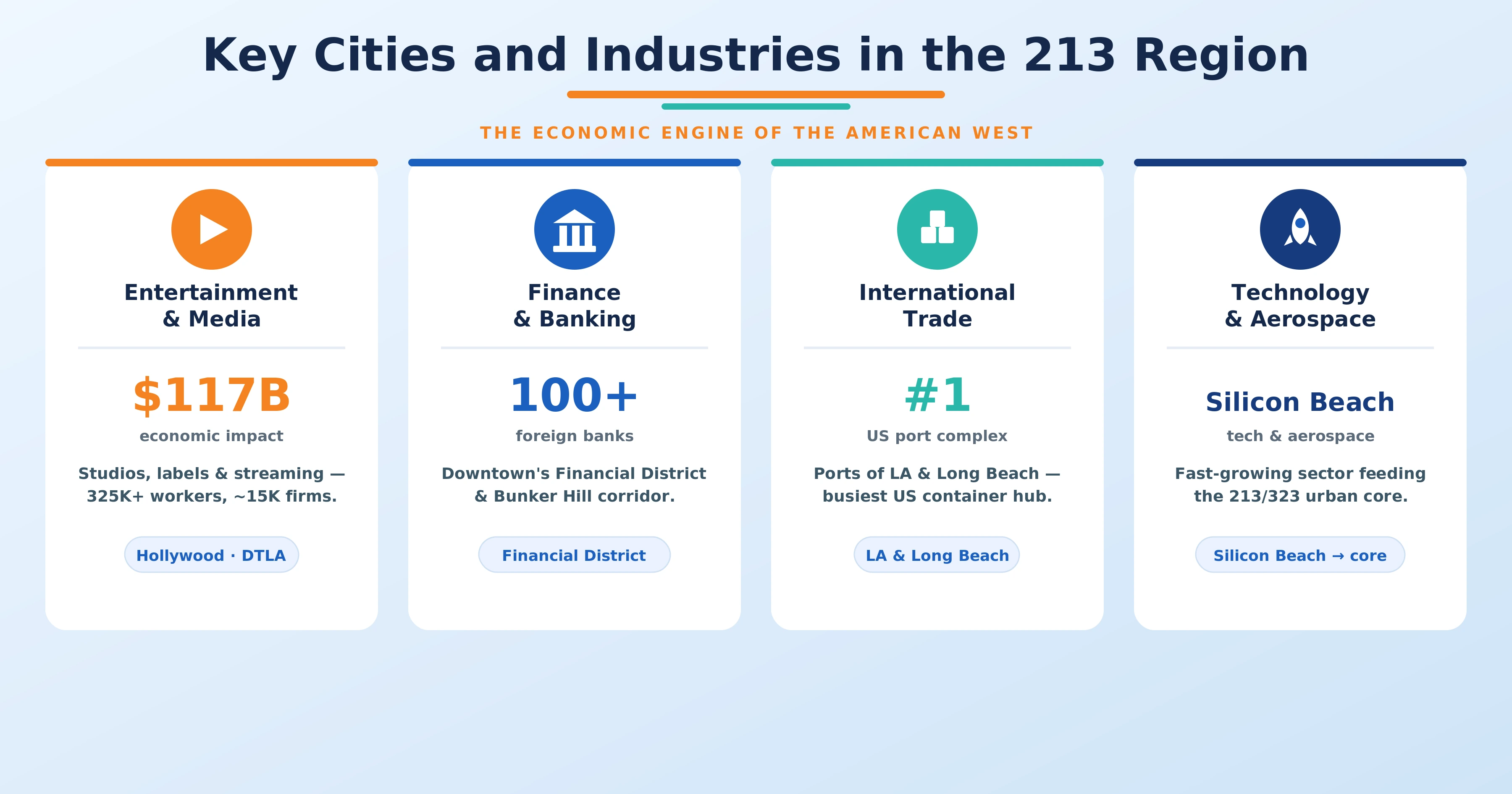
Entertainment and Media dominate the 213/323/738 territory.
The entertainment industry in Los Angeles directly and indirectly supports over 325,000 workers across approximately 15,000 businesses, generating an estimated economic impact of around $117 billion.
The major studios, talent agencies, music labels, streaming platforms, and production houses operating in Hollywood and Downtown LA have built their client-facing phone presence around 213 and 323 numbers for decades.
Finance and Banking form the region's second major pillar.
More than 100 foreign banks and countless domestic banks operate branches in Los Angeles, along with hundreds of investment banks, financial law firms, and asset management firms headquartered in or near Downtown LA's Financial District — Bunker Hill and the surrounding blocks remain one of the most concentrated financial corridors west of Chicago.
International Trade and Commerce anchor the broader LA economy, with the Ports of Los Angeles and Long Beach processing more container traffic than any other US port complex.
Technology and Aerospace round out the picture, with the LA tech sector expanding rapidly — Silicon Beach firms in the 310 territory have supply chains and vendor networks that run deep into the 213/323 urban core.
Teams managing clients across entertainment, finance, and tech use an omnichannel communication platform to keep every channel — calls, SMS, email — unified in one place.
Why Businesses Choose a 213 Area Code
A 213 number in Los Angeles carries a signal that 323, 738, and especially out-of-state numbers simply cannot match.
77 Years of Legacy Recognition. The 213 area code has been dialing into Los Angeles since 1947.
Entertainment executives, entertainment attorneys, studio procurement teams, and Downtown LA financial clients have been exchanging 213 numbers since their industries were built. A 213 caller ID reads as established — not as a pop-up shop or remote vendor.
The Entertainment Industry's Original Code. The major studios, talent agencies, and music industry offices that first put Hollywood on the map did so with 213 numbers.
That association persists, making 213 the prestige prefix for companies entering the entertainment and media ecosystem.
Downtown's Financial and Legal Community. The Bunker Hill financial district, the LA courthouse complex, and the high-rise legal offices of Downtown Los Angeles are 213 territory.
For financial services, legal practices, and professional service firms targeting these communities, a 213 number is the most contextually relevant choice.
Scalable AI-Powered Infrastructure. Teloz combines your 213 number with enterprise-grade infrastructure so your Los Angeles presence grows from a single agent to a full enterprise team without disruption. Explore the full Teloz platform at teloz.com.
“No area code in North American telephone history has been divided more aggressively than 213.”
How to Get a 213 Area Code Number
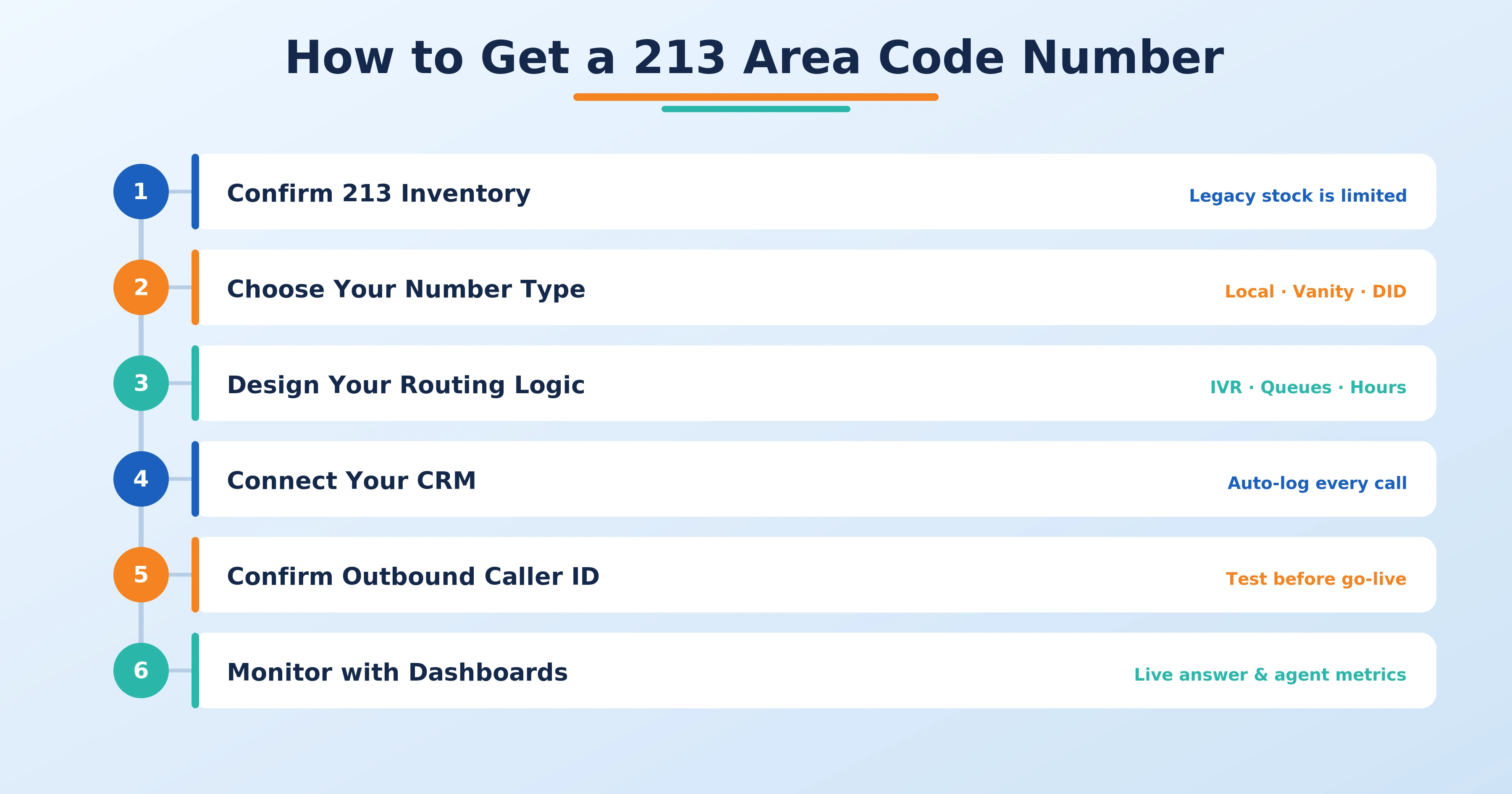
Claiming a 213 number takes six steps with a cloud VoIP provider:
If your team also needs multi-region reach, compare international virtual numbers.
Step 1: Confirm 213 Inventory
The 213 area code is one of the most sought-after legacy codes in the US. Confirm that your chosen cloud VoIP provider has active 213 numbers in stock — demand is high and legacy numbers in this prefix are limited.
Step 2: Choose Your Number Type
Select a standard local 213 number, a vanity number (e.g., 213-555-FILM for a production company), or a direct inward dialing (DID) line for a specific department or executive.
Step 3: Design Your Routing Logic
Configure IVR menus, call queues, and business-hours routing. Route calls by department, customer priority, language, or agent skillset — essential for entertainment and finance operations handling high-volume inbound traffic.
Step 4: Connect Your CRM
Integrate your 213 line with your CRM so every call — inbound and outbound — logs automatically against the right customer record. No manual entry, full interaction history.
Step 5: Confirm Outbound Caller ID
Test that your 213 number displays correctly on outbound calls before going live. In the LA market, caller ID is the first thing a client sees.
Step 6: Monitor with Real-Time Dashboards
Track answer rates, handle time, agent performance, and queue depth using live analytics from your first day in operation.
Conclusion
The 213 area code is the most storied telephone prefix in Western America — active since 1947, split five times, and still standing as the Downtown Los Angeles identifier at the heart of a $1.295 trillion metro economy.
Today it operates alongside 323 and the newly launched 738 in a triple-overlay system with mandatory 10-digit dialing, serving the entertainment industry, the financial district, international trade corridors, and the dense commercial communities of Southeast Los Angeles County.
For businesses entering the LA market, a 213 number delivers 77 years of local recognition, historic prestige in entertainment and finance, and the credibility signal that no newer LA code can replicate.
Pair it with intelligent cloud infrastructure to maximize every connection. See how Teloz powers LA business communications at teloz.com.


