Introduction
What area code serves the agency that approves every prescription drug sold in the United States, the world's largest biomedical research complex, and the nation's third-largest biopharma hub — all within a 30-mile radius? The answer is the 240 area code.
Western Maryland's 240 area code covers some of the most economically and strategically consequential geography in the United States.
Montgomery County — home to the Food and Drug Administration, the National Institutes of Health, 18 federal agencies, and 36 federal labs — generates a $117 billion GDP that represents a full 25% of Maryland's entire state economy.
Prince George's County adds Joint Base Andrews, NASA Goddard Space Flight Center, the IRS national headquarters, and the US Census Bureau to the same territory.
This is not a typical suburban area code. The 240 is the telephone prefix for the corridor of federal science, defense operations, and biotech innovation that sits just outside Washington, D.C.
This guide covers the complete history, geography, economy, and how to get a 240 number for your Maryland business.
- What Is the 240 Area Code?
- The History of the 240 Area Code
- Montgomery County: The Federal Science and Biopharma Capital
- Prince George's County: The Federal Operations Hub
- The Broader 240 Territory: Frederick, Western Maryland, and Southern Maryland
What Is the 240 Area Code?
The 240 area code is a geographic North American Numbering Plan (NANP) overlay code serving western and southern Maryland.
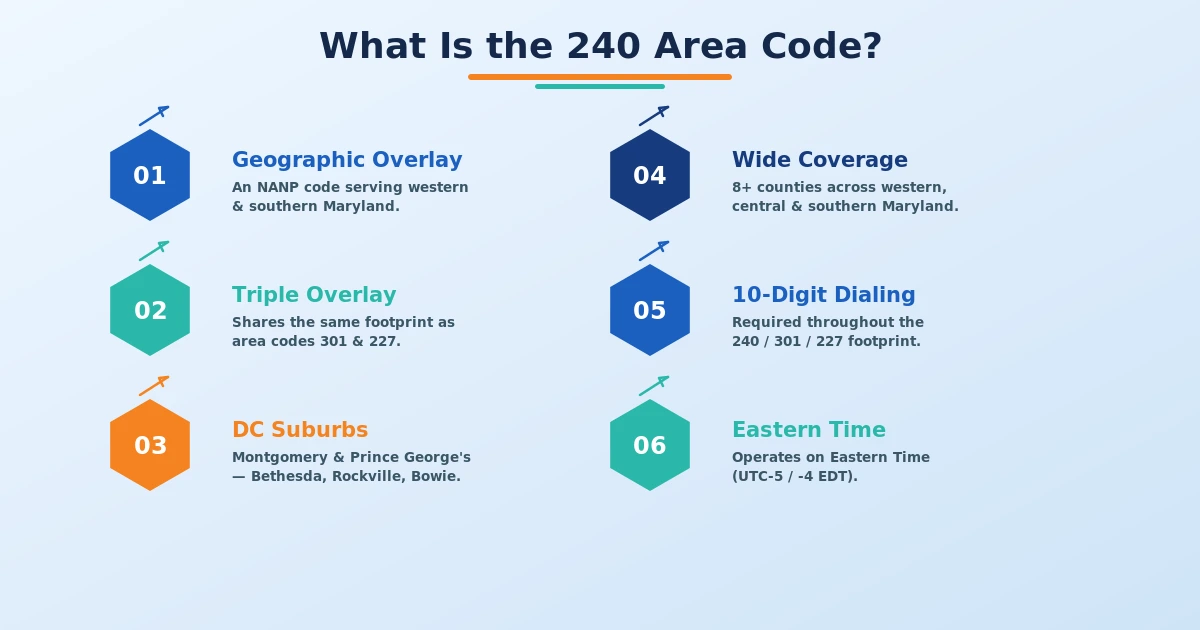
It operates across the same footprint as area codes 301 and 227 — all three codes reach the same counties, agencies, and businesses throughout the region.
The 240/301/227 numbering plan area spans western, central, and southern Maryland, covering a broad crescent of suburbs and rural communities surrounding Washington, D.C.:
Businesses that want to activate service right away can start with local phone numbers.
- Montgomery County — Rockville, Bethesda, Silver Spring, Gaithersburg, Germantown, Chevy Chase, Potomac, Takoma Park
- Prince George's County — Bowie, College Park, Largo, Greenbelt, Hyattsville, Upper Marlboro
- Frederick County — Frederick, Urbana, Gaithersburg-adjacent communities
- Charles County — Waldorf, La Plata, Indian Head
- St. Mary's County — Lexington Park, Leonardtown
- Garrett County — Oakland, Deep Creek Lake
- Allegany County — Cumberland, Frostburg
- Washington County — Hagerstown
The History of the 240 Area Code
Western Maryland's area code history reflects the explosive growth of Washington, D.C.'s suburban ring over eight decades.
1947 — Area Code 301: At the founding of the North American Numbering Plan, all of Maryland is assigned area code 301 — covering everything from Baltimore to the western mountains in a single numbering plan area.
November 1, 1991 — Area Code 410 splits off: Baltimore and eastern Maryland's rapid growth depletes the 301 number pool. Area code 410 is carved out to cover Baltimore and the eastern counties.
June 1, 1997 — Area Code 240 launches: The proliferation of mobile phones and pagers in the densely populated DC suburbs pushes 301 toward exhaustion.
Maryland introduces its first overlay: area code 240 is assigned to the same territory as 301, and mandatory 10-digit dialing takes effect.
June 14, 2023 — Area Code 227 launches: Area code 227 had been approved for the 301/240 region as far back as January 3, 2001 — but was not implemented for 22 years, as alternate number conservation methods bought time.
When 227 finally went live in June 2023, the western Maryland territory became a three-code overlay.
For a detailed numbering history, see Wikipedia's overview of the 240 area code.
| Area Code | Launched | Type | Notes |
|---|---|---|---|
| 301 | 1947 | Original NANP | All Maryland; eastern MD split to 410 in 1991 |
| 240 | Jun 1, 1997 | Overlay of 301 | Maryland's first overlay; 10-digit dialing begins |
| 227 | Jun 14, 2023 | Overlay of 301/240 | Approved 2001; delayed 22 years by alternate allocation |
Montgomery County: The Federal Science and Biopharma Capital
No county in Maryland — and arguably no county in the United States — concentrates more federal science capacity per square mile than Montgomery County.
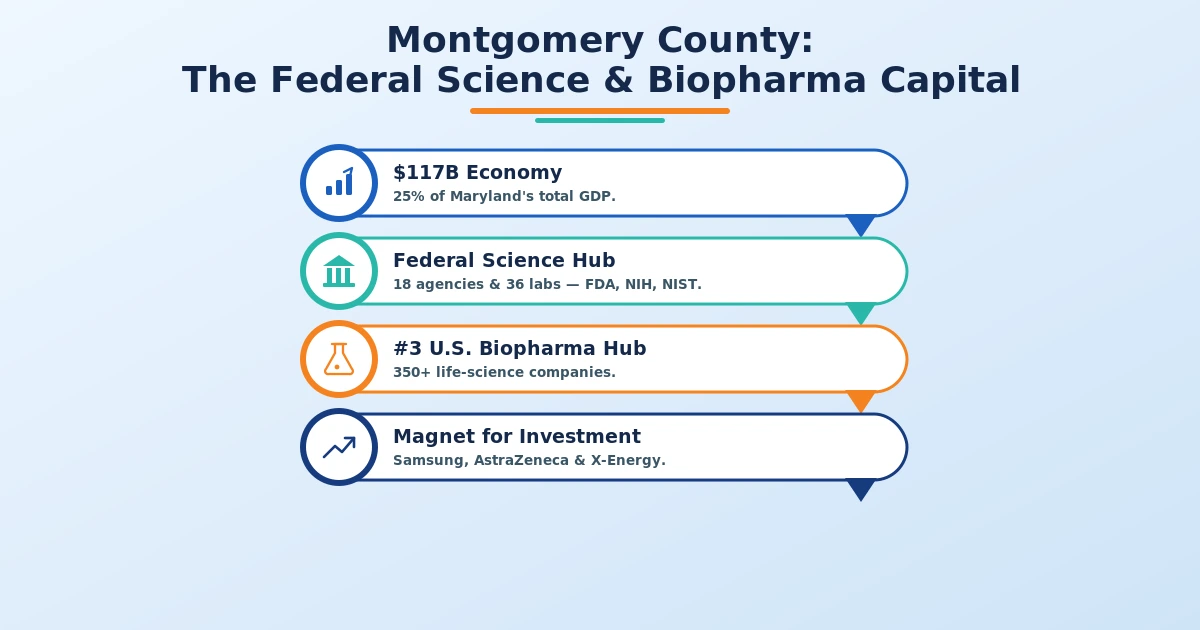
The county's Gross Domestic Product exceeds $117 billion, representing a full 25% of Maryland's total state economy. That output is anchored by an extraordinary combination of federal institutions and the private sector they have seeded.
Federal Science Agencies. Montgomery County hosts 18 federal agencies and 36 federal labs including the Food and Drug Administration (FDA) in White Oak, the National Institutes of Health (NIH) on its 300-acre Bethesda campus, the National Institute of Standards and Technology (NIST) in Gaithersburg, and the National Cybersecurity Center of Excellence (NCCoE).
The county employs 11,755 HHS employees — 33% of Maryland's total HHS workforce — generating $1.7 billion in wages.
The Biopharma Cluster. Seeded by decades of NIH and FDA proximity, Montgomery County has grown into the third-largest biopharma hub in the United States, with more than 350 life science companies specializing in gene therapies, cell therapies, vaccines, and pharmaceutical manufacturing.
Recent investments include:
- Samsung Biologics — opened its first U.S.-based manufacturing facility in Rockville in 2026, preserving and expanding over 500 jobs
- AstraZeneca — built a $300 million cell therapy manufacturing facility in Rockville (opened Spring 2025) and announced plans for an additional Gaithersburg facility
- X-Energy — advanced nuclear reactor developer valued at $11.9 billion after its 2026 IPO, consolidated into a new 125,000-square-foot Gaithersburg headquarters
Prince George's County: The Federal Operations Hub
Directly adjacent to Montgomery County and sharing the same 240/301 area code, Prince George's County represents the defense operations and federal administrative anchor of the Washington suburban corridor.
The county generates $34.5 billion in annual economic output and hosts a constellation of federal facilities:
The county is also home to the University of Maryland (College Park) — a flagship research university with 40,000+ students — and IonQ, which operates a leading quantum computing facility in the county.
- Joint Base Andrews — the largest employer in the county with 17,500 employees; home of Air Force One
- NASA Goddard Space Flight Center — 3,397 employees in Greenbelt conducting Earth science, heliophysics, astrophysics, and planetary science research
- Internal Revenue Service — national headquarters with 5,539 employees
- U.S. Census Bureau — national headquarters with 4,414 employees in Suitland
- USDA Beltsville Agricultural Research Center — one of the world's largest agricultural research complexes
The Broader 240 Territory: Frederick, Western Maryland, and Southern Maryland
Beyond Montgomery and Prince George's Counties, the 240/301/227 footprint extends across a diverse arc of Maryland communities.
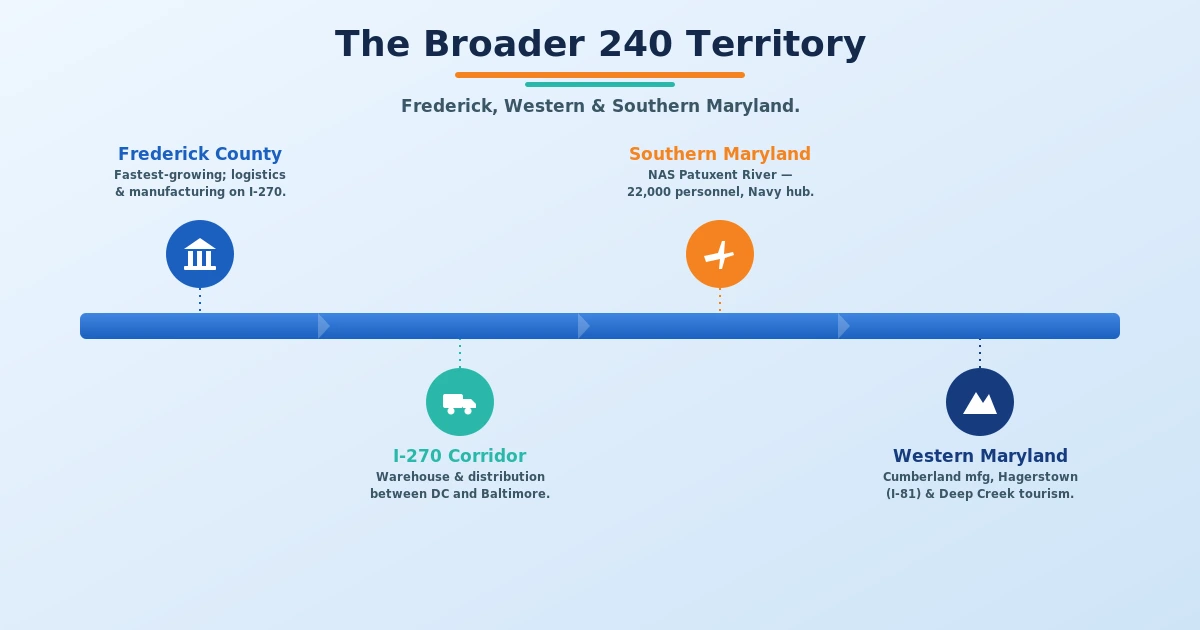
Frederick County has emerged as one of the fastest-growing counties in the state, with its county seat of Frederick serving as a logistics and manufacturing hub midway between Baltimore and Washington.
The county's proximity to both metro areas — and lower land costs than Montgomery County — has attracted significant warehouse, distribution, and light manufacturing investment along the I-270 corridor.
Charles County and Southern Maryland anchor a distinct economy around Naval Air Station Patuxent River (in St. Mary's County), the Navy's primary aircraft test and evaluation facility.
NAS Patuxent River employs approximately 22,000 military and civilian personnel, generating billions in defense-related economic activity along the southern Maryland corridor.
Western Maryland — Allegany, Garrett, and Washington Counties — adds a resource and tourism economy, including Cumberland's manufacturing heritage, Hagerstown's logistics position on I-81, and Deep Creek Lake's outdoor recreation economy.
Companies serving these diverse markets rely on an omnichannel communication platform to reach clients consistently across every channel.
Why Businesses Choose a 240 Area Code Number
For companies targeting the federal government, defense contractors, life science institutions, or any commercial market in Maryland's DC suburbs, a 240 number delivers access and credibility that out-of-state or unfamiliar prefixes cannot match.
Federal Procurement Access. Montgomery County's 18 federal agencies and Prince George's County's Joint Base Andrews, NASA Goddard, and Census Bureau headquarters collectively represent billions of dollars in annual vendor contracts.
Federal procurement officers and contracting teams apply a local-presence filter — a Maryland number signals genuine proximity and commitment to the DC market.
Biopharma and Life Science Vendor Market. The 350+ life science companies clustered in Rockville, Gaithersburg, and the I-270 biotech corridor form one of the most active vendor markets in the country.
CROs, lab equipment suppliers, regulatory consultants, and clinical data firms all compete for relationships within this cluster.
Twenty-Six Years of Established Identity. The 240 area code launched in 1997 and operated alongside only 301 for 26 years before 227 arrived in 2023.
In the federal contracting and biotech procurement worlds — where vendor relationships are built over years and reference checks go deep — that longevity matters. Teloz powers 240 business lines with enterprise infrastructure built for this market.
Explore the full platform at teloz.com.
“What area code serves the agency that approves every prescription drug sold in the United States, the world's largest biomedical research complex, and the nation's third-largest biopharma hub — all within a 30-mile radius?”
How to Get a 240 Area Code Number
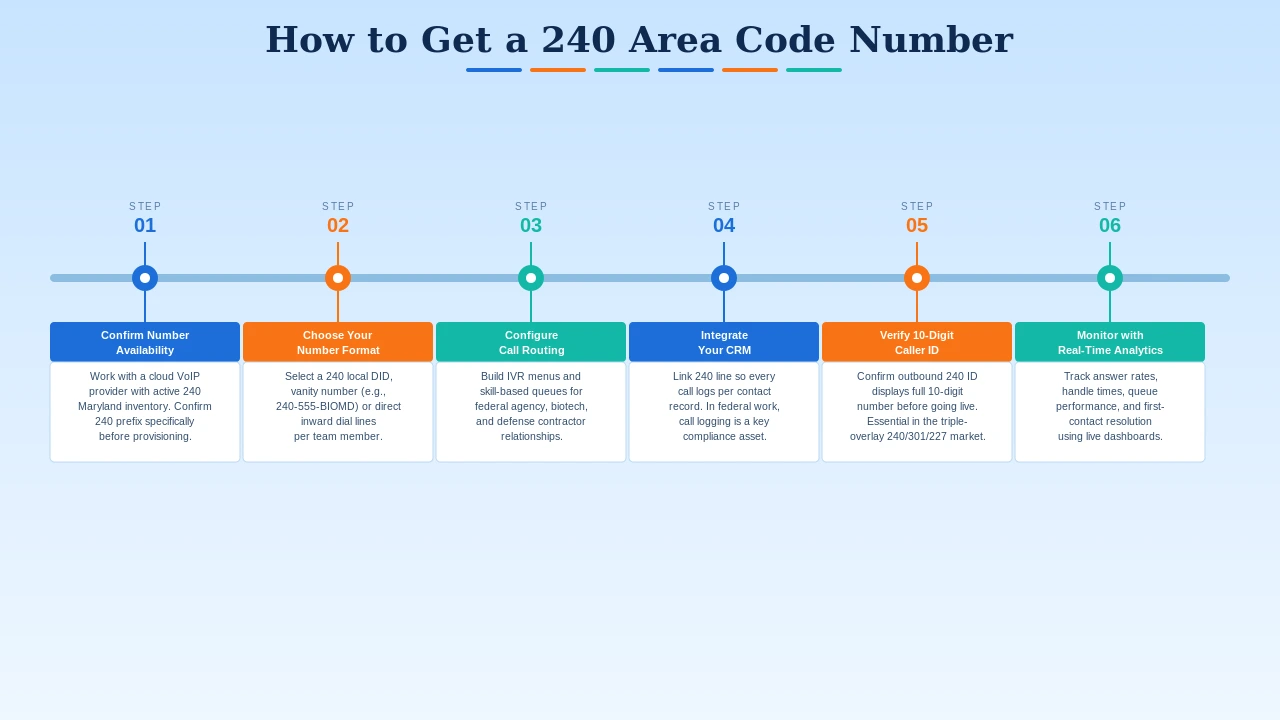
Here is the six-step process to establish a 240 Maryland number for your business:
If your team also needs multi-region reach, compare international virtual numbers.
Step 1: Confirm Number Availability
Work with a cloud VoIP provider holding active 240 Maryland inventory. With three codes (240/301/227) covering the same territory, confirm the 240 prefix specifically before provisioning.
Step 2: Choose Your Number Format
Select a standard 240 local DID, a vanity number suited to your federal or biotech market position, or individual direct inward dial lines per team member.
Step 3: Configure Call Routing
Build IVR menus and skill-based queues for the 240 market — separate routing for federal agency contacts, commercial biotech clients, and southern Maryland defense contractor relationships.
Step 4: Integrate Your CRM
Link your 240 line so every call logs automatically per contact record. In federal contracting — where proposal cycles span months and relationship documentation is essential — call logging is a compliance and competitive asset.
Step 5: Verify 10-Digit Caller ID
Confirm your outbound 240 caller ID displays the full 10-digit number correctly before going live. In the triple-overlay 240/301/227 environment, clean number display is essential for recognition.
Step 6: Monitor with Real-Time Analytics
Track answer rates, handle times, queue performance, and first-contact resolution from day one using live dashboards.
Conclusion
The 240 area code covers the most federally dense, scientifically concentrated suburban corridor in the United States. The NIH and FDA are within its boundaries.
The nation's third-largest biopharma hub — 350+ companies, Samsung Biologics, AstraZeneca — operates under its prefix. Joint Base Andrews, NASA Goddard, and the IRS answer calls that begin with 240 and 301.
A territory that has needed three area codes in 76 years — and is now served by 240, 301, and 227 simultaneously — is a market that rewards businesses that understand its depth.
For vendors, contractors, life science companies, and professional services firms entering this market, a 240 number is not optional branding. It is the first signal that you are already where your clients operate.
See how Teloz powers your Maryland presence at teloz.com.


