Introduction
The 380 area code covers central Ohio, overlaying Columbus and its surrounding suburbs like Dublin and Westerville. If that three-digit prefix just showed up on your phone, this guide explains exactly who might be calling and why.
Ohio residents and business owners both rely on these digits daily, since the region shares one dialing identity with a much older neighboring area code.
In this guide, you will learn where this prefix reaches today, why regulators waited fifteen years to actually use it, and how to spot the scams that try to hide behind it.
Stick around, because the story behind these three digits explains a lot about how central Ohio keeps issuing new numbers.
- The 380 area code went into service in 2016, as an overlay sharing territory with area code 614.
- It covers all of Franklin County plus parts of Delaware, Fairfield, and Union counties around Columbus.
- Regulators first planned this area code in 2001, but slower-than-expected growth delayed its launch for fifteen years.
- Understanding what area code is 380 helps residents and business owners recognize which calls are genuinely local.
What Is the 380 Area Code?
The 380 area code identifies calls placed to or from Columbus, Dublin, Westerville, Pickerington, and the surrounding communities of central Ohio.
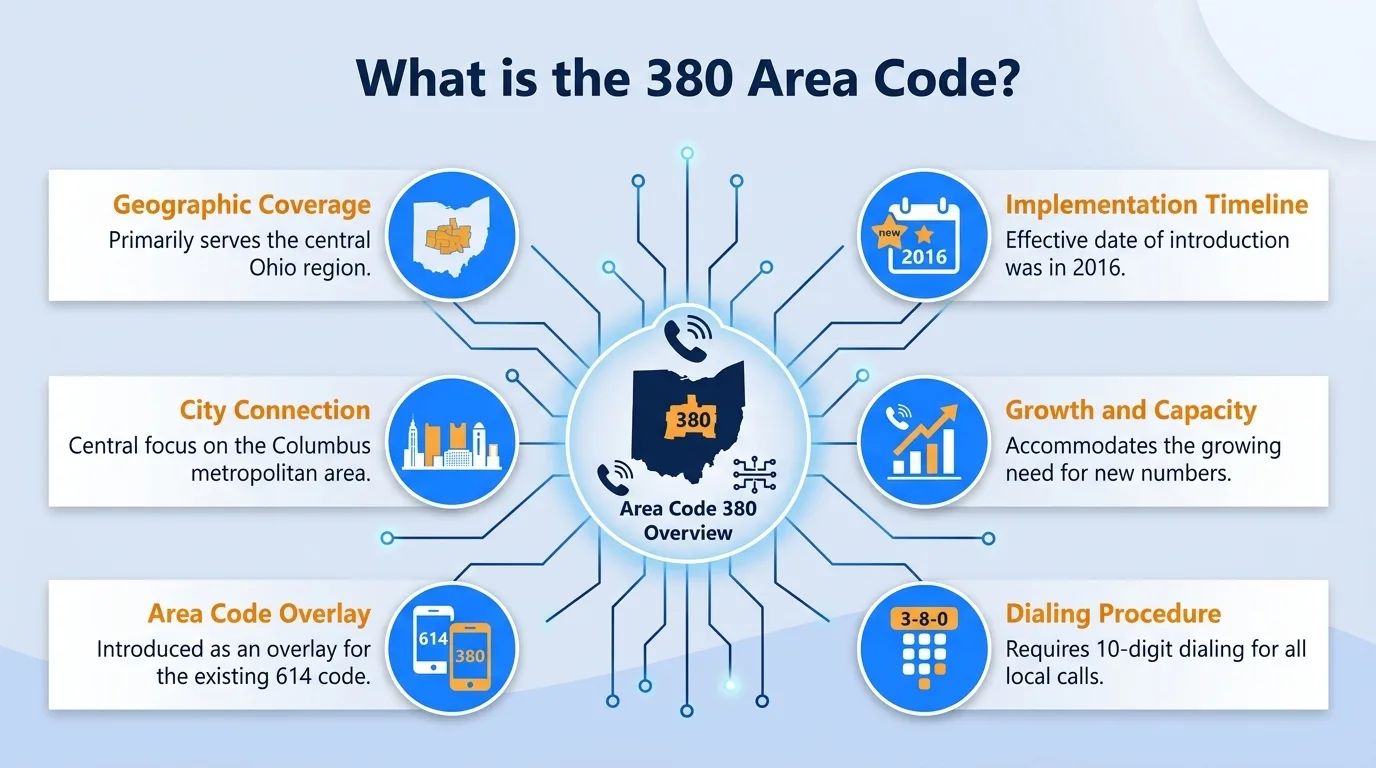
It shares its entire footprint with the older area code 614, so a call from either code could easily be a neighbor.
Pairing that local identity with reliable VoIP service providers helps a small team sound like an established local player rather than an outsider cold-calling into the market.
Any business that wants to look and sound local in central Ohio typically starts with a matching local number.
A Numbering Plan Shaped by Consumers
Central Ohio's numbering history includes a genuinely rare moment where residents themselves changed how regulators handled the region. Complaints about unequal treatment of suburban counties back in 1998 led to a reconfiguration of the area's numbering plan, marking the first time nationally that a phone company's plan was substantially modified by consumer action. That earlier fight over fairness shaped how regulators eventually approached this area code's rollout years later.
Where Is the 380 Area Code Located?
The 380 area code covers central Ohio, overlaying the same footprint as area code 614 around the state capital of Columbus. Columbus anchors the region as its largest city, home to roughly 906,000 residents based on the most recent census figures.
The whole area sits inside the Eastern time zone, matching Cleveland and Cincinnati, so scheduling calls across the region never requires converting time zones.
Cities and Counties Covered by the 380 Area Code
- Columbus, the state capital and largest city in Ohio, anchoring all of Franklin County
- Dublin and Westerville, established suburbs known for corporate offices and residential growth
- Pickerington, a fast-growing suburb spanning Fairfield and Franklin counties
- Portions of Delaware and Union counties, rounding out the region's northern and western edges
A Fifteen-Year Wait for Activation
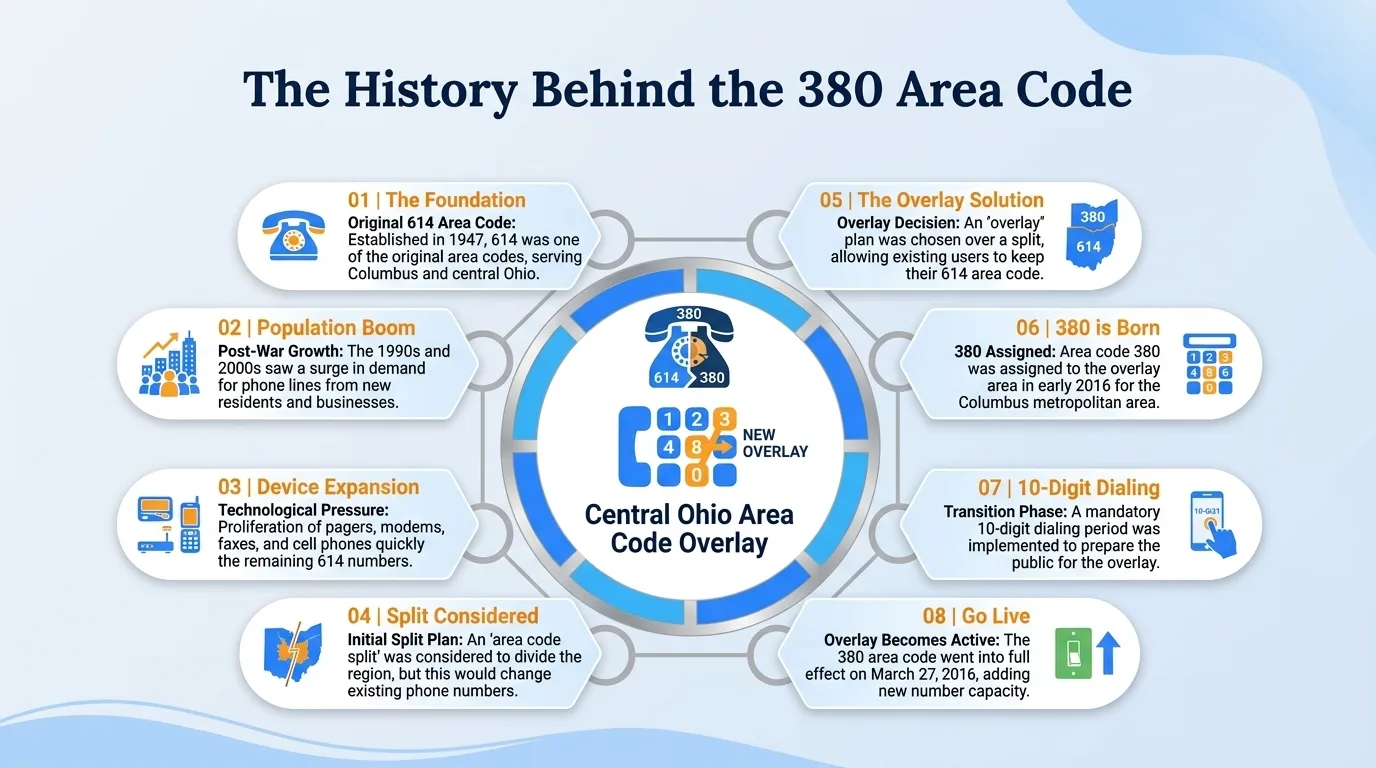
Regulators first proposed this area code as relief for 614 back in 2001, expecting the older code to run short of numbers within a few years. Growth slowed more than planners anticipated, and the launch kept getting pushed back as number pooling stretched the life of the existing supply far beyond original projections. The Public Utilities Commission of Ohio finally mandated implementation on February 27, 2016, fifteen years after the original proposal.
The History Behind the 380 Area Code
Area codes rarely appear out of nowhere, and this one is no exception. It exists today because central Ohio's population growth around Columbus eventually required a second numbering plan to keep pace with demand.
Choosing an Overlay Over a Split
Regulators originally considered splitting central Ohio geographically rather than layering a new code on top of the old one. According to Wikipedia's area code 380 entry, officials ultimately chose an overlay after determining that number pooling offered a viable alternative to redrawing the region's boundaries. That decision meant existing 614 customers never had to change their numbers.
The 2016 Launch and Ten-Digit Dialing
Ten-digit dialing became mandatory across the shared territory starting January 30, 2016, just weeks before this area code officially entered service. That change replaced the old seven-digit local calling that Columbus-area residents had used for decades. Both codes have issued numbers side by side across central Ohio ever since, giving businesses two equally valid options for a genuinely local number.
📞 Ready to sound like a true Columbus business without opening a second office? A local number gets you dialing under this area code the same day you sign up. 👉 Start Your Free Teloz Trial · 👉 Get Your Local Number Today
How to Get a Business Phone Number from Teloz
Teloz gives businesses a cloud-based phone system that works entirely through a browser, so there is no bulky hardware to install or maintain.
A company can claim a number in this area code, route calls with a built-in AI receptionist, and manage texts and voice traffic from one connected dashboard. Teloz is built for teams that want a real Columbus presence without opening a physical office there.
- 1. Visit the website and start a free trial or request a live demo.
- 2. Create your account using your business email address.
- 3. Choose a plan that fits your team's size and expected call volume.
- 4. Select your business number and pick a 380 area code, a toll-free prefix, or a local number elsewhere.
- 5. Set up your team, call routing, and IVR menu right inside the browser dashboard.
- 6. Configure the AI receptionist, voicemail transcription, and SMS settings to match your workflow.
- 7. Start making and receiving calls immediately from the webphone or any connected device.
Why a Local 380 Number Builds Trust
Businesses that serve Columbus, Dublin, or the surrounding suburbs of central Ohio gain something real by using a matching area code.
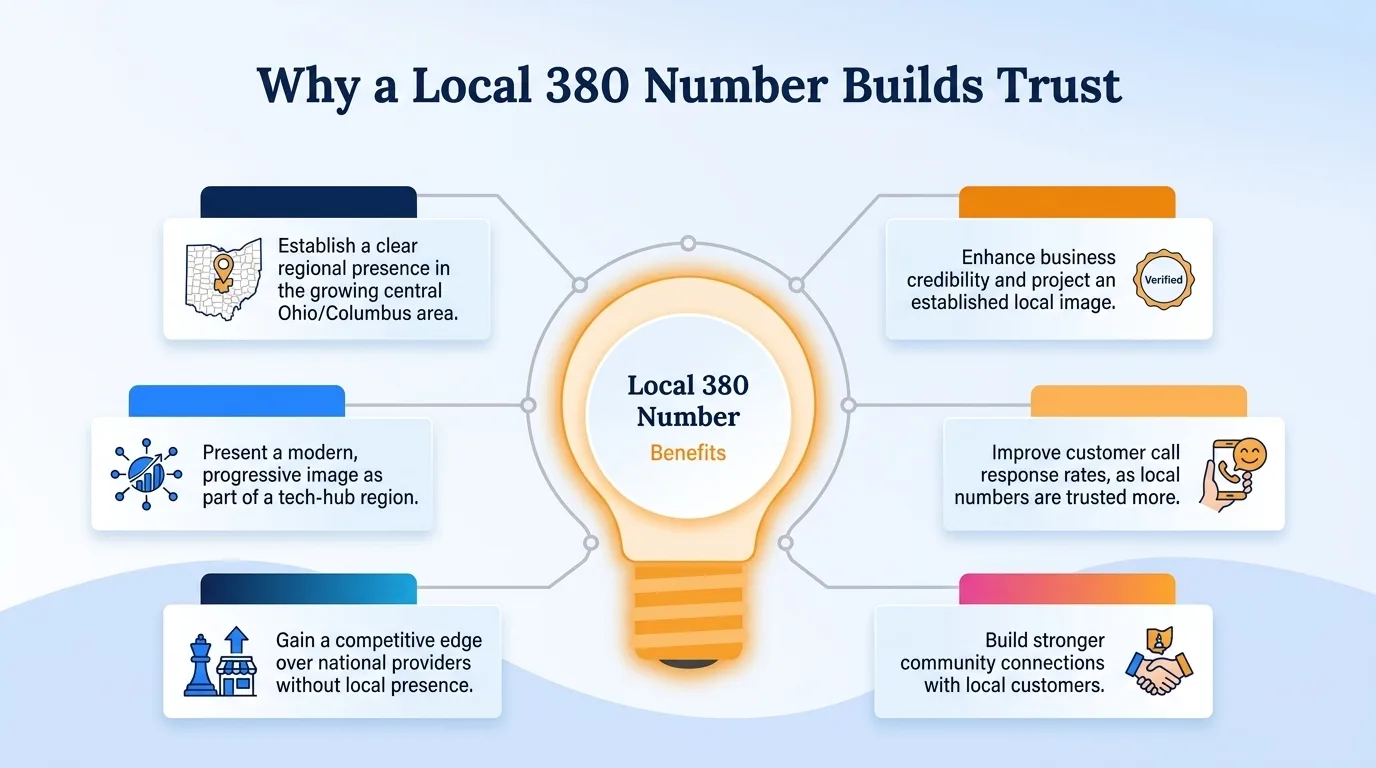
Local callers answer faster, trust faster, and refer their neighbors faster when the number on their screen looks familiar, especially once they recognize area code 380 on the display.
What area code is 380 signals to a customer here is simple: this business understands central Ohio and is reachable.
Local Numbers vs. Toll-Free Numbers
A toll-free number still has its place for national brands, but it can work against a business trying to look rooted in one specific region. A 380 area code number tells a caller in Westerville or Pickerington that the company on the other end is part of their community, not a distant call center. For local service businesses especially, that distinction often decides whether the phone gets answered at all.
“This is not a random string of digits — it is the calling identity of central Ohio, from the office parks of Dublin to the neighborhoods surrounding downtown Columbus.”
Is the 380 Area Code Safe? Scams to Watch For
The 380 area code itself is completely legitimate, used daily by real residents, hospitals, and small businesses across central Ohio. Scammers know that, which is why they spoof 380 caller IDs to make fraudulent calls look local and trustworthy.
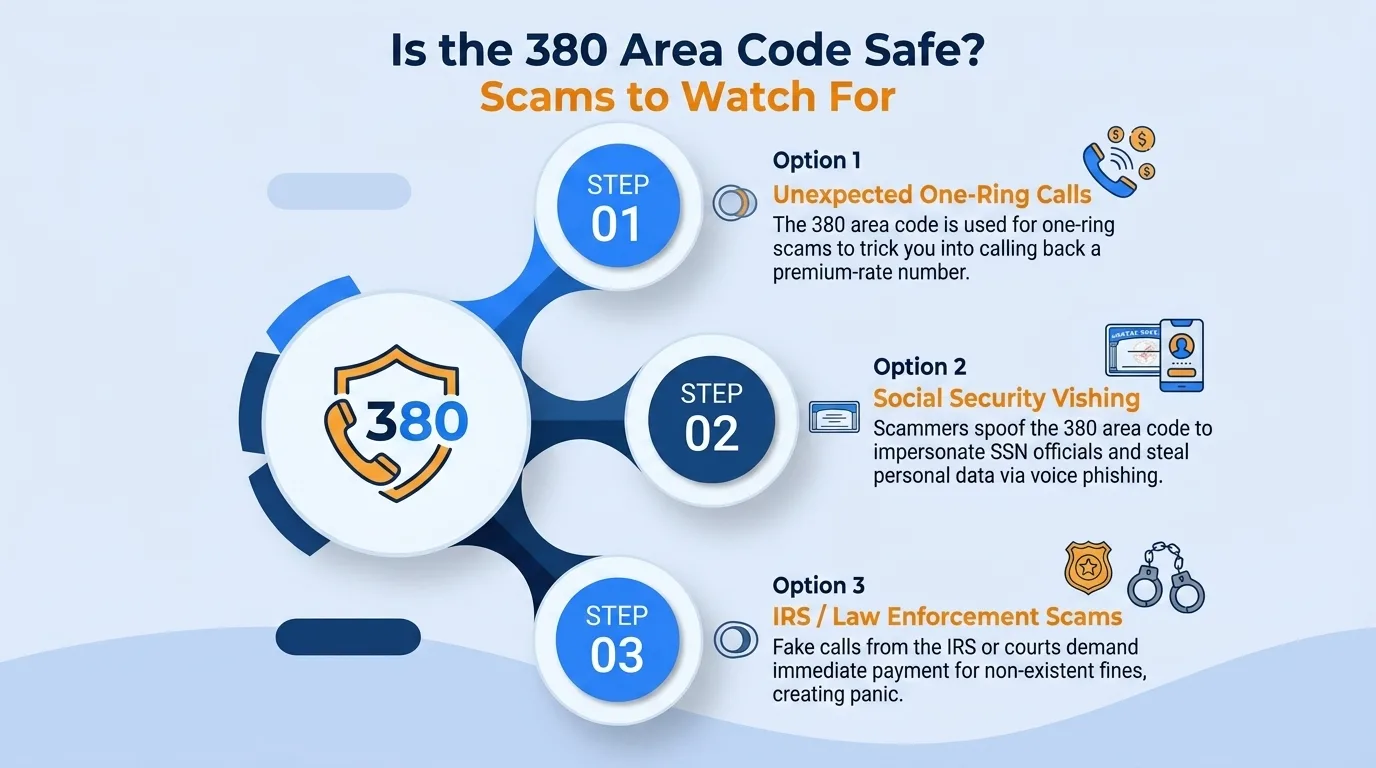
The area code on the screen never tells the full story; the behavior of the caller does.
Common Warning Signs
- Urgent demands to pay a bill immediately or face disconnection
- Requests for gift cards, wire transfers, or cryptocurrency payment
- Callers claiming to be law enforcement or a utility company demanding personal information
- One-ring calls designed to trigger a costly callback
How to Protect Yourself
Treat any unexpected 380 area code call with the same caution you would use anywhere else. Hang up and dial the official number on a bill or website instead of trusting whatever shows up on caller ID. Letting unfamiliar numbers go to voicemail costs nothing and blocks nearly every version of this scam before it starts.
Conclusion
The 380 area code is more than a random string of digits; it is the calling identity of central Ohio, from the office parks of Dublin to the neighborhoods surrounding downtown Columbus.
It has served the region since 2016, layered directly over the older 614 area code after a fifteen-year delay. Both codes now share the same territory, giving central Ohio plenty of room for new numbers without ever redrawing a boundary.
Understanding what area code is 380 helps residents and business owners alike make sense of who is really on the line.
Central Ohio businesses that want to be taken seriously locally should treat their area code as more than an afterthought.
A matching 380 area code number signals roots in the community, while a smart platform behind it keeps every call, text, and voicemail organized in one place.
Claiming that number and building that trust is straightforward, from sign-up to your very first answered call.
Whether you are protecting yourself from a spoofed call or setting up a new business line, the next step in central Ohio starts with the right number.
📍 Want your business to be the trustworthy call central Ohio actually wants to answer?
A verified local number paired with call authentication keeps your caller ID clean. 👉 Get Your Business Number Today · 👉 Start Your Free Teloz Trial


