Introduction
Picture this: a defense contractor based in Columbia, Maryland, sets up a customer support line using an out-of-state number. Local clients hesitate.
Pickup rates drop nearly 30%. The fix took three minutes — switching to a 410 area code, Baltimore's original Maryland area code, trusted by businesses across the state since 1991.
The 410 area code covers eastern Maryland, including Baltimore City, Annapolis, and 17 counties stretching from the Baltimore suburbs out to the Chesapeake Bay's Eastern Shore.
Today it shares its territory with two overlay codes — 443 and 667 — forming one of the Mid-Atlantic's more complex multi-code regions.
Whether you're a healthcare provider, a biotech startup, or a logistics firm, understanding the 410 area code is the first step toward building real local credibility in Maryland.
This guide covers everything: coverage, history, the triple-overlay system, business benefits, scam awareness, and how to claim a 410 number.
- What Is the 410 Area Code?
- The History of the 410 Area Code
- 410, 443, and 667: Maryland's Triple-Overlay System
- Key Cities and Industries in the 410 Region
- Why Businesses Choose a 410 Area Code
What Is the 410 Area Code?
The 410 area code is a North American Numbering Plan (NANP) code assigned to eastern and central Maryland. It spans 17 counties and more than 125 cities, with Baltimore City as its anchor — Maryland's largest city and economic core.
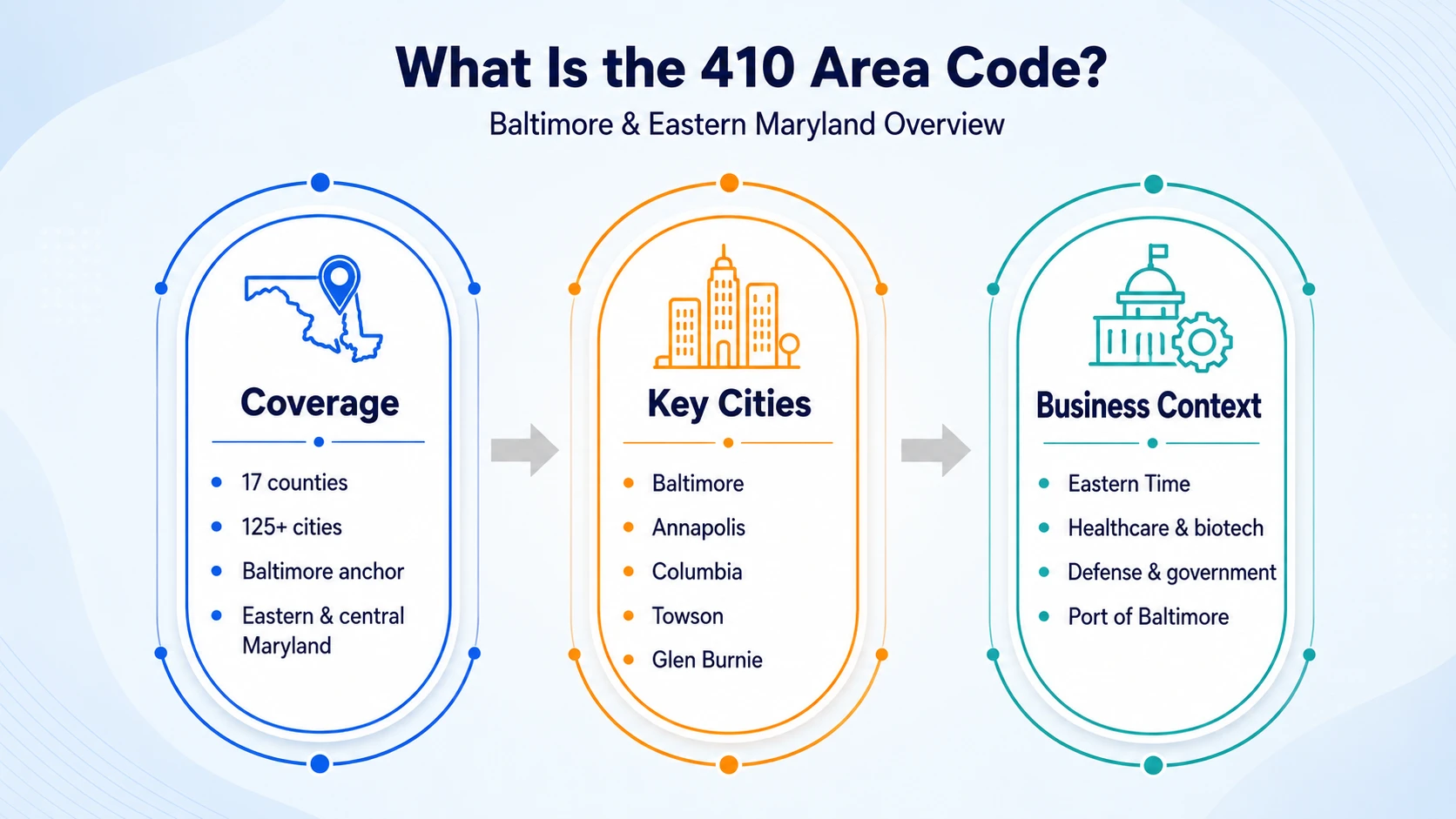
The 410 region runs from Harford County in the north, through the Baltimore Metro, Anne Arundel County in the south, Howard County to the west, and across to the Eastern Shore counties bordering Delaware and Virginia.
Major cities and communities within the 410 area code include:
The region sits in the Eastern Time Zone (UTC-5 / UTC-4 DST).
Key industries driving the economy include healthcare, defense contracting, federal government operations, biotech research, and the Port of Baltimore — one of the East Coast's busiest ports, generating approximately $70 billion in annual economic impact.
Businesses that want to activate service right away can start with local phone numbers.
- Baltimore — Maryland's largest city and primary commercial hub
- Annapolis — the state capital and historic maritime center
- Columbia — a major planned-city employment corridor in Howard County
- Towson — Baltimore County's county seat and medical services hub
- Glen Burnie — a significant retail and commercial center
- Ellicott City — a fast-growing Howard County community
- Bel Air — Harford County's county seat
The History of the 410 Area Code
The 410 area code's origin traces directly to Maryland's rapid growth in the late 1980s.
Maryland started as a single-code state. The 301 area code, established in 1947, covered the full state for over four decades.
But population growth in the Baltimore metro — alongside the explosion of mobile phones, fax lines, and internet dial-up connections in the early 1990s — began exhausting the 301 number pool.
On December 28, 1990, NANPA officially assigned the 410 area code to eastern Maryland. It went live on October 6, 1991, splitting eastern Maryland away from 301, which retained the western portion of the state including Washington, D.C. suburbs.
The 301/410 split managed demand for about six years. Then the surge in pagers and early mobile devices triggered a second shortage.
The 443 overlay was added in July 1997, covering the same geographic footprint as 410 without requiring another geographic split.
By the late 2000s, 443 numbers were themselves approaching exhaustion. In 2012, the Maryland Public Service Commission introduced a third code: 667, now active as a second overlay across the entire 410/443 territory.
For a detailed numbering history, see Wikipedia's overview of the 410 area code.
410, 443, and 667: Maryland's Triple-Overlay System
When an area code exhausts its number pool, regulators choose between two options: split the territory geographically, or add an overlay.
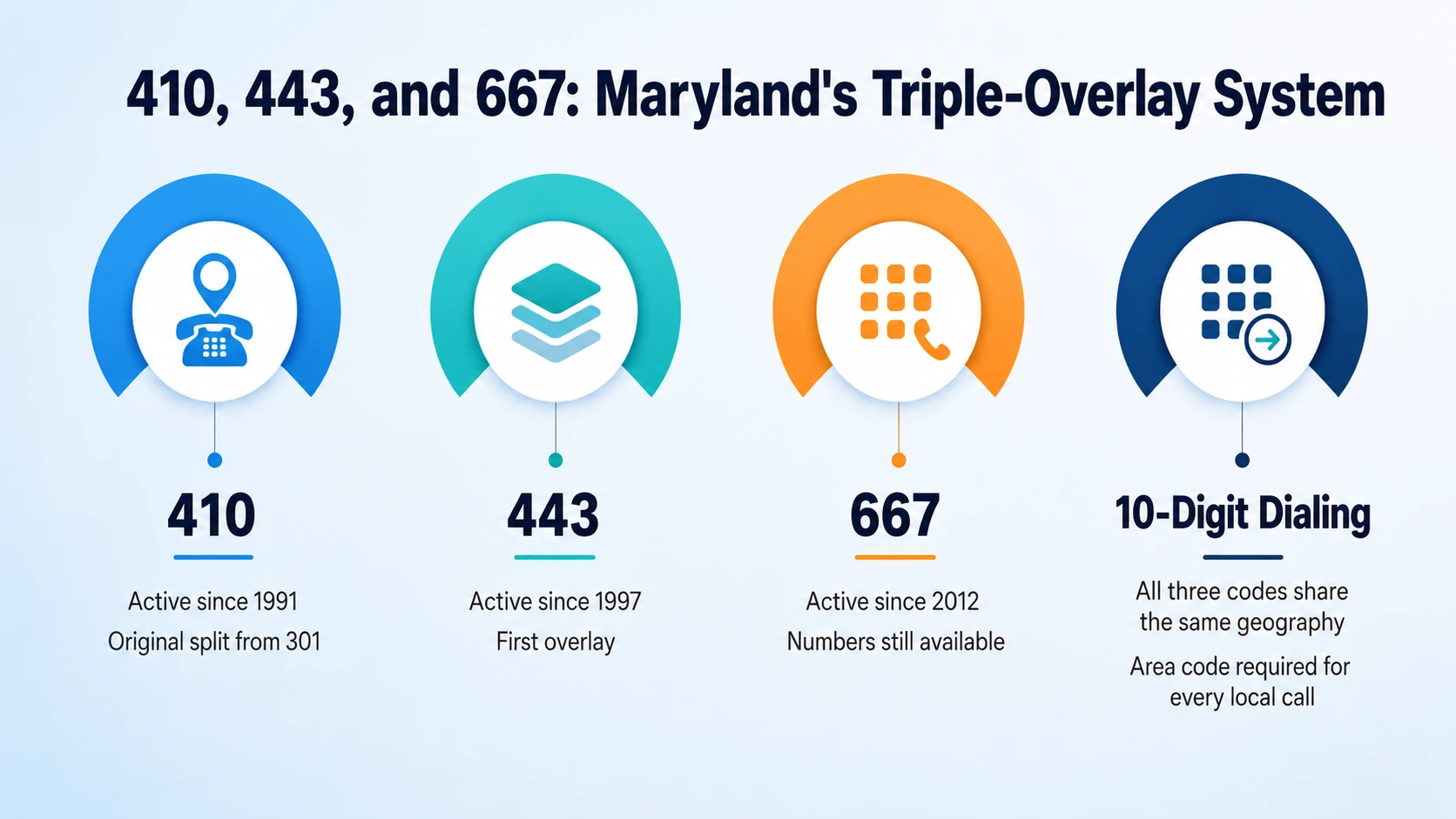
Maryland's eastern region has chosen overlays twice — meaning 410, 443, and 667 all cover the same counties and cities simultaneously.
Here's how the three codes compare:
| Area Code | Year Active | Type | Status |
|---|---|---|---|
| 410 | 1991 | Original split from 301 | Active — legacy numbers largely assigned |
| 443 | 1997 | First overlay | Active — numbers largely assigned |
| 667 | 2012 | Second overlay | Active — numbers still available |
Because all three codes cover the same geography, every local call within the region requires 10-digit dialing — the area code must be dialed even for calls across the street. This has been the standard since the 443 overlay launched in 1997.
For businesses, the overlay structure creates a meaningful trust signal. A 410 number carries over three decades of Maryland recognition. Customers receiving a call from a 410 area code immediately associate it with an established local entity. Newer 667 numbers, while fully legitimate, don't yet carry the same weight of history that 30-plus years of 410 use has built across the Mid-Atlantic.
Key Cities and Industries in the 410 Region
The 410 area code serves an economically diverse region, and that diversity shapes what businesses need from their phone infrastructure.
For operations teams managing high call volumes across healthcare and defense sectors, live wallboard analytics give supervisors real-time visibility into every queue and agent in the 410 region.
Healthcare and Life Sciences dominate Baltimore's economy.
Johns Hopkins Health System, the University of Maryland Medical System, MedStar Health, and dozens of biotech firms in the Hopkins Science + Technology Park corridor all operate within the 410 footprint.
Healthcare is the largest employment sector in Baltimore City.
Defense and Federal Operations form another major pillar. Fort Meade — home of the National Security Agency (NSA) and U.S.
Cyber Command — sits in Anne Arundel County within the 410 territory. Aberdeen Proving Ground in Harford County adds a second significant defense installation.
Thousands of defense contractors work from Columbia, Linthicum, and Hanover, all within the 410 region.
Maritime and Logistics anchor the regional economy through the Port of Baltimore, which supports over 153,000 direct and indirect jobs statewide and handles approximately $70 billion in cargo annually.
Financial and Professional Services round out the economic landscape, with firms like T. Rowe Price and regional advisory businesses headquartered in the Baltimore metro.
Why Businesses Choose a 410 Area Code
A local area code is one of the most underrated trust signals in both B2B and B2C sales.
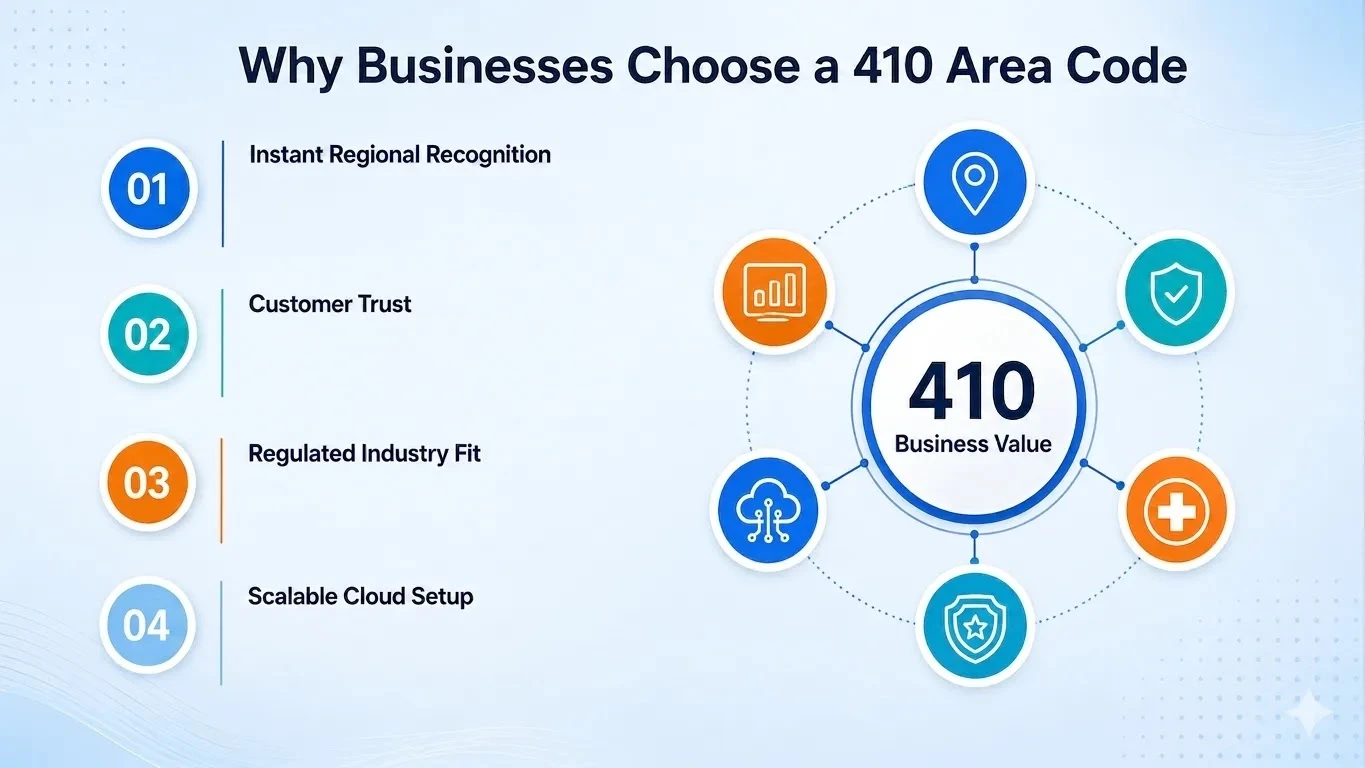
Calls from recognizable local codes consistently see higher pickup rates than unfamiliar or out-of-state numbers — particularly in industries like healthcare and defense where vendor trust is paramount.
With Teloz's cloud contact center platform, you can operate multiple Maryland numbers across departments — routing calls via AI-powered omnichannel workflows, real-time CRM integrations, and live analytics — all from a single dashboard. See how at teloz.com.
Instant Regional Recognition
Baltimore and surrounding Maryland communities have used 410 numbers for over 30 years. When your caller ID displays a 410 number, Maryland prospects recognize it as a local entity — not a national call center.
Customer Trust in a High-Complaint Market
Maryland logged nearly 42,000 Do Not Call complaints with the FTC in recent years, signaling how sensitive local consumers are to unsolicited or suspicious calls. A verified, consistently used 410 business number positions your company as a trustworthy, established presence rather than an anonymous outbound dialer.
Positioning in Regulated Industries
Healthcare and defense contractors operate under strict compliance standards. A Maryland area code on inbound and outbound communications reinforces that your business is embedded in the local regulatory and professional community.
“Picture this: a defense contractor based in Columbia, Maryland, sets up a customer support line using an out-of-state number.”
How to Get a 410 Area Code Number
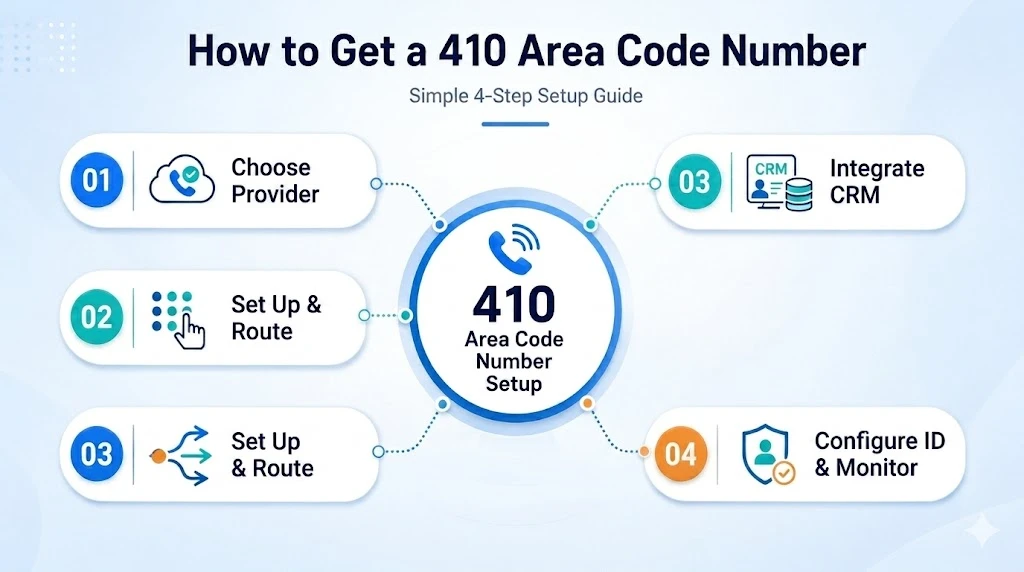
Claiming a 410 number through a cloud VoIP provider is a straightforward six-step process:
If your team also needs multi-region reach, compare international virtual numbers.
Step 1: Choose a Provider with Maryland Number Inventory
Select a cloud VoIP provider that actively holds 410 area code numbers. Since 410 numbers are sought-after legacy codes, confirm availability before starting setup.
Step 2: Pick Your Number Type
Choose between a standard local number, a vanity number (e.g., 410-555-CARE for a healthcare practice), or a direct inward dialing (DID) number for specific departments.
Step 3: Configure Call Routing
Set up IVR menus, call queues, and after-hours routing rules. Route calls by department, skill, language, or customer history.
Step 4: Integrate Your CRM
Connect your 410 number to your existing CRM so every call — inbound and outbound — is automatically logged with a full interaction record per contact.
Step 5: Enable and Verify Outbound Caller ID
Confirm your 410 number displays correctly on outbound calls before going live. This is your most visible trust signal.
Step 6: Monitor Performance from Day One
Use real-time analytics — call answer rates, hold times, agent performance — to optimize your Maryland phone operations from launch.
Conclusion
The 410 area code is more than a geographic identifier — it's three decades of established Maryland presence covering Baltimore, Annapolis, and 17 counties across eastern Maryland.
Operating alongside overlays 443 and 667 in a mandatory 10-digit dialing environment, it remains the most recognized and trusted area code in the Mid-Atlantic region.
For businesses in healthcare, defense, logistics, or professional services, a 410 number signals local authority, builds customer trust, and delivers measurable improvements in call pickup rates.
Pair that number with cloud-based AI contact center infrastructure, real-time analytics, and CRM-connected routing to maximize every inbound opportunity. See how Teloz makes Maryland business communication seamless at teloz.com.


