Introduction
Few three-digit numbers wear their hometown as proudly as the 510 area code. In Oakland and Berkeley, "the 510" is shorthand for the East Bay itself, stamped on hoodies, rap lyrics, and small-business signs alike.
But behind that local pride sits a practical story most residents never hear: where the 510 area code actually reaches, how it was split off from San Francisco's original code, why it famously ran short of numbers, and how scammers now exploit its familiar digits.
This guide covers all of it, including why a local 510 number still matters for business and how to claim one. Let us start with the map.
- Where the 510 area code reaches across California's East Bay
- How it split from 415 in 1991 and gained the 341 overlay in 2019
- The Oakland, Berkeley, and Fremont cities and communities it serves
- Why a local 510 number builds business trust in the East Bay
- How to get a 510 phone number from anywhere
- Common 510 spoofing scams and how to stay safe
Where Is the 510 Area Code?
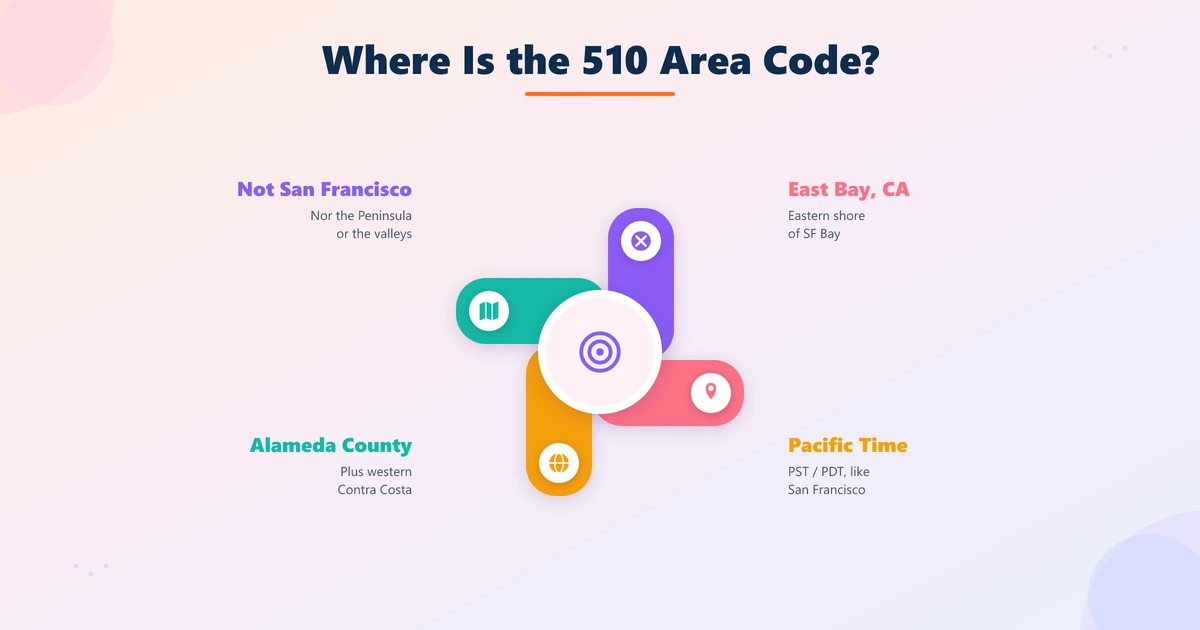
The 510 area code serves California's East Bay, the densely populated stretch along the eastern shore of San Francisco Bay. It covers most of Alameda County and the western edge of Contra Costa County, anchored by the city of Oakland.
This is the Bay Area away from the tourist postcards: working ports, university campuses, industrial flats, and hillside neighborhoods rather than a single skyline.
The whole region runs on Pacific Time, observing Pacific Standard Time in winter and Pacific Daylight Time in summer, the same clock as San Francisco across the bay.
What gives the code its identity is its anchor. Oakland is the largest city it serves and the cultural heart of the East Bay, joined by Berkeley to the north.
So when those three digits light up your screen, picture the eastern shore of the bay rather than any downtown across the water.
It helps to know what the region is not. Despite occasional online confusion, this prefix does not cover San Francisco, the Peninsula, or the inland valleys east of the Berkeley Hills.
It is firmly the code of the East Bay shoreline, a distinction that matters when you are trying to reach the right audience with a local 510 phone number.
- Anchor region: California's East Bay, eastern shore of San Francisco Bay
- Counties: most of Alameda County, western Contra Costa County
- Time zone: Pacific Time (PST / PDT)
- Does not cover: San Francisco, the Peninsula, or inland valleys
The 510 Area Code's History
The code has a busy backstory. For decades, the entire Bay Area shared 415, one of California's original 1947 codes.
As phones multiplied, 415 could not keep pace, so on September 2, 1991, the East Bay was split off into the brand-new 510 code while San Francisco kept 415.
Even that was not enough for long. On March 14, 1998, the inland East Bay was split again to create 925, with the Berkeley Hills serving as the dividing line: areas west of the hills stayed in 510, while those to the east moved to 925.
Then came a modern twist. By 2019 the 510 area code had run out of fresh numbers entirely, a milestone the East Bay greeted with real sentiment.
Rather than split the region yet again, regulators added the 341 overlay on July 22, 2019, layering a second code over the same territory. Because two codes now share the area, ten-digit dialing is required.
- 1947: 415 — one of California's original area codes
- 1991: 510 split from 415 to serve the East Bay
- 1998: 925 split off the inland East Bay at the Berkeley Hills
- 2019: 341 added as an overlay, requiring ten-digit dialing
Cities and Communities the 510 Area Code Serves
The code ties together a string of distinct, fiercely individual East Bay communities. Together these places give the code a gritty, creative, unmistakably local reputation.
For a customer in Oakland or Berkeley, a local 510 number on a business signals that the company truly belongs to the East Bay rather than dialing in from somewhere across the bridge.
The range of these markets is striking. A craft brewery in Oakland, a biotech startup in Emeryville, and a family auto shop in Hayward all share the same prefix yet serve very different customers.
That common code becomes a thread of shared identity, which is exactly why East Bay businesses fight to keep a recognizable 510 number on their storefronts, trucks, and ads even as new overlay numbers enter circulation.
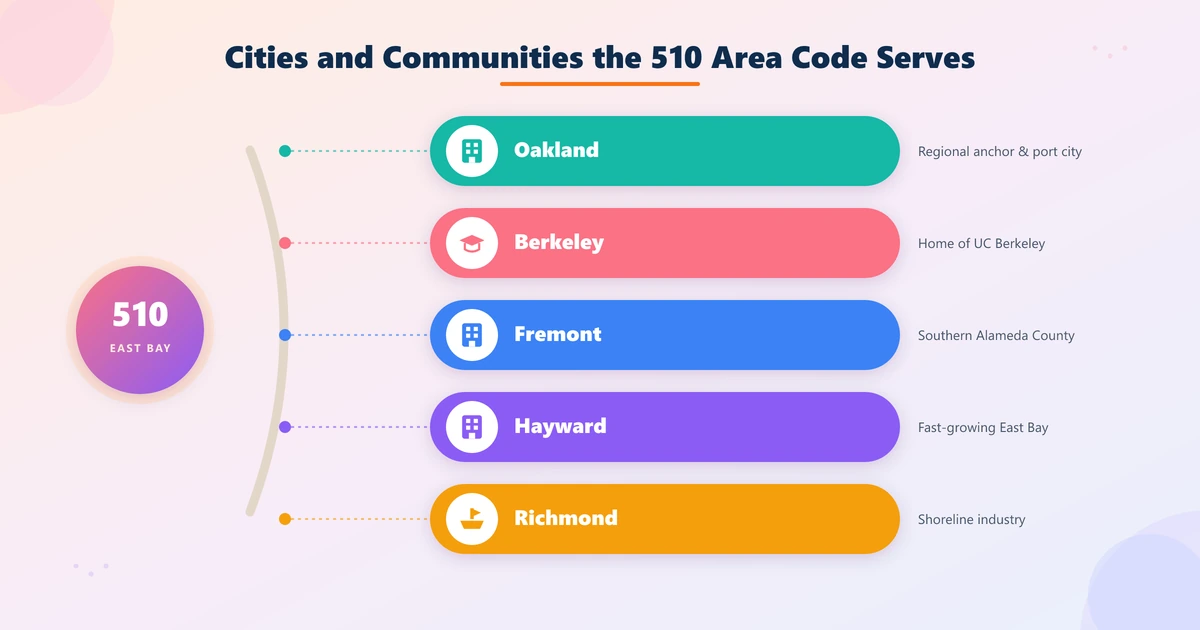
- Oakland — the regional anchor, a diverse port city and cultural hub
- Berkeley — home to the University of California's flagship campus
- Fremont and Hayward — large, fast-growing cities in southern Alameda County
- Richmond and San Leandro — industrial and residential centers along the shoreline
- Alameda, Emeryville, Albany, and Piedmont — smaller, character-rich bay communities
Why a Local 510 Number Builds Business Trust
In a region with as much local pride as the East Bay, a familiar area code is a real advantage.
Caller-behavior research consistently shows that people answer and trust calls from local-looking numbers far more than calls from unknown or out-of-state ones, and that instinct runs especially strong where neighborhood identity matters.
A 510 phone number tells customers across the East Bay that you share their market, their time zone, and their community.
That sense of nearness lifts answer rates, speeds up callbacks, and feeds the word-of-mouth that local businesses depend on in tight-knit cities like Oakland and Berkeley.
This is where the right platform pays off. A provider like Teloz, which has built business communication systems since 2005, lets a company attach a local 510 number to a cloud-based, AI-assisted contact center.
A small team can then handle calls from Richmond to Fremont with the polish of a much larger operation, routing every caller intelligently instead of letting the line ring unanswered.
How to Get a 510 Area Code Number
You do not need a storefront in Oakland to use a 510 number. Virtual and cloud providers can assign one to a business located anywhere and route the calls to whatever device your team prefers. The process is usually quick.
Because everything lives in the cloud, you can answer 510 calls from a desk phone, a laptop, or a mobile app, and add lines as your presence grows. Most numbers go live within a day or two and remain portable under FCC rules, so you are never locked in.
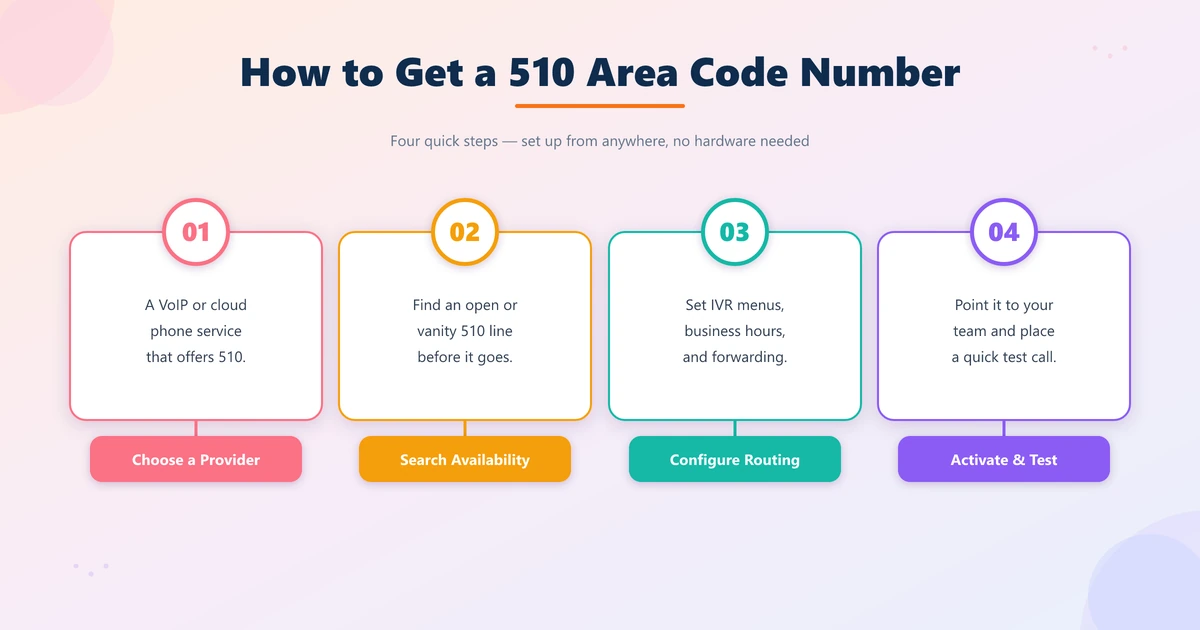
- Choose a provider — a VoIP or cloud phone service offering East Bay numbers plus IVR, voicemail, and analytics
- Search availability — look for an open 510 number; because the code is in heavy demand, options can be limited
- Configure routing — set call forwarding, business hours, and an auto-attendant so every call reaches the right person
- Activate and test — point the number at your team and place a test call to confirm it connects
“The 510 area code is more than a prefix — it is the phone identity of California's East Bay, from the port of Oakland to the campus of Berkeley.”
510 Area Code Scams and Spoofing
The 510 area code is completely legitimate, used by millions of real East Bay residents and businesses. But its local familiarity makes it a favorite mask for scammers.
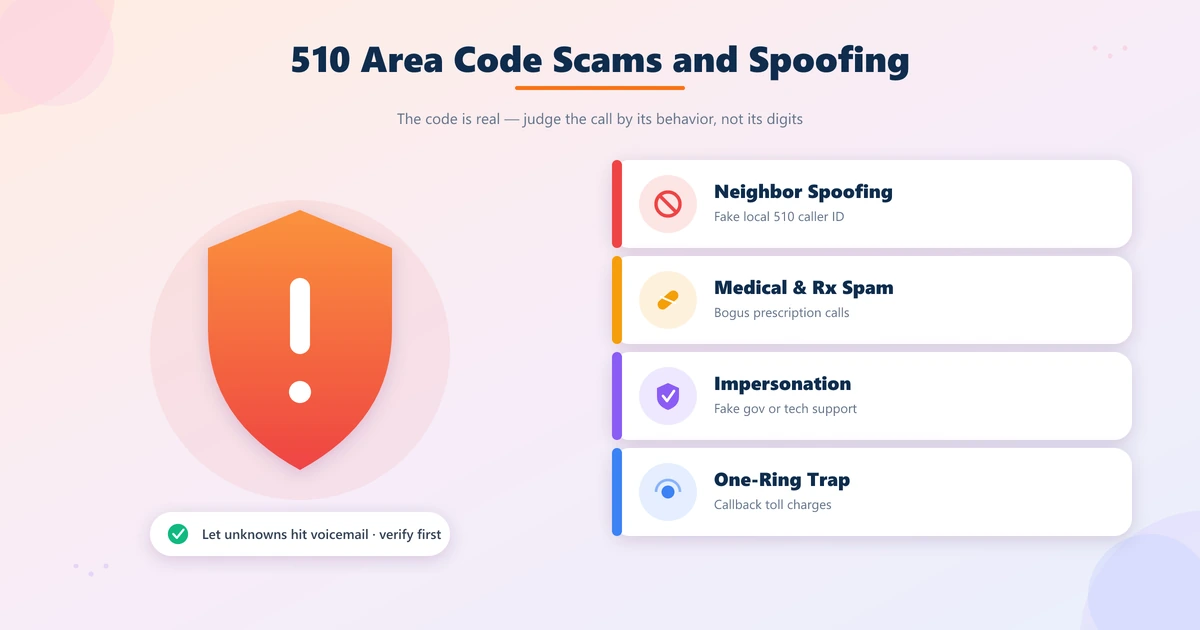
With cheap VoIP software, fraudsters fake a 510 caller ID through "neighbor spoofing," gambling that locals will answer a call that looks like it comes from their own city.
Reports from the East Bay tie 510 spoofing to medical and prescription spam, government and tech-support impersonation, and "one-ring" callback traps designed to trigger toll charges.
None of these reflect the genuine residents and businesses that use 510 area code numbers every day.
Protecting yourself is simple. Let unknown calls go to voicemail, never share codes or payment details based on caller ID alone, and if a call claims to be from your bank or utility, hang up and dial the official number yourself.
Treating 510 area code scams with healthy caution keeps you safe while still welcoming the real local calls that matter.
- Let unknown calls go to voicemail and judge callers by the message they leave
- Never share verification codes or payment details based on caller ID alone
- If a call claims to be your bank or utility, hang up and dial the official number
- Be wary of any call demanding urgent action or immediate payment
Conclusion
The 510 area code is more than a prefix; it is the phone identity of California's East Bay, from the port of Oakland to the campus of Berkeley.
Split from San Francisco's 415 in 1991, joined by 925 and later the 341 overlay, it now anchors dozens of proudly local communities across the Pacific Time Zone.
A local 510 number remains one of the simplest ways for a business to earn East Bay trust and a faster answer, as long as you stay alert to the spoofing scams that ride on that same local pride. Ready to sound unmistakably East Bay?
See how Teloz handles this at teloz.com.


