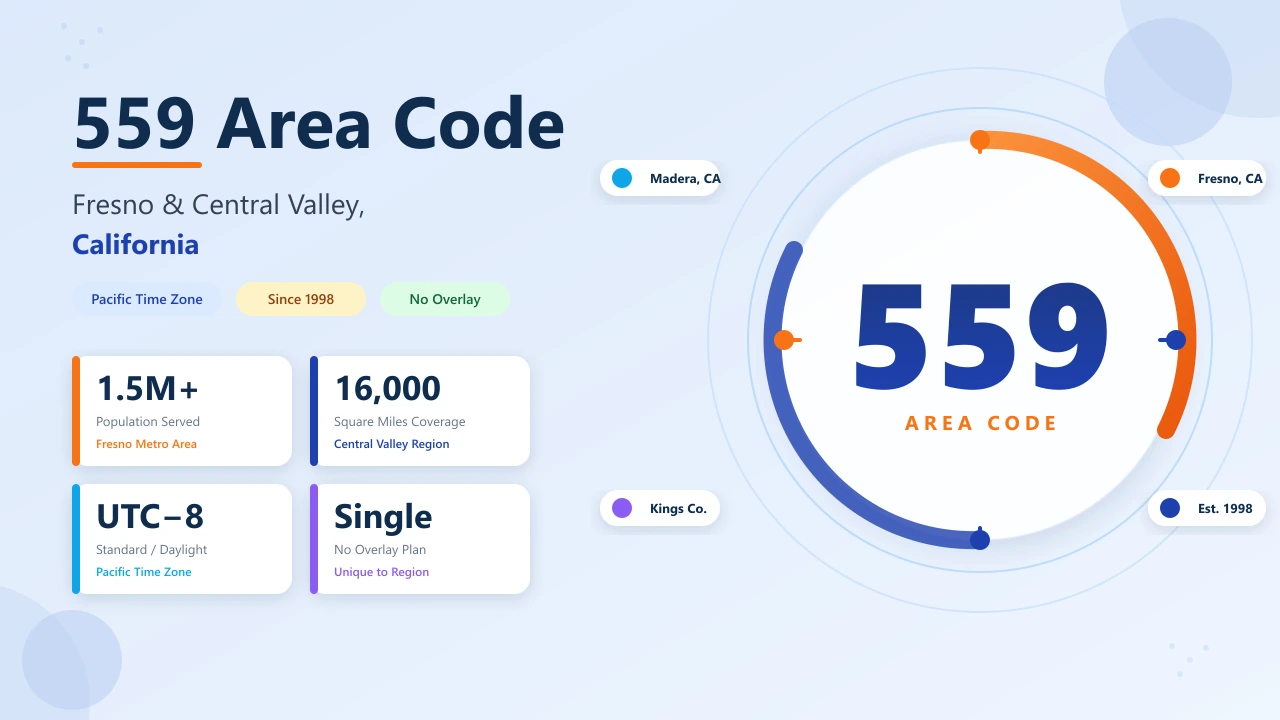
Introduction
California's Central Valley produces roughly 25% of America's food on a single ribbon of farmland — and almost all of that production runs through the 559 area code.
From Fresno's distribution warehouses to Visalia's dairy plants to Tulare's almond processors, the 559 area code is the dial tone of an agricultural economy that feeds the United States and exports to over 150 countries.
Whether you're a Central Valley business expanding nationally, an out-of-state company building Valley supplier relationships, or simply curious about that incoming 559 call, this guide covers everything you need to know.
- Where the 559 area code is located and which cities it covers
- Why 559 powers US food production — industries and key employers
- The full history — from 209 to today's single-code 559
- Time zone details and what they mean for cross-coast businesses
- Whether new 559 numbers are still available in 2026
- How to get a 559 virtual number from anywhere in the world
The 559 Area Code and California's Central Valley
The 559 area code covers the south-central section of California's Central Valley — specifically the San Joaquin Valley region — plus a swath of the southern Sierra Nevada foothills.
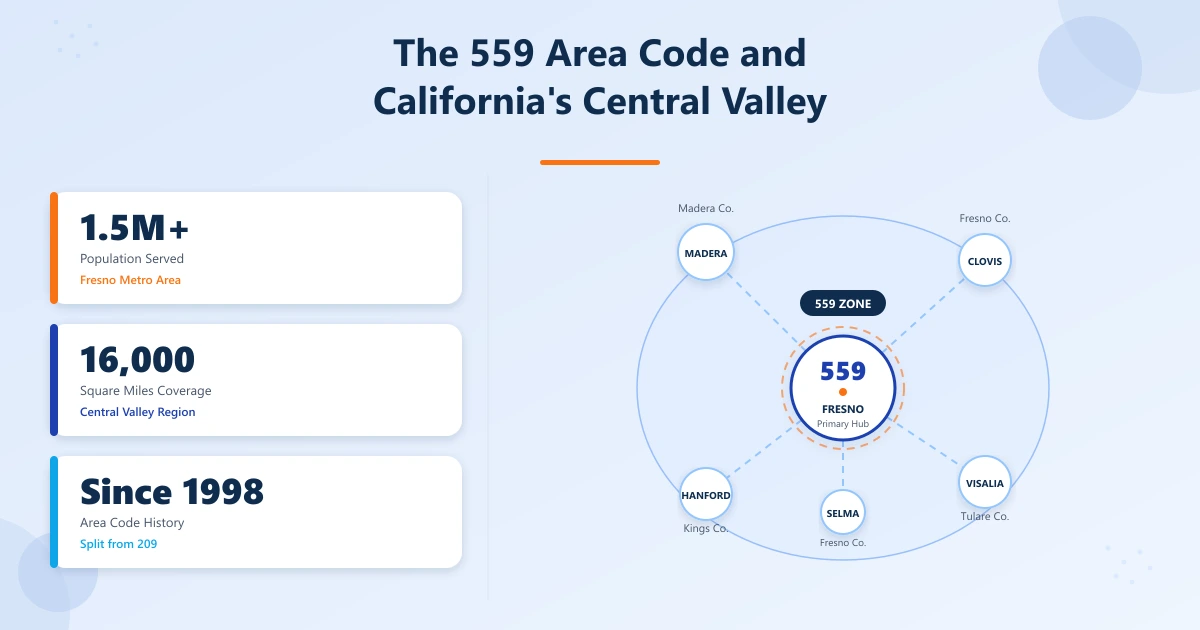
It is a sprawling rural and mid-sized urban footprint that stretches roughly 200 miles north-to-south.
Despite the modest urban population, the 559 area code covers one of the largest geographic footprints in California, anchored by the agricultural economy of the San Joaquin Valley.
- State: California (CA)
- Major city: Fresno — county seat and largest city
- Counties served: Fresno, Madera, Mariposa, Kings, Tulare, and parts of Kern
- Neighboring codes: 209 (north Central Valley), 661 (Bakersfield), 805 (coastal Central California)
- Approximate population: 1.5 million
- Approximate footprint: 16,000+ square miles
America's Breadbasket: Why 559 Powers US Agriculture
The 559 area code holds an outsized role in American food production. California's Central Valley produces about 25% of US food on roughly 1% of US farmland, and the 559 footprint contains the heart of that output.
Fresno County alone is consistently ranked as the most agriculturally productive county in the United States, with annual output exceeding $7 billion.
Out-of-state buyers, exporters, and food-industry suppliers who phone a 559 number are likely reaching a producer, a distributor, or a logistics coordinator handling shipments that appear on grocery shelves across the country within days.
The 559 area code carries one of the highest economic impacts per call of any US area code — feeding markets in over 150 countries from one regional dial tone.
- Agriculture and food processing — almonds, grapes, citrus, dairy, tree fruit, vegetables
- Distribution and logistics — refrigerated trucking and West Coast warehouse networks
- Cooperative networks — Sun-Maid, Blue Diamond Growers, Foster Farms, Saputo Dairy
- Manufacturing and packaging — food packing and agricultural equipment
- Higher education and research — Fresno State, UC Merced agricultural extension
A Brief History: From 209 to 559
The 559 area code was created in November 1998, when the original Central Valley area code (209) was split to ease number exhaustion. Before that, 209 covered the entire Central Valley — from Stockton in the north down to Bakersfield in the south.
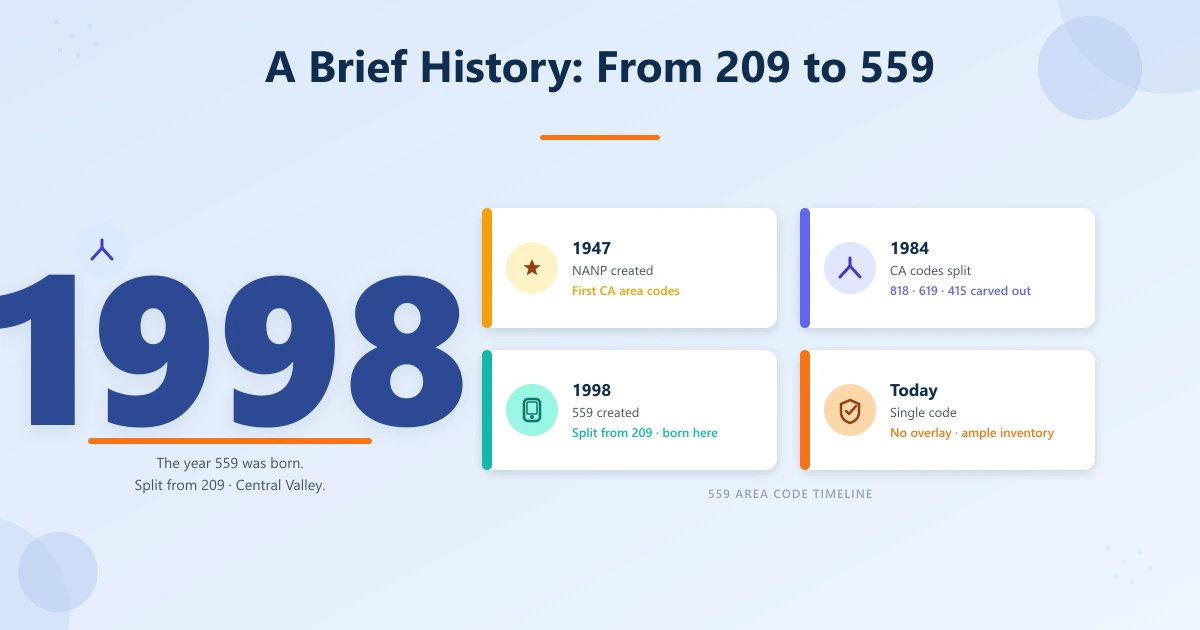
The 1998 split kept the northern Central Valley on 209 (Modesto, Stockton, Merced) and moved the south-central portion — Fresno, Visalia, Hanford, Tulare, Porterville — onto the new 559 area code. Bakersfield had already moved to 661 in an earlier split.
The redistribution was overseen by the North American Numbering Plan Administrator, which manages all US area code assignments and capacity forecasting.
559 Is Still a Single Code — and What That Means
Unlike most major California area codes, the 559 area code is not paired with an overlay.
NANPA projects existing inventory will support new assignments through at least the early 2030s, after which an overlay could be introduced if Central Valley growth continues.
For businesses, this means easier vanity-number sourcing than in 818, 415, or 213, no need to differentiate primary and overlay phone numbers in marketing materials, and a cleaner caller-ID story across the region.
Carriers connecting through wholesale SIP trunking have consistent access to 559 inventory with no overlay complexity.
- Local 7-digit dialing is still possible inside the 559 area code
- Number inventory is comparatively healthier than in overlay-heavy regions
- Vanity number patterns are more readily available than in major metro codes
- The area code itself signals authentic Central Valley presence
Time Zone, Harvest Hours, and Doing Business with the Valley
The 559 area code operates in the Pacific Time Zone (PT) — Pacific Standard Time (UTC-8) in winter and Pacific Daylight Time (UTC-7) from March through November. It shares its time zone with Los Angeles, San Francisco, Seattle, and Las Vegas.
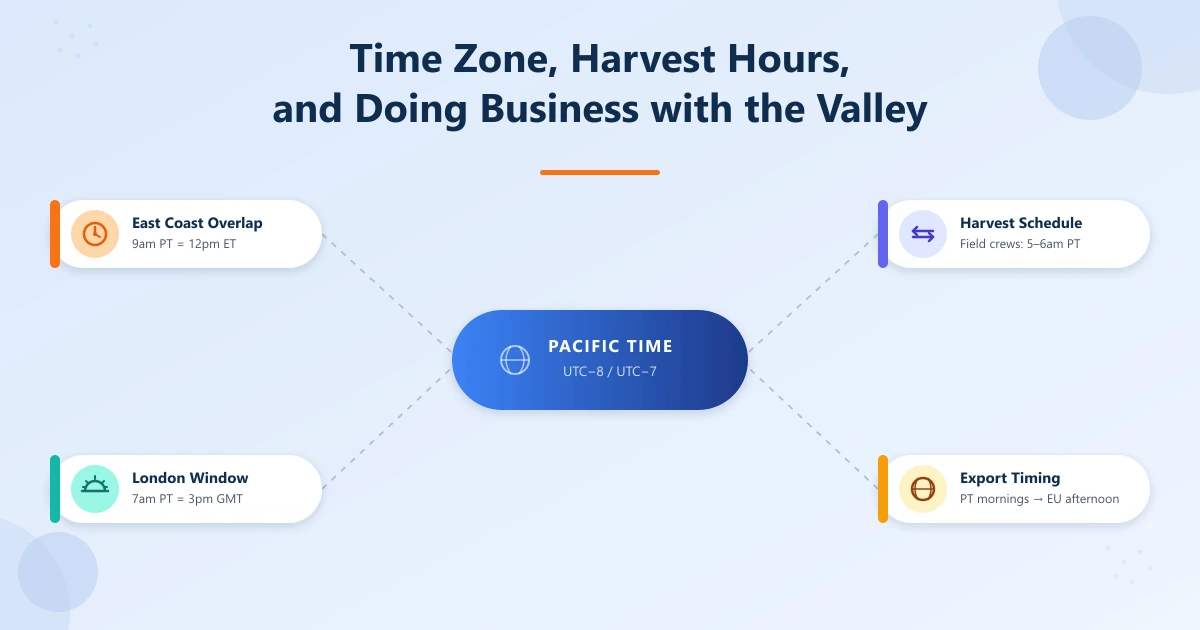
For inbound and outbound calling, a 559 number reaches Central Valley customers most reliably between 7 a.m. and 4 p.m. PT — outside that window, calls often go to voicemail because work moves quickly during agricultural shifts.
- Agricultural shifts start early. Field crews and packing plants often begin at 5–6 a.m. PT
- East Coast overlap is tight. 9 a.m.–noon PT equals 12–3 p.m. ET
- Export coordination favors mid-day. PT mornings overlap with EU afternoons, PT evenings with Asia-Pacific mornings
“The 559 area code is more than a phone prefix — it is the dial tone of California's agricultural heartland and one of the most economically impactful single-code regions in the United States.”
How to Get a 559 Phone Number for Your Business
Securing a 559 phone number is straightforward whether you operate inside the Central Valley or need to project Valley presence from another state.
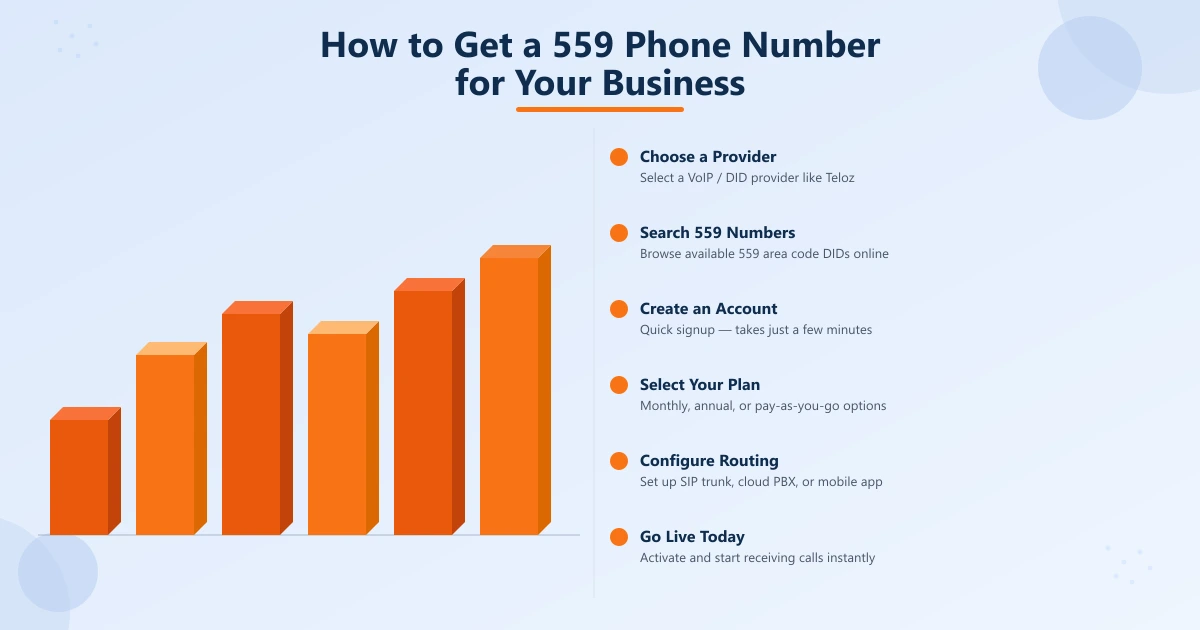
For Central Valley-based businesses: Local landline providers (Comcast Business, AT&T, Lumen) offer 559 business lines. Mobile carriers (Verizon, AT&T Mobility, T-Mobile) assign 559 mobile numbers in the area.
For out-of-state businesses wanting Valley virtual presence: Wholesale VoIP origination providers issue 559 DIDs nationally and globally. Numbers route to any SIP endpoint, cloud PBX, mobile phone, or contact center platform.
Calls present a Central Valley local presence even when answered remotely. E911 must be registered to a real responder-reachable address.
Teloz wholesale origination delivers 559 area code DIDs within minutes through our portal or API.
Whether you need a single number for an agricultural supplier sales line or a cloud PBX for a Central Valley contact center expansion, the same self-serve workflow applies.
Conclusion
The 559 area code has become inseparable from the identity of California's Central Valley — from its 1998 origin as a split off of 209 to today's single-code status anchoring Fresno, Visalia, and the broader San Joaquin Valley.
Whether you're a Central Valley business expanding nationally or an out-of-state company building Valley relationships, a 559 number remains one of the most trusted area codes in the western United States for agricultural and logistics communications.


