Introduction
Picture a planetary scientist at NASA's Jet Propulsion Laboratory in Pasadena finishing a late shift monitoring data from the Mars Perseverance rover.
She powers down her workstation, steps out into the San Gabriel Valley evening, and drives fifteen minutes south to Monterey Park.
There, the corridor of Cantonese seafood restaurants, Taiwanese bubble tea shops, and Hong Kong-style bakeries runs for miles in every direction. She texts her coworker, a Caltech-trained engineer who immigrated from Taiwan, with a 626 number.
He calls her back from his 626 number.
The 626 area code is the shared prefix of two worlds that coexist in the same valley east of Los Angeles.
One is the scientific world of Nobel laureates, Mars rovers, and interplanetary engineering; the other is the cultural world of the most expansive Chinese-American dining, commercial, and residential corridor in America.
This guide covers the full history, geography, economy, and business case for the 626 area code.
- What Is the 626 Area Code?
- The History of the 626 Area Code
- Caltech and JPL: The 626 Area Code's Scientific Core
- The San Gabriel Valley: America's Chinese-American Capital
- The Broader San Gabriel Valley Economy
What Is the 626 Area Code?
The 626 area code is a geographic North American Numbering Plan (NANP) code serving most of the San Gabriel Valley in northeastern Los Angeles County, California.
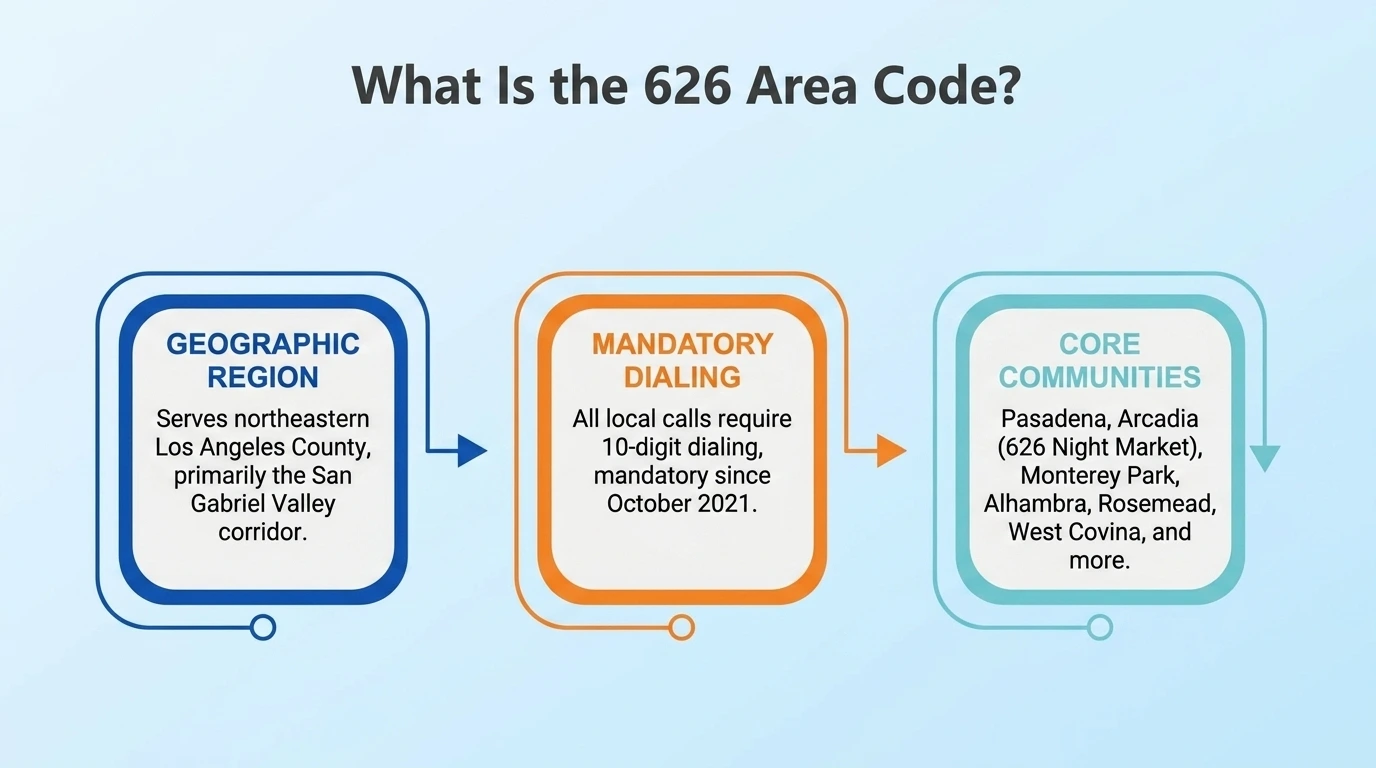
It covers a dense corridor of incorporated cities, unincorporated communities, and foothill suburbs running from the edge of Pasadena east through the San Gabriel mountains' foothills.
All local calls require 10-digit dialing, mandatory since October 2021. The entire 626 territory operates in the Pacific Time Zone (UTC−8 / UTC−7 PDT).
Businesses that want to activate service right away can start with local phone numbers.
- Pasadena — home of Caltech, JPL, the Rose Bowl, and the Tournament of Roses
- Alhambra — commercial and residential hub adjacent to Los Angeles and Monterey Park
- Arcadia — site of the 626 Night Market and Santa Anita Park racetrack
- Monrovia — foothill community with historic downtown
- El Monte — major commercial and industrial hub in the central San Gabriel Valley
- West Covina — eastern SGV commercial center
- Glendora — foothill residential community in eastern Los Angeles County
- Monterey Park, San Gabriel, Rosemead, San Marino, Temple City — core Chinese-American enclave cities
- Baldwin Park, La Puente — western San Gabriel Valley residential and commercial communities
The History of the 626 Area Code
The 626 area code's history is part of the most complex area code evolution in the United States. It happened in the Los Angeles basin, where number exhaustion drove a decades-long cascade of splits and overlays.
1947 — Area Code 213 covers all of Southern California: The original NANP assigns 213 to all of Southern California south of the Tehachapi Mountains. That covers Los Angeles, San Diego, San Bernardino, Riverside, and every community in the basin.
January 7, 1984 — Area Code 818 splits from 213: Rapid population and business growth exhausts 213's number pool. Area code 818 is created to serve the San Fernando Valley, San Gabriel Valley, and adjacent communities.
June 14, 1997 — Area Code 626 splits from 818: Explosive growth in mobile phones and internet dial-up connections exhausts 818's supply. The California Public Utilities Commission approves a geographic split.
It retains 818 for the San Fernando Valley (Burbank, Glendale, Van Nuys, Studio City). The new 626 takes the San Gabriel Valley.
2027 — Overlay incoming: On February 20, 2025, NANPA filed application A.25-02-004 with the CPUC. It sought approval for an all-services distributed overlay because the 626 number pool is projected to exhaust in the fourth quarter of 2027.
The new area code has not yet been assigned.
For a detailed numbering history, see Wikipedia's overview of the 626 area code.
| Area Code | Launched | Type | Territory |
|---|---|---|---|
| 213 | 1947 | Original NANP — Southern California | All of Southern California |
| 818 | Jan 7, 1984 | Geographic split from 213 | SF Valley + San Gabriel Valley |
| 626 | Jun 14, 1997 | Geographic split from 818 | San Gabriel Valley, Pasadena east |
| TBD | ~2027 | All-services overlay over 626 | Same territory as 626 |
Caltech and JPL: The 626 Area Code's Scientific Core
Few area codes in the United States, or anywhere in the world, can claim the concentration of scientific and engineering output produced by two institutions in the 626 territory.
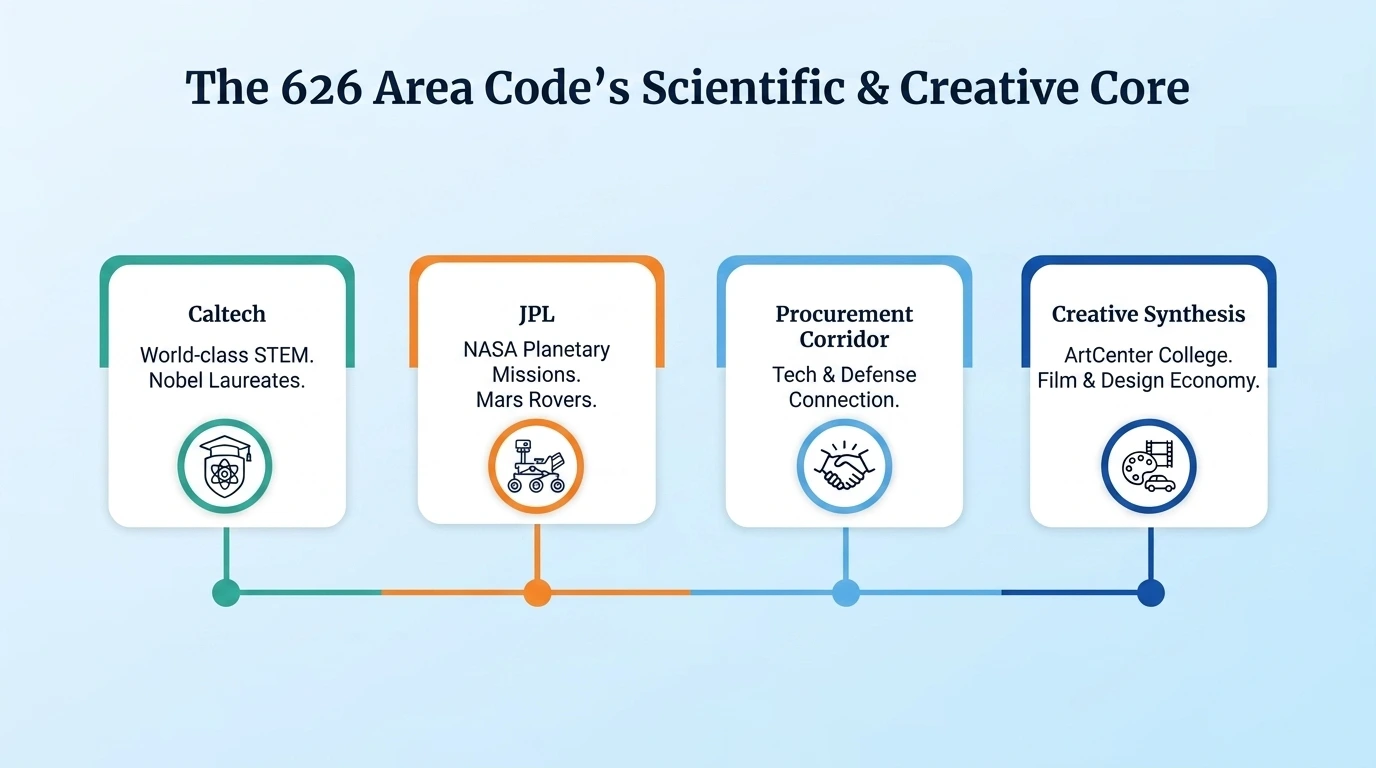
For technology vendors and defense aerospace suppliers connecting with these institutions, a cloud VoIP provider with active 626 inventory is the first step. It helps establish local market credibility in this procurement corridor.
California Institute of Technology (Caltech) sits in the heart of Pasadena. Caltech consistently ranks among the top one or two STEM universities on earth.
It has produced more Nobel laureates per faculty member than any other institution in the world. With an enrollment of about 2,200 students, it is the smallest of the world's great research universities and arguably the most intellectually dense.
NASA's Jet Propulsion Laboratory (JPL) is managed by Caltech and located in La Cañada Flintridge, adjacent to Pasadena. It is the operational headquarters of humanity's robotic reach into the solar system.
JPL manages virtually every NASA planetary mission. That includes the Voyager probes, the Mars Curiosity and Perseverance rovers, the Cassini Saturn mission, the Juno Jupiter orbiter, and the Europa Clipper.
JPL employs about 5,500 scientists, engineers, and support staff with an annual budget of about $2.7 billion.
Art Center College of Design in Pasadena adds industrial design, transportation design, graphic communications, and film disciplines to the 626 creative and technical economy.
The San Gabriel Valley: America's Chinese-American Capital
The eastern portion of the 626 territory holds a social and cultural distinction that no other American area code can match. It's home to the largest and most concentrated cluster of Chinese-American communities in the United States.
Eight of the ten US cities with the highest proportion of Chinese-American residents are located in the San Gabriel Valley. Multiple SGV cities have Asian populations exceeding 60% of all residents.
Monterey Park (65%), San Gabriel (60%), Rosemead (66%), and Arcadia (59%) are all majority-Asian communities within the 626 area code. By the early 2020s, more than 300,000 individuals of Chinese or Taiwanese descent resided in the valley.
That's about 19% of the total regional population.
The 626 Night Market in Arcadia is a popular rotating outdoor food festival named directly after the area code. It draws tens of thousands of visitors.
Those visitors identify the three digits as a shorthand for the valley's food culture, community, and sense of place.
For businesses serving Chinese-American consumers, Mandarin-speaking professional services clients, or the transnational business networks connecting the SGV to Taiwan, Hong Kong, and mainland China, the 626 number matters.
It's an immediate cultural signal of belonging.
The Broader San Gabriel Valley Economy
Beyond the Caltech/JPL scientific corridor and the Chinese-American commercial ecosystem, the 626 area code encompasses a broad regional economy. It spans healthcare, retail, manufacturing, professional services, and hospitality.
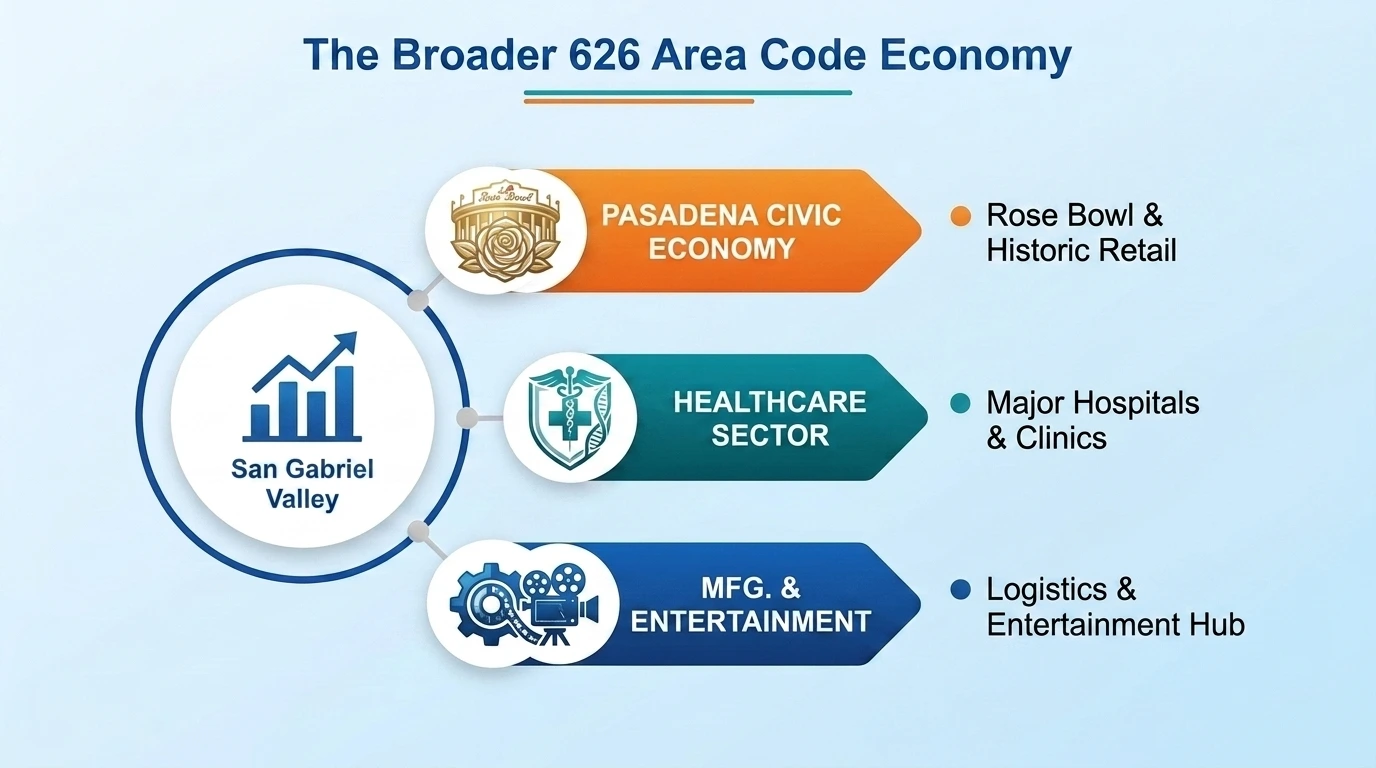
Pasadena's civic economy is anchored by the Rose Bowl. It is the site of the annual January 1 college football game and Tournament of Roses Parade — one of the most-watched annual events in American television.
It is also anchored by the Old Pasadena retail and dining district, a nationally recognized historic commercial corridor.
Healthcare is a major employer throughout the valley. Huntington Hospital in Pasadena, USC Arcadia Hospital, and numerous specialty clinics serve a dense, multi-ethnic population.
Together they make the 626 territory one of the more active healthcare markets in the Los Angeles basin.
Manufacturing and logistics in El Monte and the western San Gabriel Valley serve the broader LA metro supply chain.
The Arcadia retail and commercial corridor and the Santa Anita racetrack complex anchor a significant hospitality and entertainment economy in the eastern valley.
Why Businesses Choose a 626 Area Code Number
Companies targeting the defense aerospace supply chain, the Asian-American consumer and business market, the healthcare sector, or the Caltech/JPL research procurement corridor all benefit from a 626 number.
It delivers local market credibility and cultural alignment that national toll-free and out-of-state numbers cannot provide. Businesses that establish a 626 number before the overlay's new code deploys will hold the established code.
In this market, the three digits carry 30 years of cultural and commercial identity. See the full Teloz platform at teloz.com.
Defense and Aerospace Supply Chain
JPL's $2.7 billion annual budget flows to hundreds of subcontractors and vendors in engineering, materials science, electronics, software, and specialized manufacturing. Suppliers and service firms working the JPL procurement corridor who present a 626 number are recognized as embedded regional participants rather than out-of-state solicitors.
Chinese-American and Transnational Business Markets
The SGV's Chinese-American business community spans import/export, real estate, financial advisory, legal services, and consumer retail. It conducts the majority of its business in the 626 territory. For professional services firms, financial institutions, and technology vendors serving Mandarin-speaking business owners and transnational operators with US-China commercial ties, a 626 number is the expected regional credential.
The 2027 Overlay Window
Businesses that secure a 626 number before the overlay's new code deploys preserve the established code. In this market, the three digits carry 30 years of cultural and commercial identity — value that lasts until the new, unfamiliar code begins competing for regional recognition.
“Picture a planetary scientist at NASA's Jet Propulsion Laboratory in Pasadena finishing a late shift monitoring data from the Mars Perseverance rover.”
How to Get a 626 Area Code Number
Here is the six-step process for establishing a 626 San Gabriel Valley number for your business:
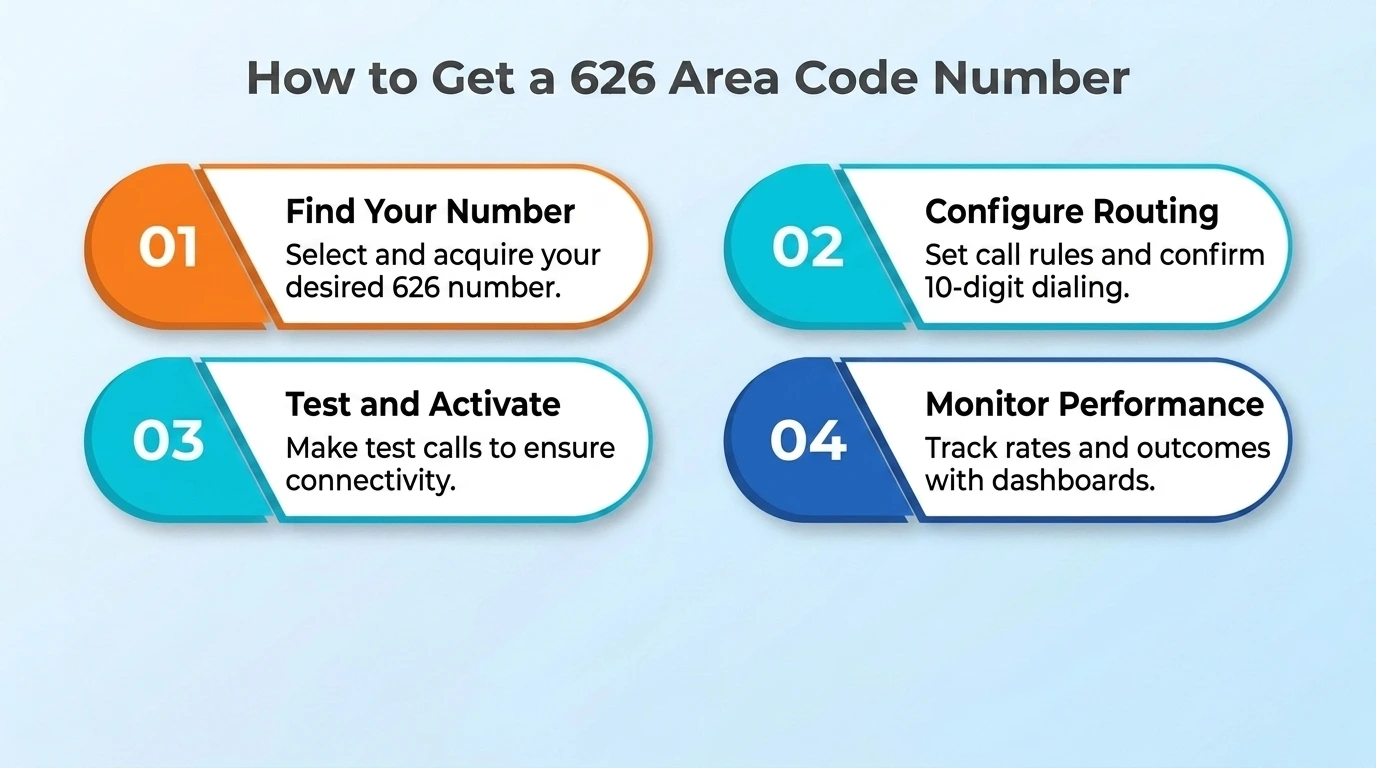
If your team also needs multi-region reach, compare international virtual numbers.
Step 1: Confirm Number Availability
Work with a cloud VoIP provider holding active 626 California inventory. With a 2027 overlay projected, the 626 supply is tightening — act before the new overlay code deploys to secure established 626 identity.
Step 2: Choose Your Number Format
Select a standard 626 local DID or a vanity number reflecting your SGV market position — whether aerospace supply chain, Chinese-American professional services, healthcare, or Pasadena-area education and research.
Step 3: Configure Market-Specific Routing
Build separate routing queues for your SGV market segments: defense/aerospace, Asian-language consumer services, healthcare, retail/hospitality, or education procurement — with skills-based routing connecting each caller to the right team.
Step 4: Integrate Your CRM
Link every inbound and outbound 626 call to your CRM automatically. In the SGV's relationship-driven professional services economy and JPL's long-cycle procurement environment, documented call history is a competitive differentiator.
Step 5: Verify 10-Digit Caller ID
Confirm your outbound 626 caller ID displays all 10 digits. Ten-digit dialing has been mandatory in the SGV since October 2021 — ensure no legacy configuration references 7-digit formats.
Step 6: Monitor with Real-Time Analytics
Track answer rates, campaign performance, handle times, and first-contact resolution from live dashboards before your first SGV call.
Conclusion
The 626 area code is unique in America. It routes calls to both NASA's planetary mission control operations and a university that has produced more Nobel laureates per faculty member than any institution on earth.
It also connects the most expansive Chinese-American community network in the United States.
That combination of scientific prestige, cultural depth, and a 30-year commercial identity makes the 626 prefix one of the most market-specific three digits in California telephony.
With a 2027 overlay on the way, the 626 number carries added value as the established code. In this territory, the digits themselves have become a cultural symbol.
For businesses entering Pasadena's aerospace corridor, the SGV's Chinese-American market, or the valley's healthcare and professional services economy, the 626 number is how you signal you already belong.
See how Teloz powers your San Gabriel Valley presence at teloz.com.


