Introduction
Picture this: you have been trying to reach a director at a Midtown Manhattan firm for two weeks. Every call from your out-of-state prefix goes straight to voicemail — automatically screened out, never returned.
Then, for the first time, you dial from a 646 area code number. They pick up on the second ring.
Manhattan's business environment runs on local trust signals most callers underestimate. Activated on July 1, 1999, as an overlay for the original 212 code, the 646 area code covers the full Manhattan borough, New York City.
Whether you received a call from a 646 number, are tracing Manhattan's phone geography, or are building a New York presence, this guide covers 646's history, the 212 overlay, time zone, major industries, business advantages, and scam awareness.
- What the 646 area code is and when it was activated
- The Manhattan districts and neighborhoods it covers
- How the 212 overlay works and why four codes share Manhattan
- Time zone, dialing format, and mandatory 10-digit rules
- Why businesses choose a local 646 number for instant NYC credibility
What Is the 646 Area Code?
The 646 area code is a Manhattan, New York City telephone prefix activated on July 1, 1999 under the North American Numbering Plan (NANP).
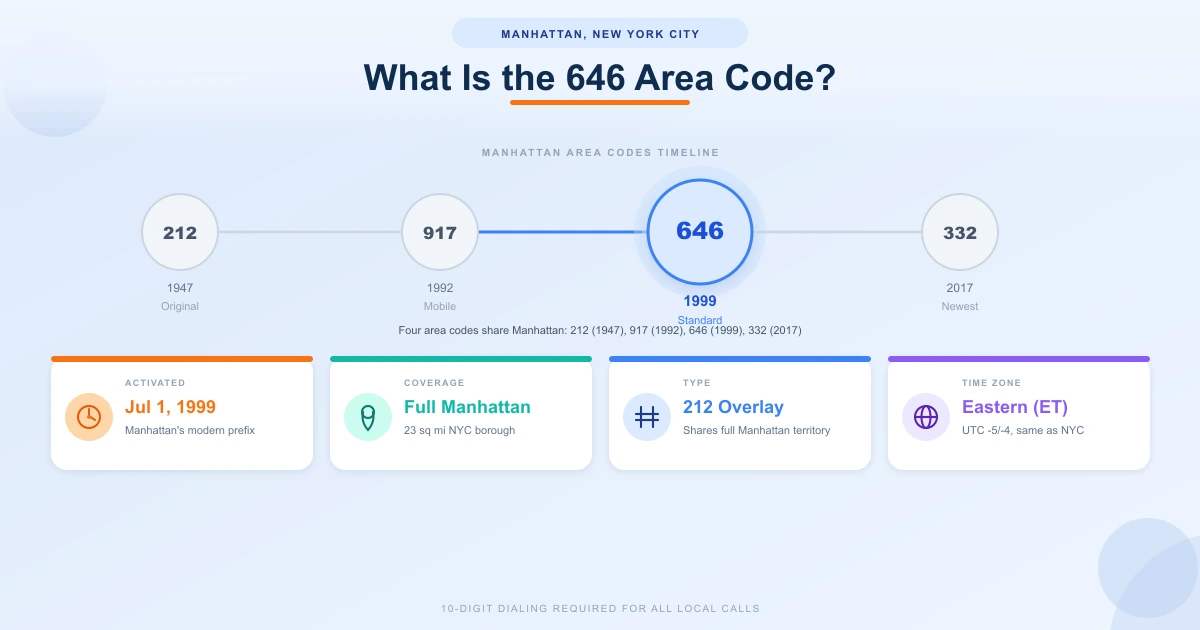
It was introduced as an overlay for area code 212 — the original NYC code established in 1947 — when 212's available number combinations neared exhaustion.
Rather than splitting Manhattan geographically, regulators assigned 646 across the full borough alongside 212.
Today, 212 numbers are no longer available to new subscribers, which makes 646 Manhattan's de facto standard prefix for any new phone line assignment.
- Activated: July 1, 1999
- Type: Overlay of area code 212
- Coverage: Manhattan, New York City (plus Roosevelt Island and Marble Hill)
- Other codes sharing coverage: 212 (original), 917 (mobile-heavy), 332 (newest)
- Time zone: Eastern Time (ET)
- Dialing: 10-digit mandatory for all calls
Where Does the 646 Area Code Cover?
The 646 area code covers the borough of Manhattan — the 23-square-mile island at the core of New York City.
Major districts within its coverage include Midtown Manhattan, the largest central business district in the United States; the Lower Manhattan Financial District home to the NYSE, Goldman Sachs, and JPMorgan Chase; Silicon Alley, NYC's technology startup corridor through Flatiron, Chelsea, and Midtown South; Upper Manhattan including the Upper East Side, Upper West Side, Harlem, and Washington Heights; and Roosevelt Island and Marble Hill.
- Midtown Manhattan — Rockefeller Center, Times Square, office corridor 34th to 59th Street
- Lower Manhattan / Financial District — NYSE, Goldman Sachs, Morgan Stanley, JPMorgan Chase
- Silicon Alley — NYC tech startup corridor, second-largest US tech ecosystem
- Upper Manhattan — Upper East Side, Upper West Side, Harlem, Washington Heights
- Roosevelt Island and Marble Hill — geographically within 646 coverage
The 212 Overlay: How Manhattan Got Four Area Codes
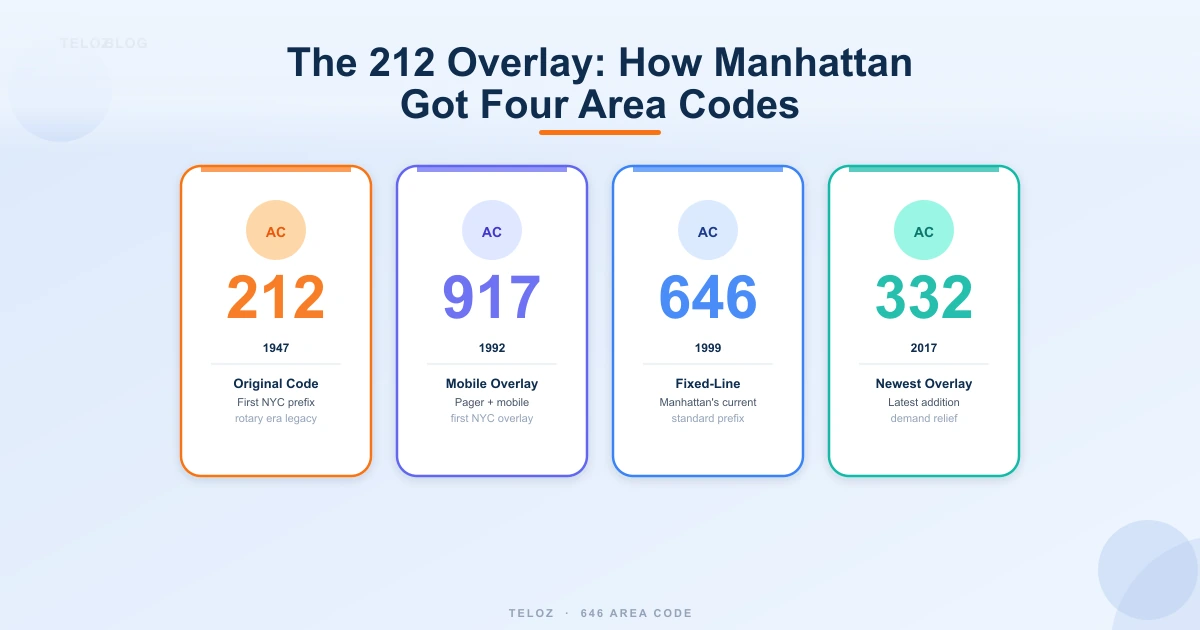
Manhattan's 212 area code is among the original 86 codes created when the NANP launched in 1947. As the largest telephone market in the country, New York City received 212 — at the time, the most dialable sequence on a rotary handset.
For five decades, 212 was the signature New York number.
As 212 approached exhaustion, regulators introduced 917 in 1992 for mobile and pager lines, then 646 in 1999 for fixed-line demand. The most recent overlay, 332, was added in 2017.
Today, four area codes share Manhattan's territory — 212 (1947), 917 (1992), 646 (1999), and 332 (2017) — with 10-digit dialing mandatory for all calls. A 646 number calling a 212 number one city block away still requires the full area code prefix.
646 Area Code Time Zone and Dialing Rules
The 646 area code operates entirely within the Eastern Time Zone (ET) — consistent with all of New York State.
Eastern Standard Time (EST): UTC −5:00, observed from early November through mid-March. Eastern Daylight Time (EDT): UTC −4:00, observed from mid-March through early November.
Eastern Time places Manhattan one hour ahead of Chicago and three hours ahead of Los Angeles. For businesses coordinating with West Coast partners — common in Manhattan's media and technology sectors — a 3:00 PM Pacific call lands at 6:00 PM ET.
Because all four Manhattan codes share the same geography, 10-digit dialing is mandatory for every call — including calls between neighbors in the same building: (646) XXX-XXXX. For international callers dialing into Manhattan: +1 (646) XXX-XXXX.
- Eastern Standard Time (EST): UTC −5:00 — November through mid-March
- Eastern Daylight Time (EDT): UTC −4:00 — mid-March through November
- 10-digit dialing mandatory for all calls within Manhattan
- Local format: (646) XXX-XXXX
- International format: +1 (646) XXX-XXXX
Manhattan's Major Industries and the 646 Area Code
The 646 area code geography encompasses one of the most economically concentrated territories in the world. The industries it serves explain why a Manhattan prefix commands immediate attention.
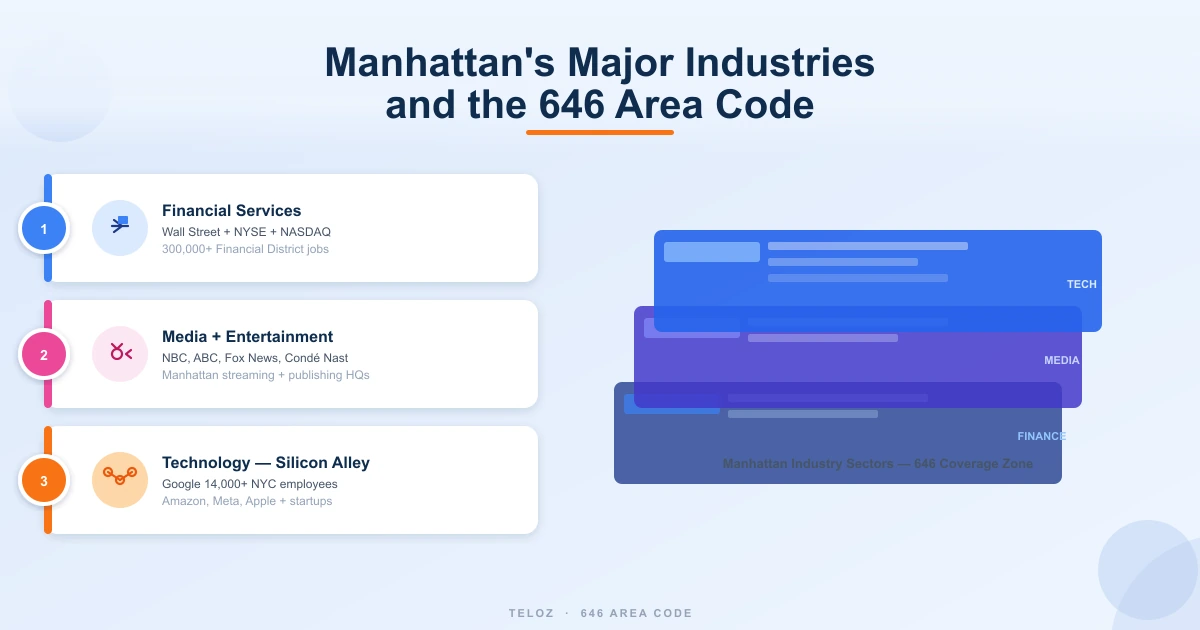
Financial services — Wall Street, the NYSE, NASDAQ, and the U.S. headquarters of most major global investment banks cluster in Lower Manhattan. Financial District employment exceeds 300,000 people.
Vendor relationships in this sector are built on perceived proximity and credibility.
Media and entertainment — NBC, ABC, Fox News, Condé Nast, and major publishing and streaming companies maintain Manhattan headquarters. A local number is a standard expectation in media vendor conversations.
Technology (Silicon Alley) — Google's Manhattan office employs over 14,000 people. Amazon, Meta, and Apple maintain major NYC presences in a startup ecosystem ranked second in the country.
For anyone trying to break into these markets, a 646 number removes the first filtering barrier before a conversation even begins.
Why Businesses Choose a 646 Area Code Number
For companies building a Manhattan presence without committing to some of the world's most expensive commercial real estate, a 646 area code number delivers access that outweighs its cost many times over.
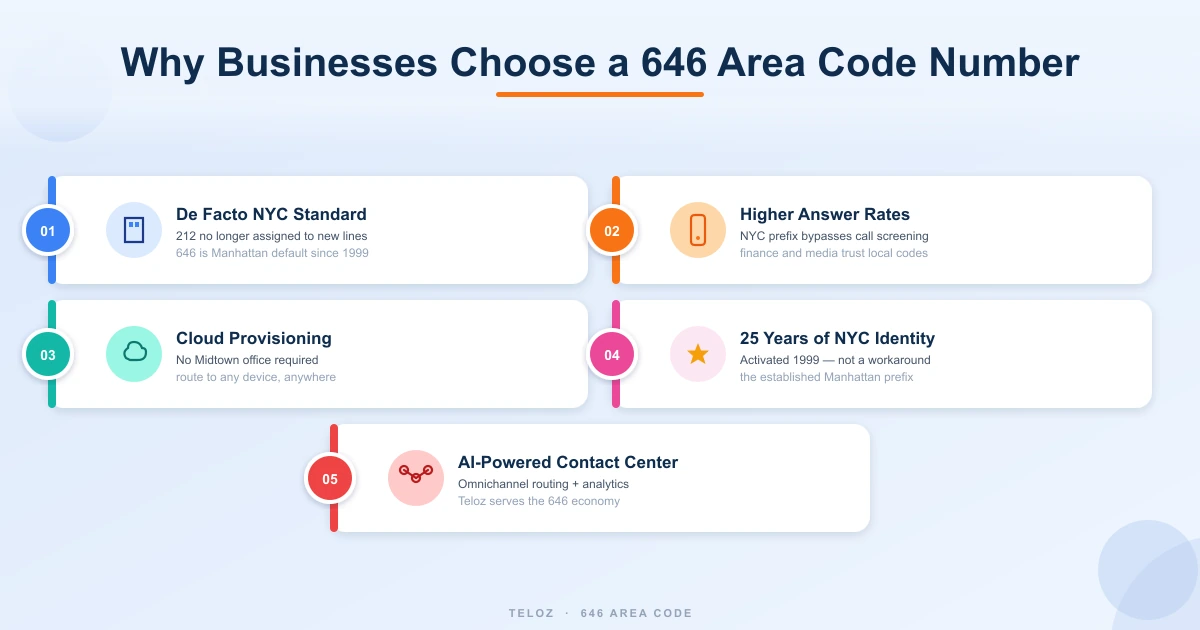
646 is Manhattan's working number for new businesses. Since 212 is no longer assigned to new subscribers, every startup, boutique firm, and remote team entering the New York market receives a 646 number by default.
The code carries 25 years of Manhattan identity — it is not a workaround; it is the standard.
Higher answer rates across every sector. Unrecognized out-of-state prefixes and toll-free numbers are screened automatically in environments where executive attention is scarce. A 646 prefix removes that filter before the first ring.
Cloud provisioning without a Midtown lease. Platforms like Teloz provision 646 numbers routed to any device from anywhere — no New York office required.
Teloz's web-based video conferencing eliminates friction in Silicon Alley's laptop-first, conference-room-light culture.
Its AI-powered omnichannel contact center — real-time analytics, inbound routing intelligence, and live performance dashboards — serves the media, fintech, and professional services firms that define the 646 economy.
“Since 212 is no longer assigned to new subscribers, 646 is not a workaround — it is Manhattan's de facto standard prefix, carrying 25 years of NYC identity into every call.”
How to Identify and Avoid 646 Area Code Scam Calls
The 646 area code's association with Manhattan — and by extension, finance, law, and institutional authority — makes it a high-value target for caller ID spoofing.
Fraudsters display fake 646 numbers to make calls appear local when they originate from entirely different locations.
Common 646 scam patterns: IRS or Social Security impersonation citing overdue tax penalties; fake New York State court summons demanding immediate payment; bank fraud alerts mimicking major Manhattan financial institutions; tech support calls citing known NYC employers.
Steps to protect yourself: let unknown 646 calls go to voicemail — every legitimate Manhattan organization leaves a message. Run unfamiliar numbers through a reverse phone lookup before returning any call.
Enable call screening on your device; most major carriers offer it free. Report suspected scam calls to the FTC at reportfraud.ftc.gov and the FCC at consumercomplaints.fcc.gov.
Caller ID spoofing has no geographic connection to the 646 area code. A Manhattan prefix on a display provides no assurance the caller is anywhere near New York City.
Conclusion
The 646 area code has defined Manhattan's modern phone identity since July 1999, growing from 212's overflow code into the borough's de facto standard prefix for every new business line.
Covering all of Manhattan — from Wall Street and Silicon Alley to Harlem and Roosevelt Island — 646 operates on Eastern Time with 10-digit mandatory dialing shared across four Manhattan overlay codes.
For businesses, a 646 number functions as a virtual Manhattan address: it bypasses the automatic screening that out-of-state numbers trigger and opens conversations across finance, media, and technology before a word is spoken.
Cloud VoIP makes it achievable without Midtown rent. See how Teloz delivers virtual phone number provisioning with AI-powered contact center capabilities built for the 646 economy.


