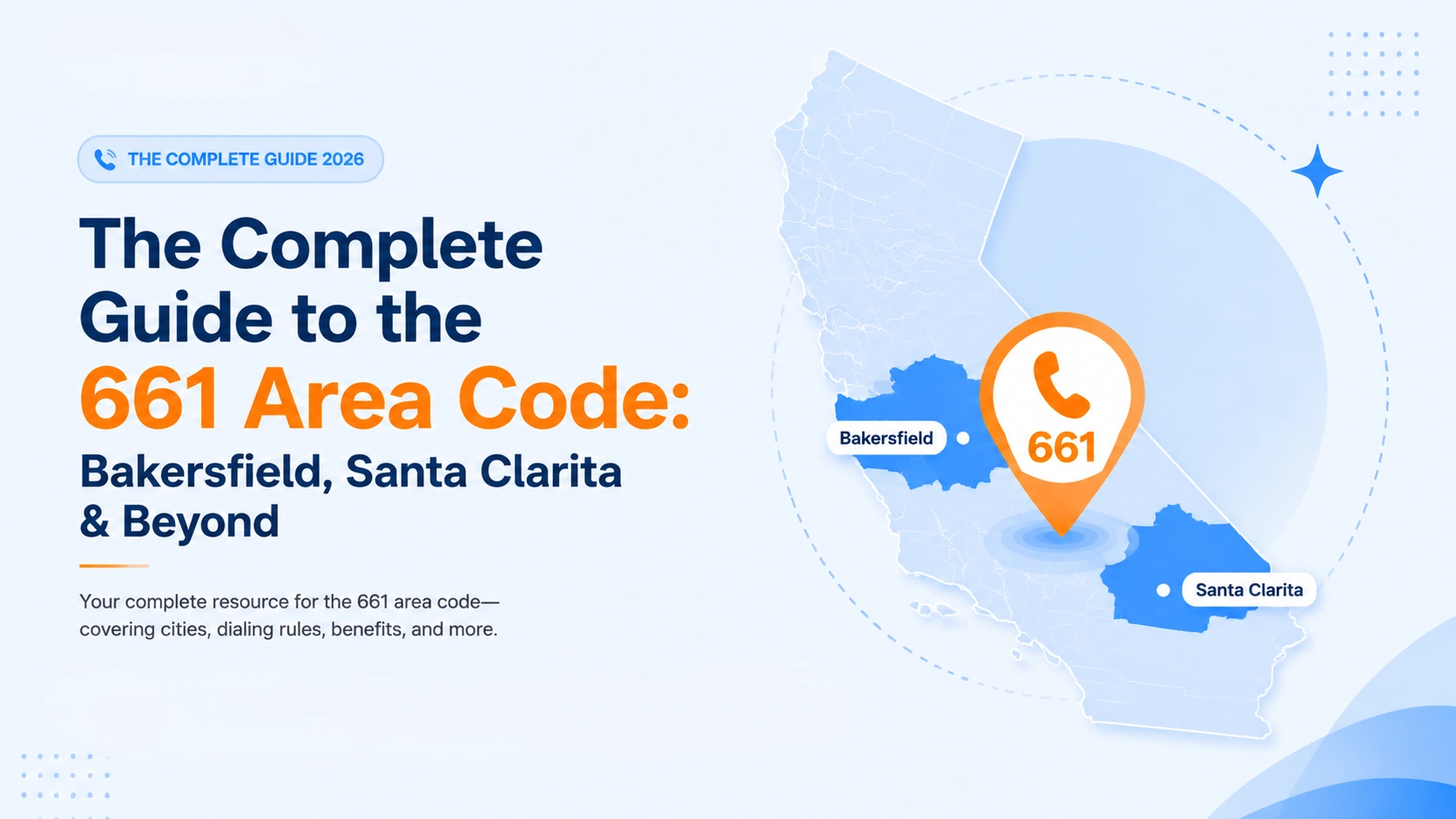
Introduction
People who work in California telecom for 25 years learn one thing about the 661 area code: outsiders often miss how big this region really is. Local business owners have known it for decades.
They have used it to build strong positions in two of California's biggest industries.
The 661 area code split off from 805 in 1999. It covers a long stretch of central and northern California.
This area includes the oil fields and farmland of Kern County's San Joaquin Valley. It also includes the Santa Clarita Valley, home to film and TV production, and the Antelope Valley, home to aerospace work.
Edwards Air Force Base and major defense contractors are based there.
No overlay has ever been added to 661. It is still a single code covering one whole area.
The region it covers adds more than $60 billion a year to California's economy. Maybe you run an energy company, a defense subcontractor, a film production vendor, or a healthcare business.
Either way, a 661 number makes you look like a trusted local operator. That matters in a market where outside firms rarely break in.
- What Is the 661 Area Code?
- The History of the 661 Area Code
- Kern County and the San Joaquin Valley: The Southern Half
- The Antelope Valley and Santa Clarita: The Northern Half
- Why Businesses Choose a 661 Area Code
What Is the 661 Area Code?
The 661 area code is a North American Numbering Plan (NANP) code for a large part of south-central and northern California. Unlike most California metro codes, 661 has no overlay.
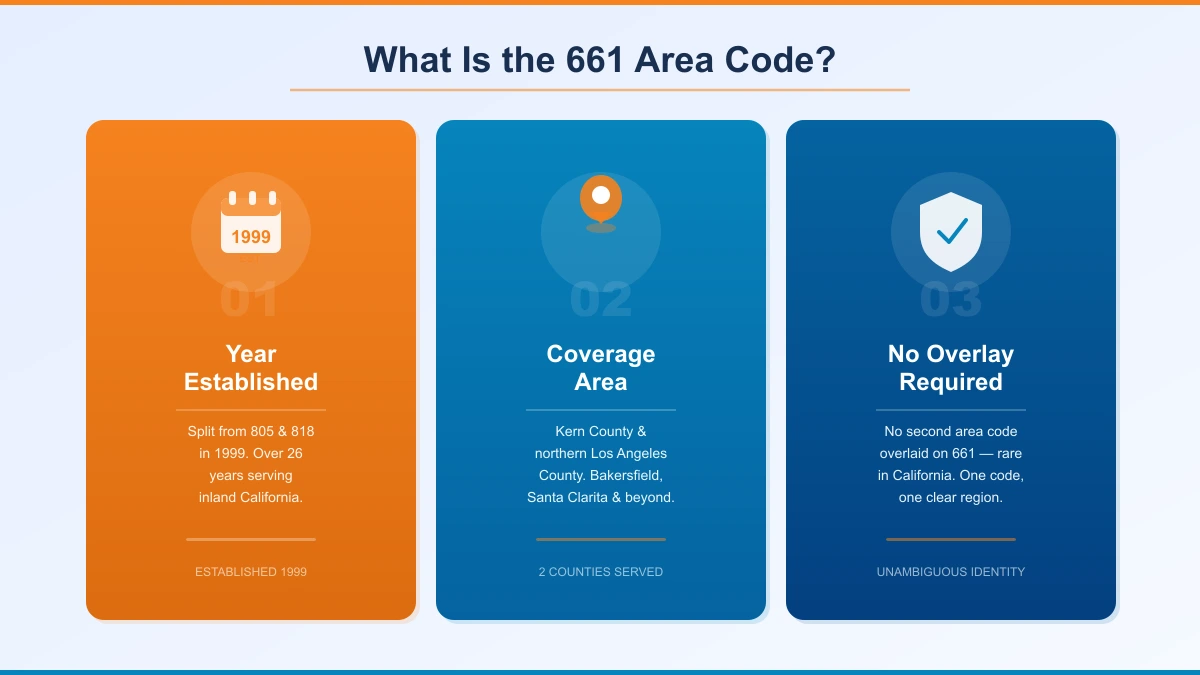
One code covers the whole area, and you do not need to dial 10 digits within the 661 zone.
The 661 area code covers five counties and about 44 cities, including:
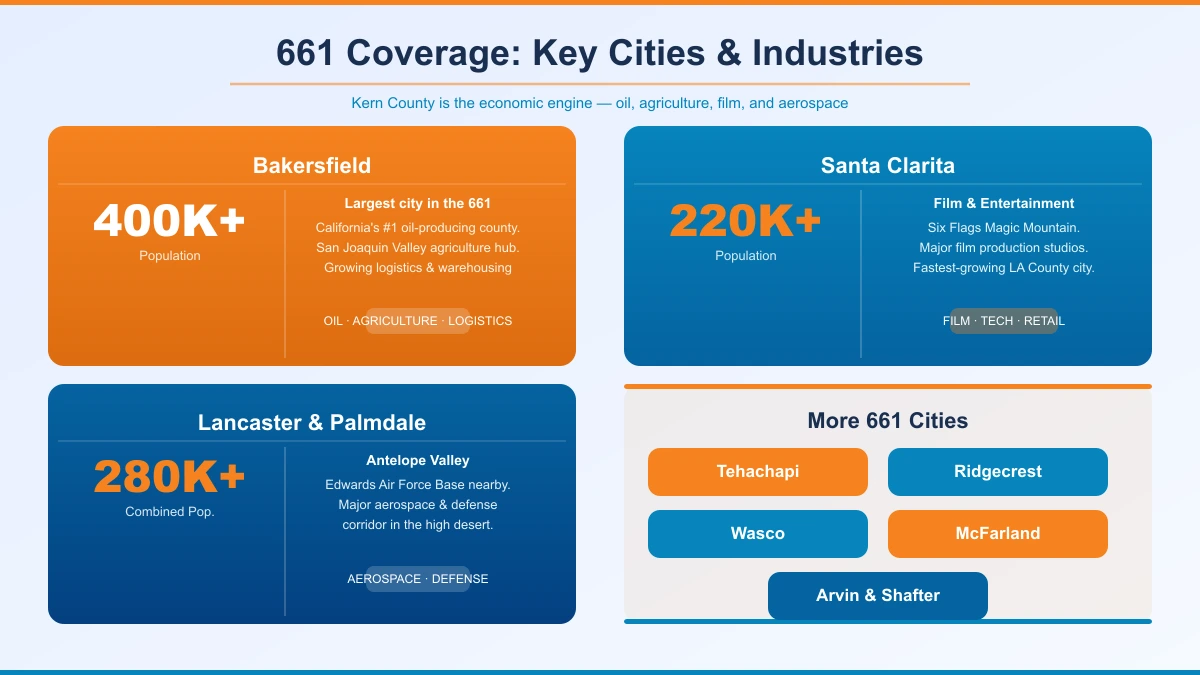
Major cities in the 661 area code include Bakersfield, Santa Clarita, Lancaster, Palmdale, and Delano. Bakersfield is the seat of Kern County and California's 9th-largest city by labor market size.
Santa Clarita is the fourth-largest city in Los Angeles County and a major hub for film production. Lancaster and Palmdale are centered on aerospace work.
Delano is a farming center in the southern San Joaquin Valley. The region runs on the Pacific Time Zone (UTC−8 / UTC−7 DST).
If you want service right away, start with local phone numbers.
- Kern County — Bakersfield, Delano, Tehachapi, Ridgecrest, Taft, and surrounding unincorporated areas
- Northern Los Angeles County — Santa Clarita, Lancaster, Palmdale, and the Santa Clarita and Antelope Valleys
- Small portions of Ventura, Santa Barbara, and Tulare Counties
The History of the 661 Area Code
The 661 area code exists because California grew fast in the 1990s. That growth put heavy strain on one of the state's most crowded area codes.
Before 1999, the whole 661 region used the 805 area code, which also covered Ventura County and the Santa Barbara coast. By the late 1990s, more people were using mobile phones, pagers, fax machines, and internet dial-up lines.
This pushed the 805 number pool close to running out.
The California-Nevada Code Administration (CNCA) decided 805 needed relief. Instead of adding an overlay, regulators chose to split the region in two.
On February 13, 1999, the 661 area code went live. It separated the inland and valley towns from the coastal 805 area.
Bakersfield, Santa Clarita, Lancaster, and Palmdale — cities among the fastest-growing in California — got their own code for the first time.
In the 25 years since, 661 has grown with the region. No overlay has been added, so 661 is still one of the few large California area codes that cover one clean, single zone.
For more on the numbering history, see Wikipedia's overview of the 661 area code.
| Area Code | Event | Year | Territory |
|---|---|---|---|
| 805 | Original assignment pre-1999 | Pre-1999 | Kern County + coastal Ventura/Santa Barbara + Santa Clarita + Antelope Valley |
| 661 | Geographic split from 805 | Feb 13, 1999 | Kern County, Santa Clarita Valley, Antelope Valley, portions of 5 counties |
Kern County and the San Joaquin Valley: The Southern Half
The southern half of the 661 region — Kern County and the San Joaquin Valley floor — is an economic powerhouse that most casual observers overlook.
Firms that sell into energy, farm supply, or healthcare here need one platform that connects voice calls, texts, and digital channels together. Buyers are spread across a wide area, so this kind of reach matters.
Energy drives the region. Kern County has long produced most of California's oil and natural gas. At the same time, it hosts some of the nation's largest renewable energy sites — the Tehachapi Wind Resource Area and huge solar farms in the Mojave Desert.
Farming matches energy in scale. Kern County's 2023 crop value topped $8.63 billion, making it one of the most productive farming counties in the United States. Grapes, citrus, almonds, pistachios, and vegetables fill the valley floor.
Healthcare and Professional Services are the top employers in Bakersfield itself. The Bakersfield metro area generated about $59.8 billion in current-dollar GDP in 2023.
Kern County's real GDP grew 5.2% that year — more than double California's average rate of 2.0%.
The Antelope Valley and Santa Clarita: The Northern Half
The northern half of the 661 region tells a very different economic story — one built on aerospace work, film production, and suburban commerce.
Aerospace and Defense define the Antelope Valley. Edwards Air Force Base, in the 661 area east of Lancaster, is one of the most important flight test centers in the world. It was also the landing site for early Space Shuttle missions.
Major defense contractors, including Lockheed Martin Skunk Works, Boeing, and Northrop Grumman, run large facilities in Palmdale and Lancaster. Most people call the Antelope Valley California's aerospace hub.
Film and Television Production anchors Santa Clarita's economy. Santa Clarita Studio, one of the largest studio complexes in Los Angeles County, hosts productions for Netflix, Disney, and major broadcast networks.
Santa Clarita sits close to Hollywood. It also offers lower production costs and built-for-purpose facilities.
That combination makes it a top choice for TV series and feature film shoots.
Suburban Commerce and Healthcare round out Northern LA County's 661 economy. Santa Clarita's population has grown fast, which drives demand for retail, professional services, and healthcare facilities.
Why Businesses Choose a 661 Area Code
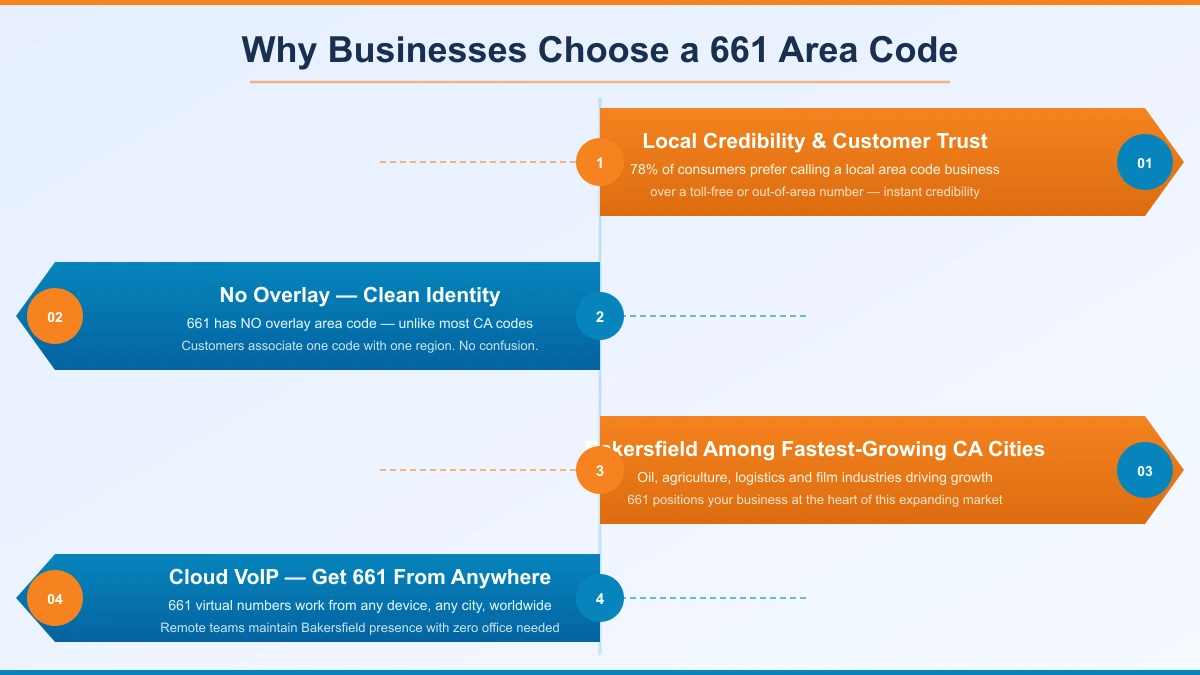
For firms working in Bakersfield, Santa Clarita, or anywhere in between, a 661 number gives you something no national toll-free or out-of-state code can match. It gives you instant trust in a market built on local ties.
With Teloz's cloud contact center platform, a 661 number works with AI-driven call routing. It also connects communication tools for calls, texts, and chat, plus CRM connections and real-time analytics.
Your operation can grow from a two-person team to a full, large contact center without ever changing your local number. Discover the full Teloz suite at teloz.com.
Oil and Agriculture Trust Economies
Kern County's energy and farming businesses run on long-term supplier and vendor ties. A 661 number tells people your business is part of the local community, not a remote vendor cold-calling from a distant call center. People answer calls from known local prefixes more often than calls from out-of-region numbers. That matters a lot in fields built on trust.
Single Code — No Overlay Confusion
Unlike most California metro areas, the 661 region has one code and no overlay to worry about. Customers never have to wonder whether their 661 contact is truly local or just an overlay number. One code, one area, one clear local identity.
Aerospace and Film Vendor Positioning
Antelope Valley defense contractors and Santa Clarita production firms work with tightly screened vendor lists. A 661 number makes your business look like a known local player — already rooted in the place where the work happens.
“People who work in California telecom for 25 years learn one thing about the 661 area code: outsiders often miss how big this region really is. Local business owners have known it for decades. They have used it to build strong positions in two of California's biggest industries.”
How to Get a 661 Area Code Number
Getting a 661 number through a cloud VoIP provider takes six steps:
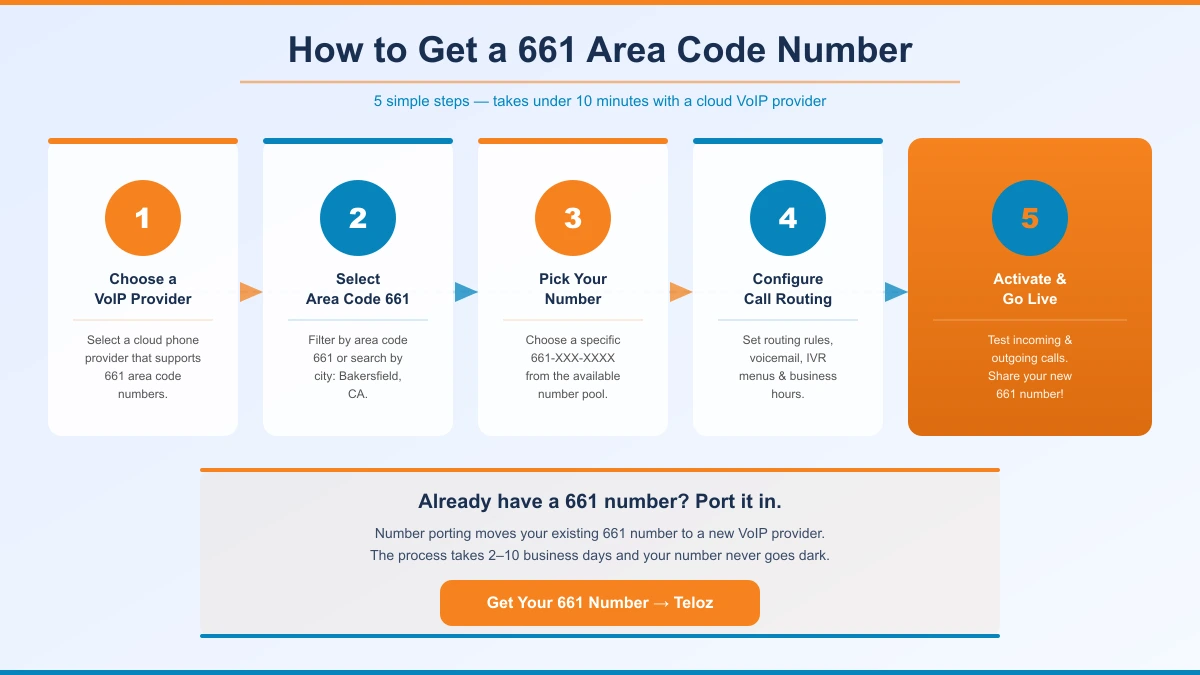
If your team also needs reach across multiple regions, compare international virtual numbers.
Step 1: Verify Number Availability
661 covers one single area with no overlay. Work with a cloud VoIP provider that keeps an active Central California number inventory and can confirm 661 numbers are available now.
Step 2: Select Your Number Type
Choose a standard local 661 number, a vanity number (for example, 661-555-FARM for a farm supplier), or a direct inward dialing (DID) number. A DID number gives each department or field agent their own dedicated 661 line.
Step 3: Build Your Call Routing
Set up IVR menus, call queues, and business-hours handling. Energy firms and farm operations need after-hours routing and emergency escalation paths.
Step 4: Integrate Your CRM
Connect your 661 line to your CRM platform. Every inbound and outbound call then logs automatically to the right customer record. You skip manual entry and keep a full history for long-term client ties.
Step 5: Confirm Outbound Caller ID
Check that your 661 number shows up correctly on outbound calls before you go live. In tight-knit fields like energy and farming, a familiar caller ID is the first sign of trust.
Step 6: Monitor with Real-Time Analytics
Use live dashboards that track call answer rates, queue depth, handle time, and agent performance. This helps you fine-tune your Central California phone service from day one.
Conclusion
The 661 area code is one of California's most underrated telephone prefixes. It is a single, overlay-free code.
It covers two very different regional economies. One is Kern County's $60 billion oil, farming, and energy powerhouse.
The other is Northern LA County's aerospace and film hub, stretching from Edwards Air Force Base through Santa Clarita.
For firms in energy, farming, defense contracting, or film production, a 661 number builds trust fast in local markets. There is no overlay confusion and no competing codes.
It is just one clean, single-area number. Your Bakersfield, Lancaster, and Santa Clarita clients know it right away.
See how Teloz helps you build that local presence at teloz.com.


