Introduction
Roughly half of all phone calls Americans ignore come from numbers they do not recognize, and a ringing 908 area code is one many New Jersey residents see often.
This three-digit prefix has anchored north-central New Jersey since 1990, covering Elizabeth, Plainfield, Westfield, and dozens of surrounding towns. So what does a call from the 908 area code actually mean, and should you trust it?
In this guide you will learn exactly where the code reaches, why it exists, how to recognize the scam calls that abuse it, and how to claim a 908 phone number of your own if you want a trusted local footprint in the Garden State.
- Where the 908 area code sits and which NJ counties it covers
- The cities and towns that dial with a 908 prefix
- How 908 split from 201 in 1990 — and later spun off 732
- How to spot and stop spam and scam calls that spoof 908
- Why a local 908 number builds trust for your business
- How to claim your own 908 number in minutes
The 908 Area Code at a Glance
Before the details, here are the essentials in one place:
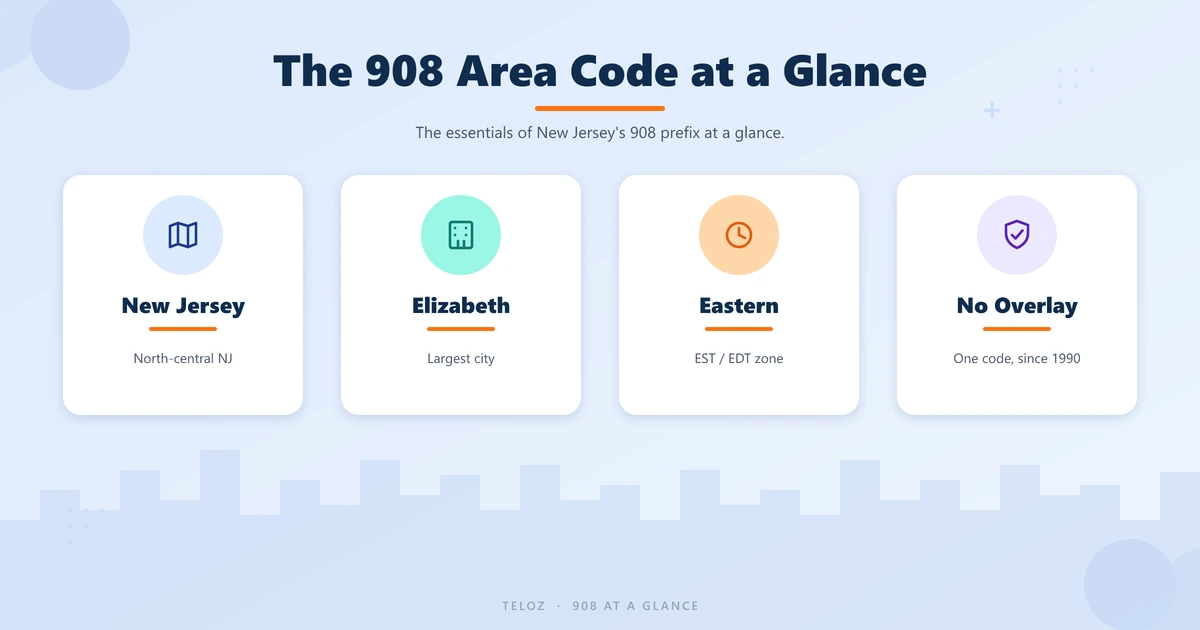
- State: New Jersey
- Region: North-central NJ (Union, Somerset, Hunterdon, and Warren counties)
- Largest city: Elizabeth
- Time zone: Eastern Time (EST/EDT)
- In service since: November 1, 1990
- Overlay: None — 908 is the sole code for its area
Which New Jersey Cities Use the 908 Area Code?
The 908 area code New Jersey footprint stretches across the north-central part of the state. Elizabeth, with about 125,000 residents, is the anchor city, but the code reaches a wide spread of communities.
Major towns include Plainfield, Linden, Westfield, North Plainfield, South Plainfield, Somerville, and Phillipsburg out near the Pennsylvania line.
This territory blends dense urban centers with leafy commuter suburbs and stretches of industrial and port activity. Newark Liberty International Airport sits just to the east, and the region's rail and highway corridors feed directly into Manhattan.
For a business, that mix means a 908 local phone number reads as genuinely local to a large, economically active audience rather than a generic out-of-state line.
The reach also crosses county lines.
Union County holds the largest share of 908 numbers and population, but the code stretches west through Somerset County towns like Bridgewater and Hillsborough, into rural Hunterdon County, and out to Warren County along the Delaware River.
How the 908 Area Code Came to Be
The 908 area code went live on November 1, 1990, carved out of the original 201 area code. New Jersey's 201 was one of the first codes ever assigned in 1947, and by the late 1980s its supply of numbers was running thin.
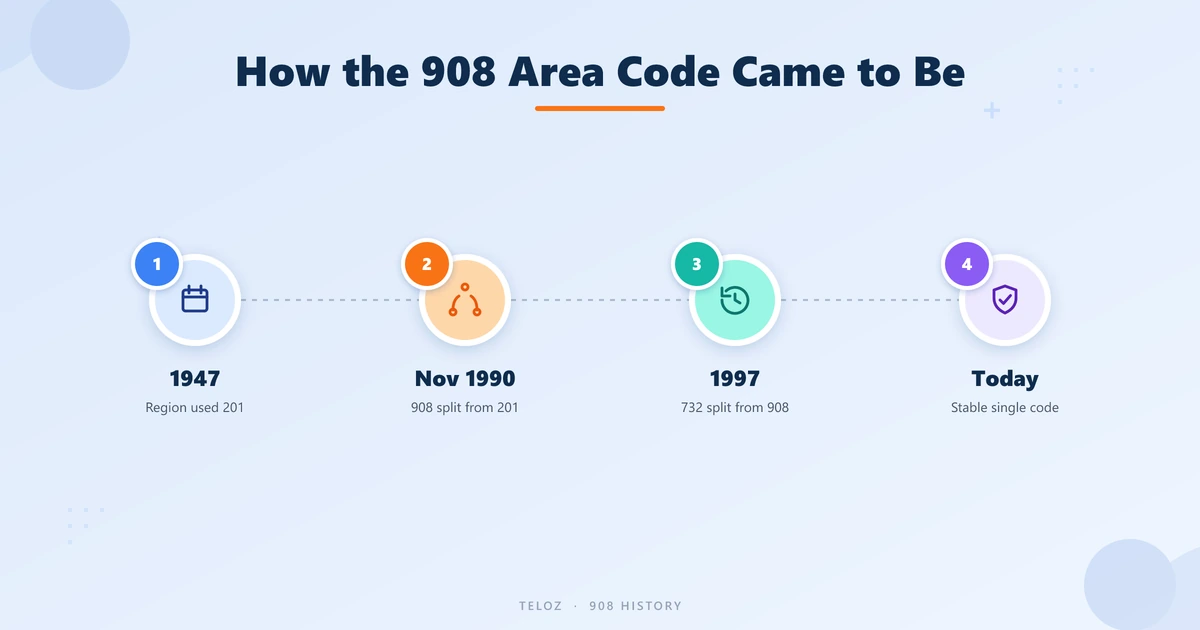
Regulators split off 908 to ease that strain.
A few years later, demand kept climbing, and in 1997 the 908 territory was divided again to create the 732 area code covering the central and shore portions of the original zone. What remained is the 908 area code in its present form.
Unlike much of the country, it has never been given an overlay, so the prefix stays uniquely tied to its geography.
That stability is worth appreciating. Many metro areas now stack two or three area codes on top of one another, weakening any sense that a code points to one place.
Because 908 has avoided that fate, it carries a clear identity: when a 908 number appears, locals know roughly where it comes from.
Spotting Spam and Scam Calls from 908 Numbers
A 908 number is not a red flag on its own — the code serves millions of legitimate residents and businesses. Still, scammers exploit it like they do every area code.
The schemes reported most often involve callers posing as a utility company threatening to cut power unless you pay immediately, and impersonators claiming to be from the Social Security Administration.
Auto warranty robocalls top the local complaint charts, followed by solar panel pitches, mortgage refinance offers, and bogus health insurance calls.
Many of these use "neighbor spoofing," disguising caller ID to mimic a nearby number so you are more likely to pick up. A few simple habits neutralize most of these attempts:
- Send unknown numbers to voicemail and verify before returning the call.
- Never pay a supposed utility or government caller with gift cards or wire transfers.
- Add your number to the National Do Not Call Registry.
- Use your carrier's spam-blocking tools to filter repeat offenders.
Should Your Business Use a 908 Number?
Local numbers convert. People are noticeably more likely to answer a call that shows a familiar area code than one from an unfamiliar or toll-free prefix.
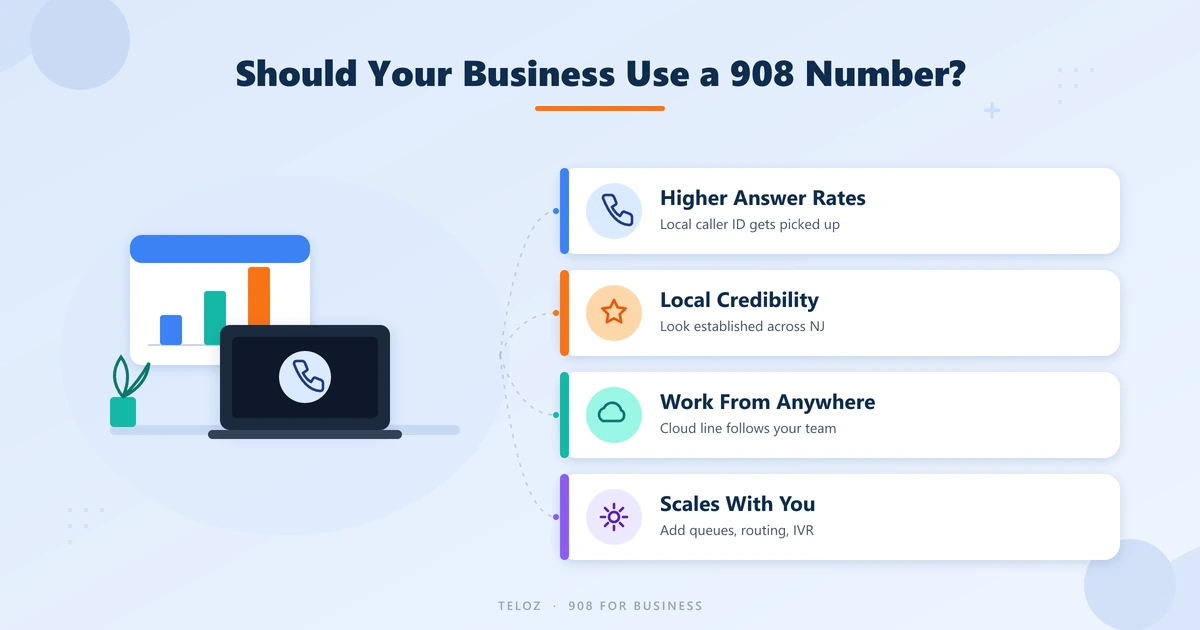
If your customers are in New Jersey, a 908 phone number for business signals that you belong to the community rather than calling in from somewhere far away.
The payoff extends to marketing too. A 908 number on your ads, website, and listings reinforces local credibility and can lift response rates.
And because today's numbers live in the cloud, you do not need an office in Elizabeth or Somerville to use one.
A single line can grow into call queues, extensions, and after-hours routing through a modern cloud contact center without changing providers.
A cloud-based 908 line travels with your team, so staff can take local calls from a laptop or mobile app whether they are in the office or working remotely.
You can track which campaigns drive calls, record conversations for training, and forward after-hours calls to voicemail or an answering service.
“When a 908 number appears on the screen, north-central New Jersey knows exactly where it comes from — and that recognition is an asset money cannot easily buy.”
Getting Your Own 908 Number in Minutes
Claiming a 908 number no longer requires a landline or local address, and you do not need to wait days for an installation appointment.
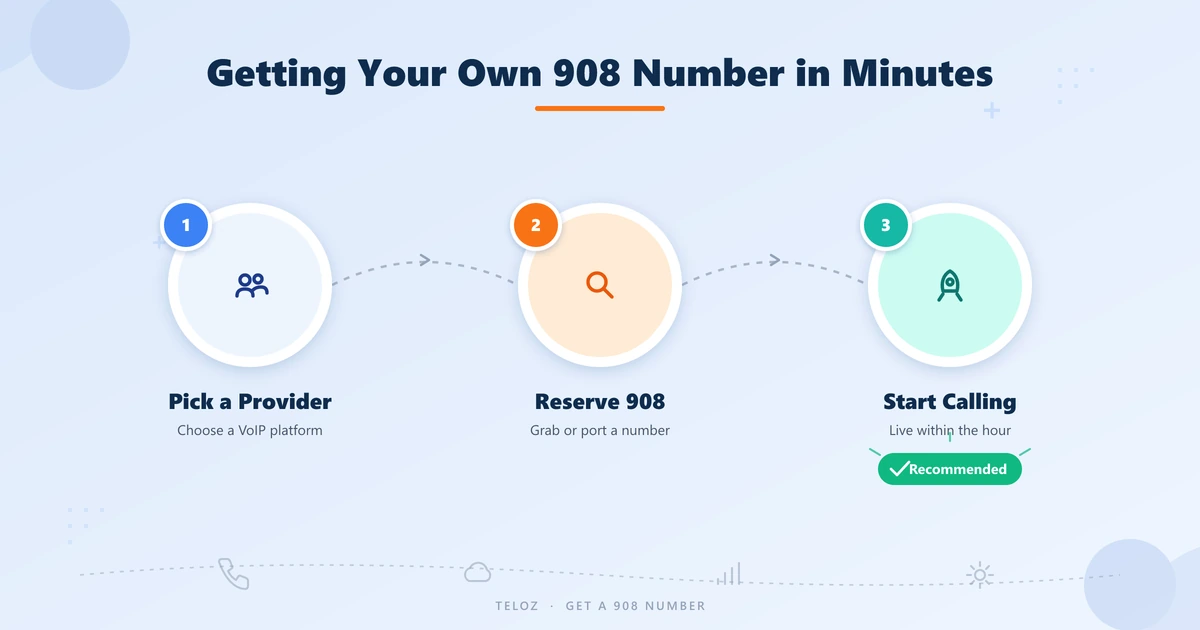
A cloud-based VoIP service lets you pick one online and start taking calls almost immediately, often within the same hour you sign up. The steps are simple:
- Pick a provider that carries New Jersey local numbers and the features you need.
- Browse available 908 numbers and reserve one, or port a number you already own.
- Route incoming calls to your team, mobile devices, or office handsets.
- Layer on business tools such as an auto-attendant, voicemail-to-email, and call recording.
Conclusion
The 908 area code is a reliable marker of north-central New Jersey, centered on Elizabeth and running on Eastern Time with no overlay since its 1990 launch.
It is a legitimate code that occasionally gets misused by spoofers, so a little caution with unknown callers goes a long way. For businesses, it remains an easy way to build local trust across the region.
When you are ready to claim a 908 phone number backed by enterprise calling features, see how Teloz handles this at teloz.com.


