Introduction
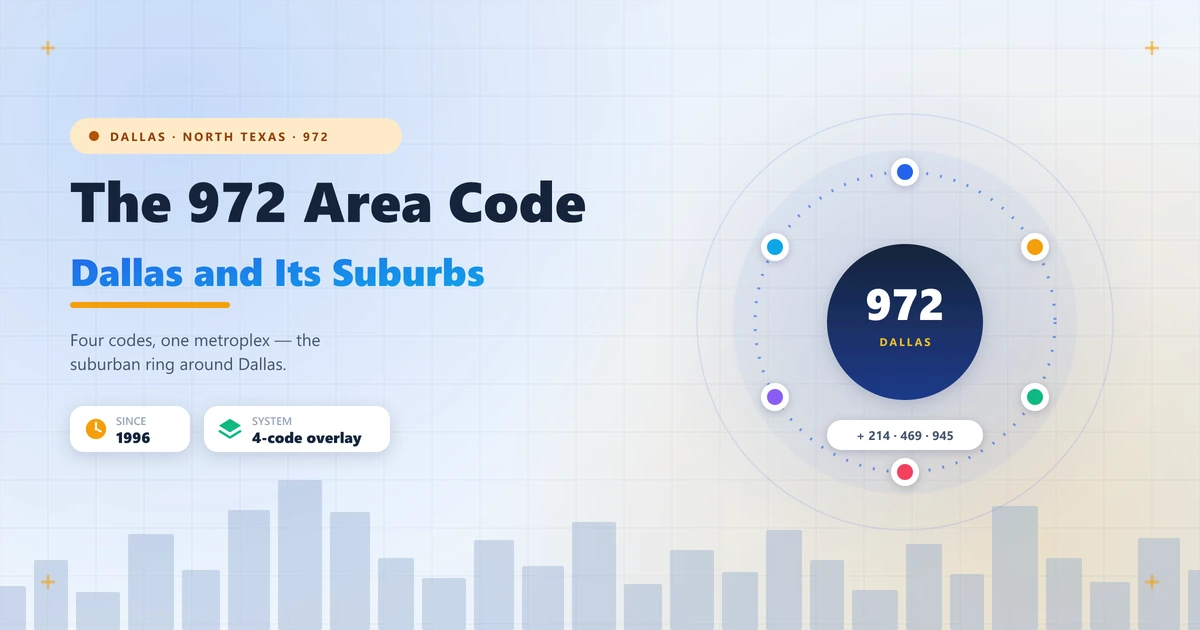
Quick trivia: Dallas does not have one area code, it has four. The 972 area code is the one that grew up in the suburbs, the prefix you will find on phones across Plano, Frisco, Irving, and the busy ring of cities circling the city center.
If you have ever wondered what the 972 area code covers, where it came from, or why your screen keeps lighting up with unknown 972 numbers, this guide has the answers.
We will map the region it serves, trace its unusual history, explain why a local 972 number still helps a business, and show you how to separate real calls from the spoofed ones. Let us get into it.
- Where the 972 area code reaches across the Dallas metroplex
- How it began as a suburban ring around the 214 core in 1996
- Why 214, 972, 469, and 945 now overlay the same region
- The Plano, Frisco, and Irving cities and counties it serves
- Why a local 972 number builds North Texas business trust
- How to get a 972 number and spot the spoofing scams
The 972 Area Code in Brief
The 972 area code is a North Texas phone prefix anchored in the Dallas-Fort Worth metroplex. It is not limited to one suburb; it stretches across a wide band of communities in and around Dallas.
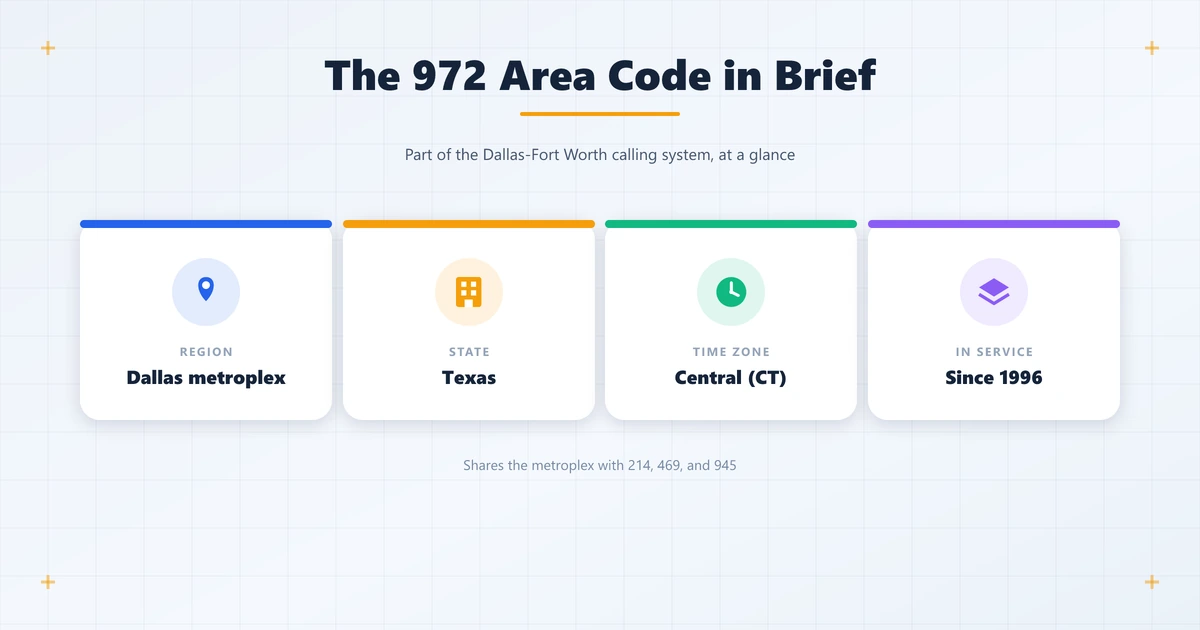
Because it shares the metroplex with several other codes, the 972 area code functions as part of a larger Dallas calling system rather than a single, isolated zone. When those digits appear, picture the sprawling suburbs and exurbs of North Texas.
It also helps to know what the 972 area code is not. It is not a single suburb's private code, and it is not tied to a far-flung part of the state.
It belongs squarely to the greater Dallas region, sitting alongside the city's other prefixes rather than standing apart from them.
- Region: the Dallas metroplex and its surrounding counties
- State: Texas
- Time zone: Central Time (UTC-6 / UTC-5 in daylight saving)
- In service since: September 1996
From Suburban Ring to Full Overlay: The 972 Story
The 972 area code has one of the more interesting origin stories in Texas. For decades, the entire Dallas region used 214. As the metroplex boomed in the 1990s, that single code could not supply enough numbers.
On September 14, 1996, regulators carved out the suburbs into the new 972 area code, leaving 214 for the urban core. For a short while, 972 was literally a ring around Dallas, a suburban "doughnut" surrounding the city's 214 center.
That tidy split did not last. Within two years, demand surged again, so in 1998 the boundaries were erased and a third code, 469, was layered over the whole region as an overlay.
A fourth code, 945, joined later. Today 214, 972, 469, and 945 all blanket the same metroplex, which is why ten-digit dialing is mandatory across North Texas.
There is a practical lesson buried in that history. Overlays replaced splits because forcing residents and businesses to change numbers proved hugely disruptive and expensive.
By stacking new codes over the same map, regulators let every existing 972 line stay exactly as it was while fresh numbers came from the newer prefixes.
For anyone holding a 972 number today, that stability is the quiet payoff: the digits you printed years ago still work, still ring, and still read as North Texas.
- 1947: 214 serves the entire Dallas region
- 1996: 972 splits off as a suburban ring around the 214 core
- 1998: 469 overlays the whole metroplex; 945 joins later
- Result: four codes share one region, requiring ten-digit dialing
The Cities and Counties 972 Calls Home
Because it covers the metroplex, the 972 area code reaches dozens of fast-growing communities across several counties. That footprint touches Collin, Dallas, Denton, Rockwall, and neighboring counties.
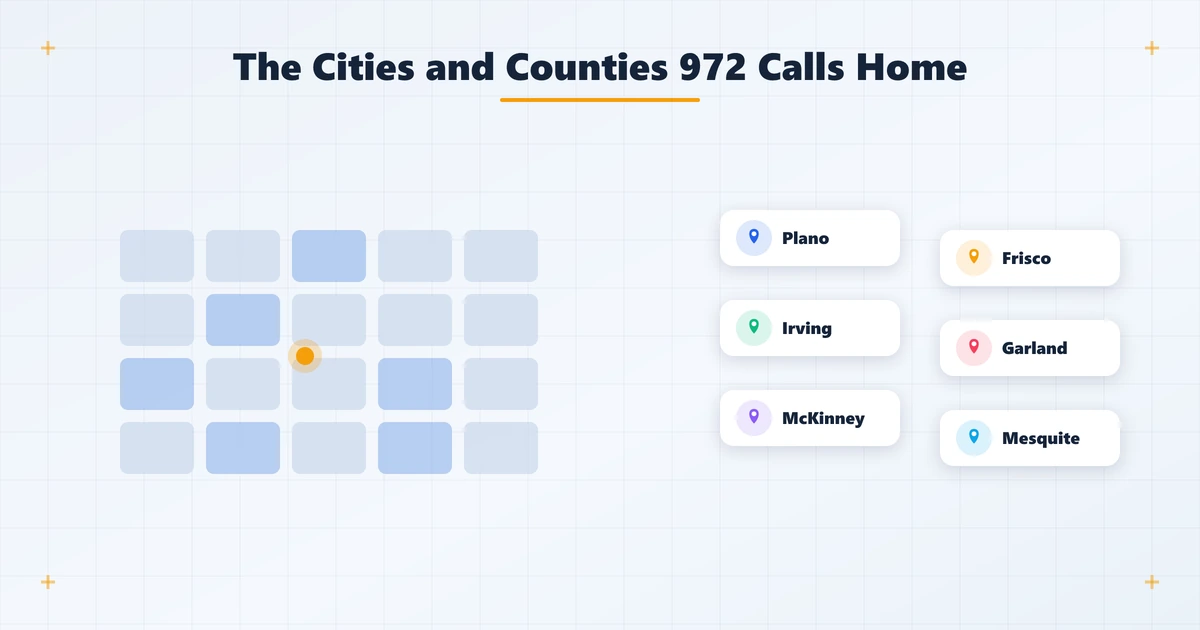
For a customer in Plano or Frisco, a local 972 number signals that a business is part of the North Texas community rather than calling in from out of state.
The economic variety across these cities is enormous.
A tech employer in Richardson's telecom corridor, a homebuilder in booming McKinney, a logistics operation in Garland, and a family restaurant in Irving might all carry a 972 prefix while serving completely different customers.
What they share is a single regional identity, which is exactly why so many North Texas businesses treat a recognizable 972 number as part of their brand.
- Plano and Richardson — corporate and tech hubs north of Dallas
- Frisco and McKinney — among the fastest-growing cities, in Collin County
- Irving and Carrollton — established suburbs on the western and northern edges
- Garland and Mesquite — large communities to the east
- Lewisville and Grand Prairie — sprawling suburbs across Denton and Dallas counties
A 972 Number as a North Texas Business Asset
A local number is an easy advantage to overlook, yet it shapes how people respond to you.
Callers are simply more likely to answer and trust a number that looks local than one from an unfamiliar region, and that instinct holds across the competitive Dallas market.
A 972 phone number tells customers you share their metroplex, their Central Time hours, and their community. That perceived closeness can raise answer rates, shorten response times, and build the referrals that growing businesses rely on.
The system behind the number matters as much as the digits.
Teloz, which has built business communication tools since 2005, can connect a local 972 line to an AI-powered contact center platform so each call is greeted, routed, and analyzed intelligently.
A small team can then field inquiries from Irving to McKinney with the responsiveness of a far larger operation, no extra hardware required.
When 972 Calls Aren't What They Seem: Scam Awareness
The 972 area code is completely legitimate, used by hundreds of thousands of real residents and businesses. But its size and recognizability make it a heavy target for fraud.
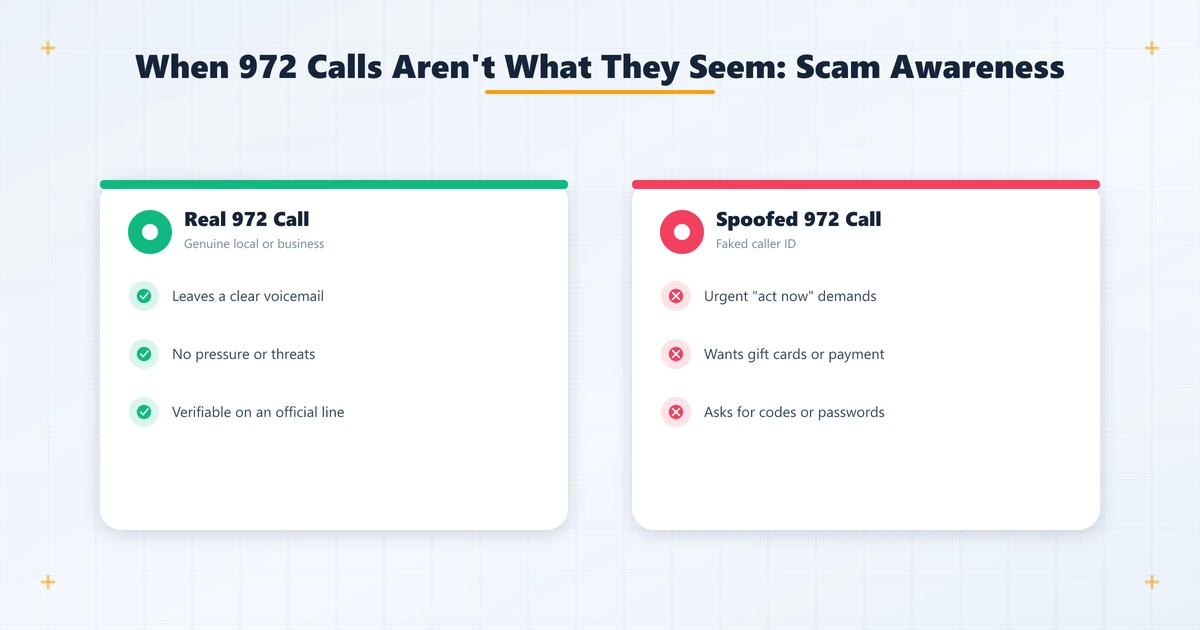
Industry estimates suggest thousands of spoofed 972 calls go out every day, aimed at people far beyond Texas.
Scammers fake a 972 caller ID through "neighbor spoofing," betting that locals will answer a call that looks nearby.
Reported 972 scams include IRS and Social Security threats, fake Amazon purchase alerts, bank-account warnings, and law-enforcement impersonation demanding immediate payment.
The number on your screen proves nothing on its own. As the Federal Communications Commission explains in its guidance on caller ID spoofing, fraudsters can display any number they like.
So judge the call by behavior, not digits. When something feels off, hang up and call the organization back on a number you look up yourself.
- Pre-recorded messages and urgent "act now" pressure
- Demands for payment by gift card, wire, or app
- Requests for passwords, Social Security, or account numbers
- Threats of arrest, fines, or account closure
“The 972 area code is the suburban heartbeat of the Dallas-Fort Worth metroplex — born as a ring around the 214 core.”
Setting Up Your Own 972 Line
You do not need a Dallas office to use a 972 area code number. Cloud-based services can assign one to a business located anywhere and route the calls to whatever device your team uses. The setup is usually quick.
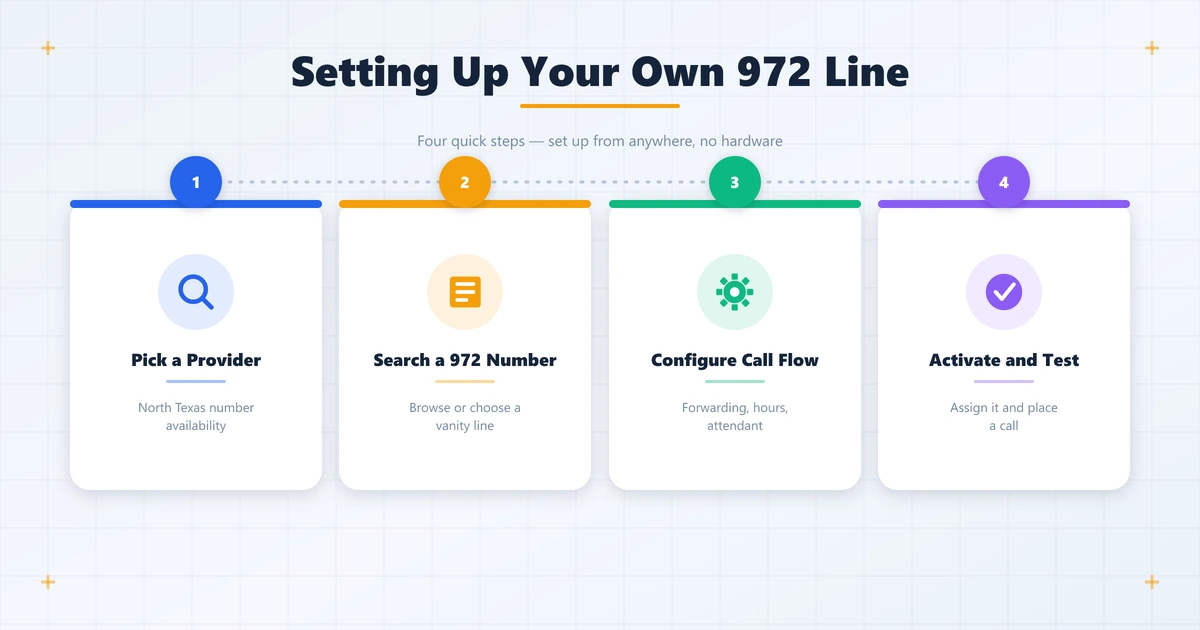
Teloz offers 972 lines among its local and virtual phone numbers, and because everything runs in the cloud, you can answer calls from a desk phone, a laptop, or a mobile app, and scale up lines as you grow without buying equipment.
- Choose a provider and plan — look for North Texas availability plus call menus, voicemail, and analytics
- Search for a 972 number — browse available options, or pick a memorable combination
- Configure your call flow — set forwarding, business hours, and an auto-attendant
- Activate and test — assign the number and place a test call to confirm everything works
Conclusion
The 972 area code is the suburban heartbeat of the Dallas-Fort Worth metroplex, born in 1996 as a ring around the city's 214 core and now woven into a four-code overlay that blankets all of North Texas.
It spans tech hubs, boomtowns, and established suburbs from Plano to Mesquite. For a business, a local 972 number is a simple way to earn metroplex trust and a faster answer, provided you stay sharp about the spoofing scams that ride on its familiarity.
Ready to put a North Texas number to work? See how Teloz approaches modern business communication at teloz.com.


