Introduction
Sending a free SMS online has never been easier – or more complicated. Dozens of websites and apps let you text a mobile number from your computer without picking up your phone, and several provide a real virtual phone number for two-way SMS at no cost.
For personal use, these tools work well enough for the occasional text from a laptop or a secondary number you would rather not give out.
The picture changed significantly in 2024 and 2025, however, in ways that affect anyone using free SMS tools for business purposes. Every major US carrier – AT&T, T-Mobile, and Verizon – shut down their public email-to-text gateways due to spam abuse.
And as of February 2025, all three carriers began blocking unregistered business SMS entirely. Free tools that route messages through anonymous or unregistered senders no longer deliver reliably to US numbers for anything resembling business outreach.
This guide covers the best free SMS online tools available in 2026, their real limitations, and the dividing line between when free SMS works and when it does not.
- What Is Free SMS Online and How Does It Work?
- Top Free SMS Online Tools
- Free SMS via Email-to-Text: What Changed
- Key Limitations of Free SMS Online Tools
- Free SMS vs. Business SMS: Why 10DLC Changes Everything
What Is Free SMS Online and How Does It Work?
Free SMS online describes three different categories of tools that work quite differently and serve different use cases.
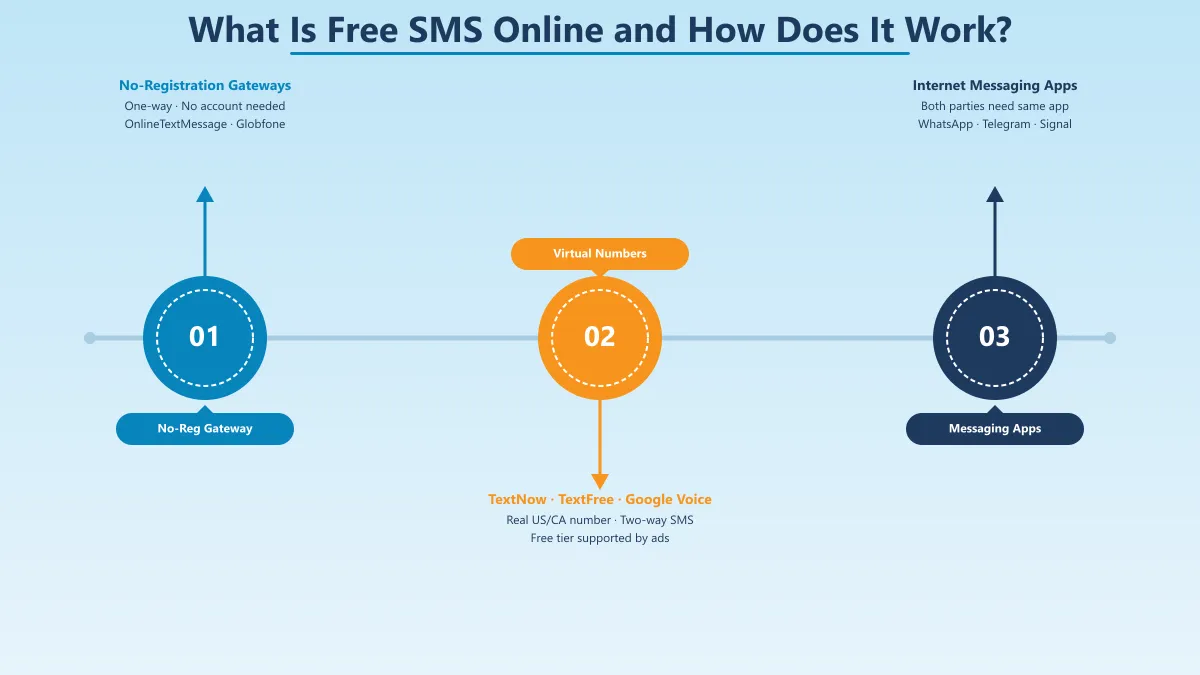
Matching the right category to your need prevents the most common frustration – using an anonymous one-way gateway when you actually need a persistent number for replies.
For businesses specifically, the category also determines whether compliant business SMS{blue} requirements apply to your use case.
1. No-registration web gateways – Websites that let you type a phone number and a message and send it directly to any mobile.
No account, no app, no sign-in. These route messages through SMS aggregators or carrier connections.
Examples include OnlineTextMessage.com, Globfone, and AfreeSMS.
2. Virtual number apps – Services that give you a real US or Canadian phone number you can use to send and receive SMS from a browser or app.
Recipients can reply and you receive messages in the web dashboard. Examples include TextNow, TextFree, and Google Voice – all free on the basic tier with ads or feature limitations.
3. Internet messaging apps – Platforms like WhatsApp Web, Telegram Web, and Signal Desktop that deliver over the internet rather than the SMS network. Both sender and recipient must have the same app installed.
Businesses that outgrow free tools typically move to a dedicated business SMS and MMS platform.
Top Free SMS Online Tools
The tools below are organized by category. Choosing the right one depends on whether you need a one-time no-account message, a persistent two-way number, or a desktop interface for an existing messaging app.
No-Registration Web Gateways
- OnlineTextMessage.com – Sends free SMS to any US mobile number from a browser with no registration. Supports AT&T, T-Mobile, Verizon, and other major carriers. Best for one-off messages where delivery confirmation is not critical. - Globfone – A long-running free SMS gateway covering multiple countries. No account required; paste a number, write a message, send. Delivery is not guaranteed, and messages may be filtered as spam by recipient carriers. - AfreeSMS – Focuses on international regions including Asia, Europe, and Africa. Free with no registration; useful for reaching numbers in countries where US-centric services have limited coverage.
Free Virtual Number Apps
- TextNow – The most feature-complete free tier. Provides a real US or Canadian phone number, unlimited two-way SMS within North America, and an optional SIM/eSIM for cellular coverage. Free tier is supported by in-app ads. Available on web browser, iOS, Android, and desktop. - TextFree – Similar to TextNow: real US/Canadian number, free unlimited texting, web and app access, international texting to 30+ countries. The free tier includes more intrusive full-screen ads but works well for the core SMS use case. - Google Voice – Google's free virtual phone number service, integrated with Gmail and Google Workspace. Provides US-only numbers, free SMS to US numbers, and voicemail transcription. Requires a Google account. Best suited for users already in the Google ecosystem who want a permanent secondary number.
Internet Messaging Apps with Web Access
- WhatsApp Web – Access your WhatsApp account from any browser. Free for all message types to other WhatsApp users. With over 2.7 billion users worldwide, the majority of contacts in Latin America, Europe, and South Asia are already on WhatsApp – the most practical desktop messaging solution for international communication. - Telegram Web / Signal Desktop – Both offer full web and desktop access to their respective encrypted messaging platforms. Free, no per-message limit, and fully functional for users whose contacts use the same app.
Free SMS via Email-to-Text: What Changed
For years, US carriers operated public email-to-SMS gateways that let anyone send a text by emailing a formatted carrier address.
IT teams used these for server monitoring alerts, booking systems used them for appointment reminders, and individuals used them as a free-forever workaround.
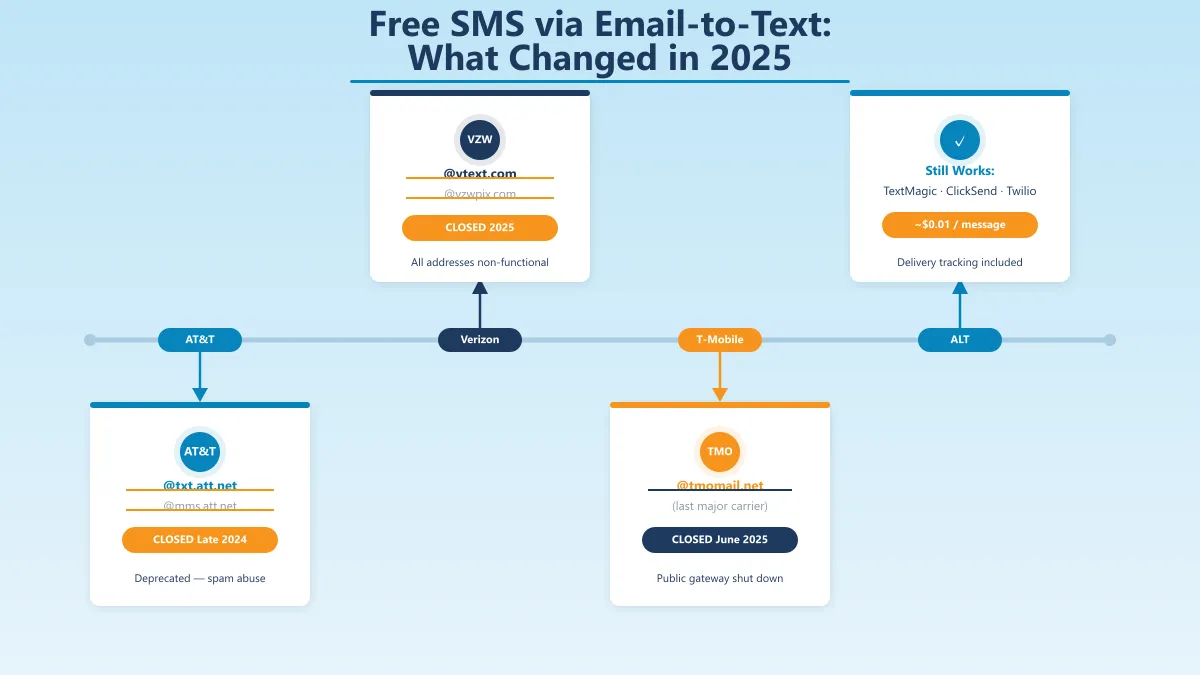
Between late 2024 and June 2025, all three major US carriers shut these gateways down due to massive spam abuse – the public gateways had become a primary delivery vector for bulk unsolicited messages:
Third-party email-to-SMS services (TextMagic, ClickSend, Twilio) still provide email-to-text functionality at a per-message rate of roughly $0.0075–$0.04 per message, with delivery tracking, two-way reply support, and proper carrier relationships.
For any workflow that previously relied on carrier email-to-text, migration to a third-party service is now the only reliable path.
For the underlying protocol, see Wikipedia's entry on SMS.
- AT&T deprecated @txt.att.net and @mms.att.net
- Verizon deprecated @vtext.com and @vzwpix.com
- T-Mobile deprecated @tmomail.net
Key Limitations of Free SMS Online Tools
Free SMS tools are useful for specific personal use cases and genuinely fall short in others. Understanding the limitations prevents wasted time and, for businesses, compliance exposure:
- Delivery is not guaranteed. No-registration gateways route through shared aggregator connections that carriers increasingly filter. Your message may be silently dropped before it reaches the recipient. This is acceptable for a casual personal message; it is unacceptable for a business notification, appointment reminder, or verification code.
- Messages frequently appear as spam. When messages arrive from anonymous or generic sender IDs, many recipients' phones flag them as potential spam or they land in filtered message folders. Recipients who do not know to look there may never see them.
- No two-way messaging on anonymous tools. No-registration gateways deliver your message but provide no mechanism for the recipient to reply. Any scenario requiring a response – appointment confirmation, customer inquiry, RSVP – requires a virtual number app or business SMS platform instead.
- Privacy exposure. No-registration tools typically log the sender's IP address even when they claim not to require account information. If privacy is a genuine concern, these tools provide weaker protections than they appear to.
- Free tier limitations. Virtual number apps (TextNow, TextFree) sustain their free tiers through advertising and feature restrictions. Premium features – number porting, international SMS, custom caller ID – require paid plans.
- Carrier-level TCPA risk. Using anonymous SMS tools to send any business or promotional message to people without their prior written consent creates TCPA liability of up to $1,500 per message – regardless of whether the delivery tool is free.
Free SMS vs. Business SMS: Why 10DLC Changes Everything
The most consequential change for anyone considering free SMS tools for business use occurred in February 2025, when AT&T, T-Mobile, and Verizon moved from throttling to blocking all unregistered A2P (application-to-person) SMS on standard 10-digit long codes.
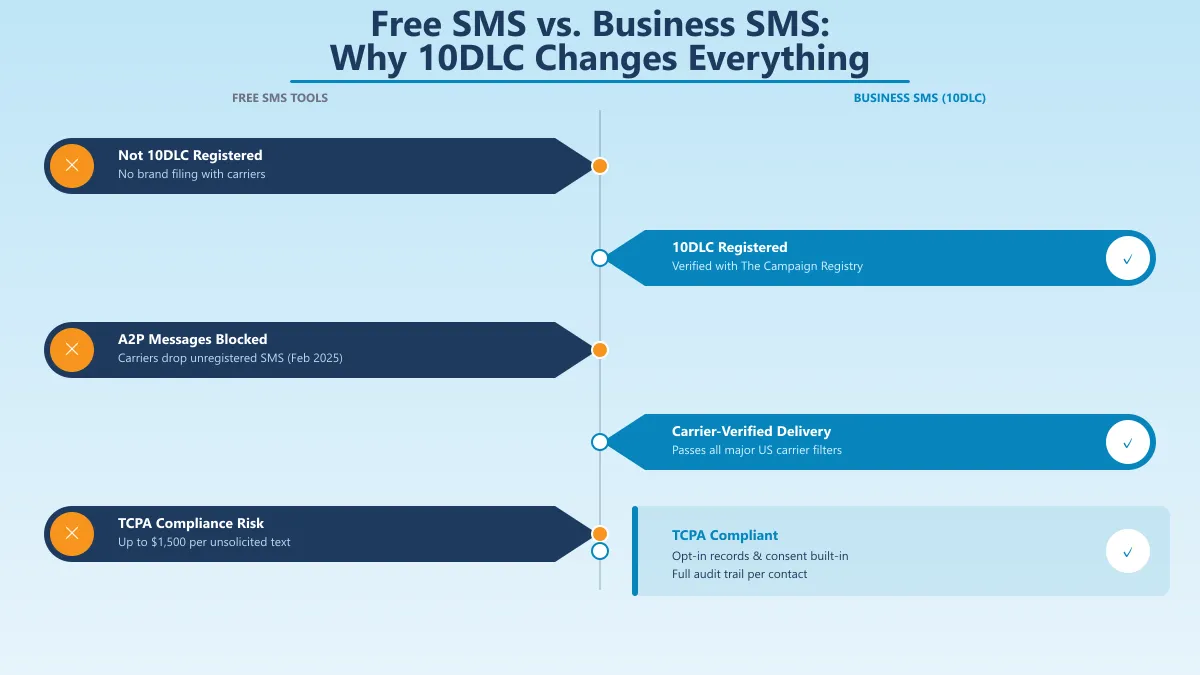
The standard is called 10DLC (10-Digit Long Code).
10DLC requires businesses to register their brand and specific SMS messaging use cases with The Campaign Registry{blue} before carriers will deliver their messages. Registered senders get verified delivery, higher throughput, and reduced spam filtering.
Unregistered senders – including anyone routing business messages through free SMS tools – get blocked entirely.
Teams standardizing on a single compliant channel usually coordinate it through a shared team chat tool.
What This Means Practically
- A business using TextNow or Google Voice to send promotional messages, appointment reminders, or customer support texts to opt-in contacts without 10DLC registration will have those messages blocked at the carrier level as of February 2025. - The recipients never see the messages – there is no delivery failure notification to the sender. - 10DLC registration requires a legitimate business entity, a registered brand, and campaign-level descriptions of your messaging use cases. It cannot be done through free consumer SMS tools.
This is not a niche compliance concern – it affects any business sending text messages to US mobile numbers at any scale, including small businesses sending appointment reminders from a TextNow number. For businesses that need reliable delivery, a 10DLC-registered business SMS platform is the only path.
“Explore the best free SMS online tools – no-registration gateways, TextNow, Google Voice – plus what the latest carrier changes mean for businesses.”
When Free SMS Works – and When to Upgrade
Matching your tool to your use case is the key decision. Free SMS tools excel at personal communication; business use cases require a purpose-built registered platform.
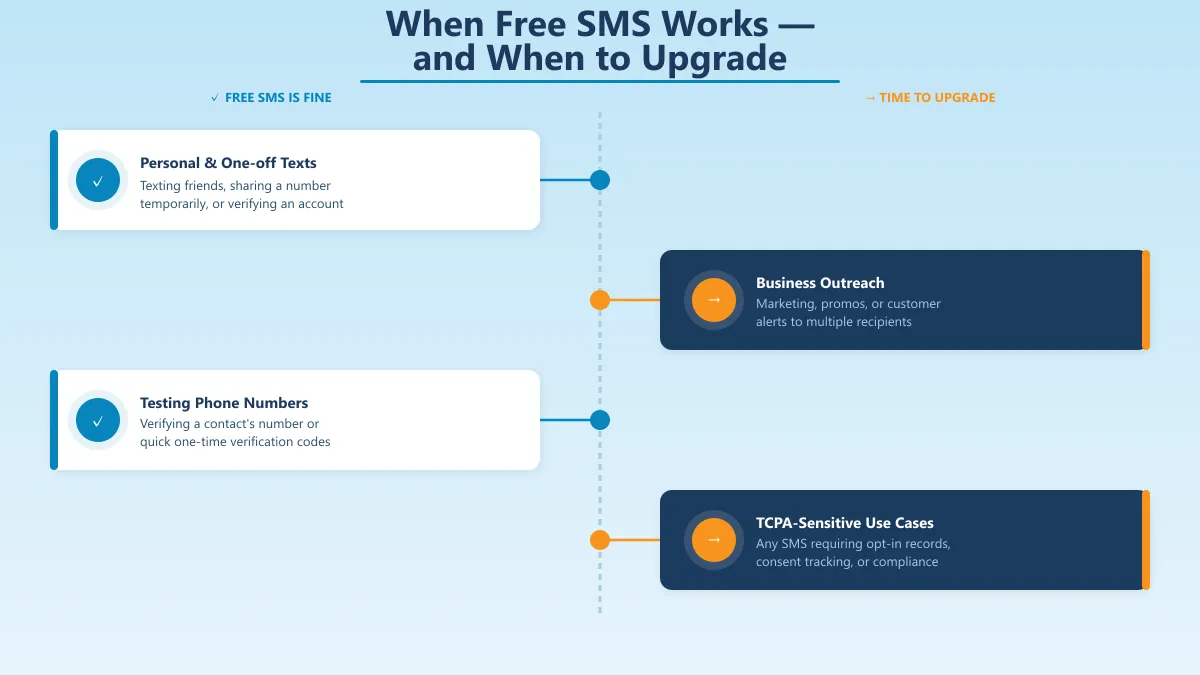
Use Free SMS Online Tools When:
- You need to send a one-off personal message from your computer - You want a secondary virtual number for personal use without buying a second SIM - Your contacts use WhatsApp, Telegram, or Signal and you want desktop access to those conversations - You are testing a concept before investing in a paid platform - Your use case is entirely personal with no business or commercial element
Upgrade to a Business SMS Platform When:
- You are texting customers, prospects, or contacts in any commercial capacity - You need two-way messaging at any volume - You need delivery confirmations and read receipts - You need CRM integration to log SMS interactions against contact records - You are sending appointment reminders, alerts, promotions, or support messages - You want 10DLC-registered, carrier-verified delivery
Teloz's cloud contact center platform{blue} includes business SMS functionality with 10DLC registration support, two-way messaging, real-time delivery analytics, and AI-driven routing – so every text your team sends reaches its destination and ties back to the right customer record. For businesses that have outgrown free consumer tools, the difference in deliverability alone justifies the upgrade.
Conclusion
Free SMS online tools cover a genuine range of useful personal communication needs – texting from your computer, maintaining a secondary virtual number, or accessing WhatsApp and Telegram from a desktop browser.
For occasional personal use, Google Voice, TextNow, and no-registration gateways remain effective in 2026.
The boundary for businesses is now clearly drawn: carrier 10DLC enforcement since February 2025 means free consumer SMS tools do not deliver business messages reliably to US mobile numbers.
Any commercial use – from appointment reminders to customer support – requires a registered business SMS platform with 10DLC compliance, two-way messaging, and delivery tracking. See how Teloz handles your business SMS needs end-to-end at teloz.com.


