Introduction
Germany's phone number formats can be tricky, especially for international dialing. The telecom system has a unique structure that is important to know.
For business, travel, or personal calls, using the correct format ensures smooth communication. Learning this German phone number format structure prevents errors and keeps calls connected.
With mobile and VoIP on the rise, understanding German numbers is more important than ever. Using the correct Country code +49, area code, and local number ensures calls reach the right person.
Following these rules avoids delays and miscommunication. Staying informed keeps calls accurate, reliable, and simple.
- Structure: +49 country code, area code, and a subscriber number that varies in length.
- Country Code: Always dial +49 from abroad and drop the leading zero in the area code.
- Area Codes: Vary from 2–5 digits — shorter for major cities like Berlin (030).
- Fixed-Line vs. Mobile: Mobile numbers start with 015, 016, or 017 and aren't tied to a region.
- Special Numbers: 110/112 for emergencies, 0800 toll-free, 0900 premium, 0180 shared cost.
Structure of a German Phone Number
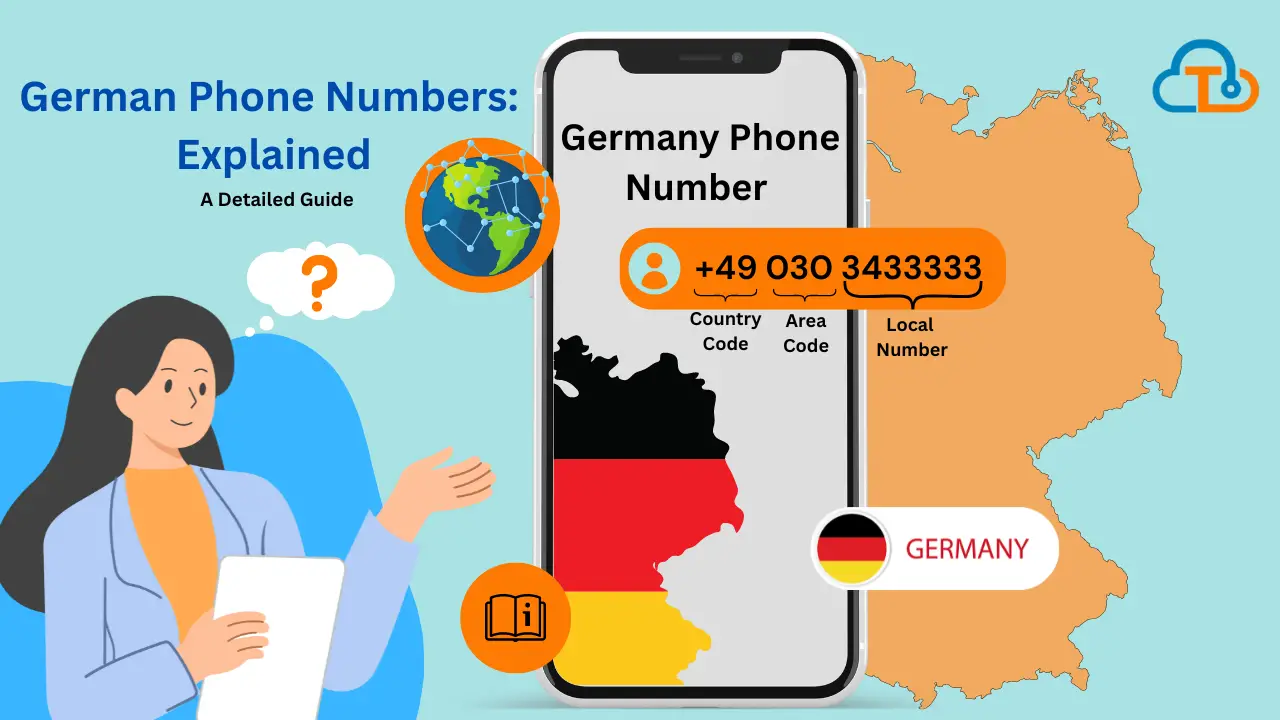
German phone numbers comprise three main components of the German phone number format.
Understanding how each piece works together ensures smooth communication locally and abroad, reducing errors and connection failures.
Breakdown of Different Components
- Country Code (+49): The Country code +49 is required for international calls to connect to the German network.
- Area Code: Identifies the region (e.g., 030 for Berlin). Drop the leading zero when calling internationally.
- Local Number: Unique to the subscriber; unlike fixed formats, these vary significantly in length.
The Country code +49 identifies Germany globally. From abroad, dial your exit code, +49, the area code (dropping the leading zero), and the local number. On mobiles, hold '0' to enter '+', replacing specific exit codes like 00.
Examples of German Phone Number Format
- Calling Berlin from US: 011 49 30 1234567
- Calling Berlin from UK: 00 49 30 1234567
- Calling German mobile from Australia: 0011 49 171 2345678
Area Code
Area codes in Germany (Vorwahl) range from two to five digits. Major cities use shorter codes, while smaller towns have longer ones.
- Berlin: 030
- Hamburg: 040
- Munich: 089
Within Germany, include the leading zero (e.g., 030 1234567). From outside, omit it (e.g., +49 30 1234567).
Local Number
Local numbers follow the Area codes in Germany and are unique to the subscriber. Lengths vary by region. Business lines often use direct dial-in extensions (Durchwahl), allowing callers to reach specific employees via extra digits.
- Berlin: 030 1234567
- Small town: 0400 987654
Understanding the Country Code (+49)
The +49 country code is the designated international dialing prefix for the Federal Republic of Germany as assigned by the International Telecommunication Union (ITU).
It is required to reach any telephone number — landline, mobile, or VoIP service — within Germany from outside the country.
Significance
- International Identification: Identifies Germany globally.
- Standardization: Follows ITU-T E.164 German phone number format rules, ensuring a 15-digit maximum for compatibility.
- Routing & Billing: Ensures calls route correctly and are billed properly.
How to Dial Internationally to Germany
- Dial your exit code (or hold '0' for '+' on mobiles).
- Enter Germany's code: +49.
- Add the area code (omit the leading zero).
- Dial the local number.
Examples
- USA/Canada (Exit 011): 011 49 30 1234567
- UK (Exit 00): 00 49 30 1234567
- Australia (Exit 0011): 0011 49 30 1234567
Pro Tips
- Use VoIP or apps for lower rates.
- Check provider international plans.
- Call during off-peak hours.
Area Codes and Their Importance
Area codes are essential numerical prefixes that assign phone numbers to specific geographic regions, ensuring calls are routed to the correct local network.
They are vital for structuring national telecommunications, determining call rates, and helping users identify the location of a caller.
Major Area Codes
- Berlin: 030
- Hamburg: 040
- Munich: 089
- Cologne: 0221
- Frankfurt: 069
Dialing Within Germany
- Local Calls: Area code may be omitted if calling within the same region.
- National Calls: Area code must be included.
- Mobile Numbers: Always dial the full German phone number with the prefix.
Examples
- Berlin to Munich: 030 1234567
- Within Hamburg: 1234567
- Mobile: 0171 2345678
Local Numbers: Fixed-Line vs. Mobile
Fixed-line numbers are tied to specific geographic regions via local area codes (like 030 for Berlin), establishing a trustworthy local presence.
Conversely, mobile numbers are location-independent, using distinct prefixes like 015, 016, or 017 to provide connectivity anywhere within the national network.
Fixed-Line
- Linked to a location.
- Example: Berlin 030 1234567.
- Cheaper for local calls, offering higher clarity and reliability which is crucial for professional use.
Mobile
- Flexible, not location-based.
- Prefixes: 015, 016, 017.
- Example: 0171 2345678.
- Easily ported between providers to retain contact identity without disruption.
Usage Tips
- Fixed-Line: Businesses should use fixed lines to establish credibility with clients.
- Mobile: Suits on-the-go communication and seamless remote work integration.
Fixed-Line vs. Mobile Number Differences
Fixed-line numbers are ideal for homes, offices, and businesses. They often offer cheaper local call rates and support features like call waiting, making them cost-effective for frequent domestic calls. Mobile numbers, on the other hand, start with prefixes like 015, 016, or 017 followed by a 7–8 digit number — perfect for individuals who need flexibility.
Key Tip: Always dial the full number when calling a mobile, including the prefix.
Special Service Numbers and Their Usage
Special service numbers, such as 0800 (toll-free) and 0900 (premium), facilitate specific non-geographic functions like customer support, voting, and emergency services.
These prefixes dictate the billing structure, which can range from completely free access to higher per-minute rates for value-added content.
- 110: Police emergencies
- 112: Fire and medical emergencies
- 0800: Free calls, e.g., customer service
- 0900: Higher charges for specialized services
- 0180: Cost split between caller and provider
Tips
- Emergency numbers can be dialed directly.
- Toll-free numbers cost nothing.
- Check your charges before calling premium-rate numbers.
How to Recognize and Dial These Numbers
Always include the country code and area code before the local number. This ensures your call connects correctly every time.
Recognizing Special Numbers
- Emergency Numbers: 110 (police), 112 (fire/medical).
- Toll-Free Numbers: Start with 0800, free from landlines and mobile phones.
- Premium/Shared: 0900 incurs higher charges; 0180 splits costs between caller and provider.
Dialing Procedures
- Emergency: Dial 110 or 112 directly; no prefix needed.
- Toll-Free: Dial 0800 + subscriber number (e.g., 0800 1234567).
- Premium-Rate: Dial 0900 + number (charges apply).
- Shared-Cost: Dial 0180 + number (costs shared).
Practical Considerations
- Cost Awareness: Be mindful of premium charges. Toll-free numbers are cost-effective for businesses.
- Service Reliability: Emergency numbers (110/112) are always accessible.
- Usage Scenarios: Use 110/112 for emergencies, 0800 for support, and premium lines for specialized services.
Understanding these German phone number format procedures ensures effective navigation of Germany's telecom system for emergencies and services.
How to Dial Within Germany
To call within Germany, start with the area code followed by the local number. No country code is needed for domestic calls.
Fixed-Line
Include area code with leading zero. Example: Berlin 030 1234567.
Mobile
Dial full number with prefix. Example: 0171 2345678.
Tips
- Verify Area codes in Germany.
- Avoid confusion between mobile prefixes and area codes.
- Save numbers in international format for consistency.
How to Call Germany from Abroad
Start with your country's exit code, then dial Germany's country code +49, followed by the area code and local number. This ensures your international call connects correctly.
Steps for German Phone Number Format
- Dial your country's exit code.
- Add Germany's country code (+49).
- Include area code without leading zero.
- Dial the local number.
Regional Notes
- North America: 011 + 49 + area code + number
- Europe: 00 + 49 + area code + number
- Asia: 00 or local international code + 49 + area code + number
Tips
- Use VoIP or messaging apps to save money.
- Check international calling rates.
- Schedule calls considering time zones.
Calling Germany from Landline vs. Mobile
There's a small difference in how you build the dial string depending on whether you're calling from a landline or a mobile device.
- Landline: Exit code (specific to your region) + country code + area code (without 0) + local number.
- Mobile: +49 + area code (network prefix without the leading zero) + local number.
Tips
- Verify numbers before calling to avoid reaching wrong regions.
- Consider using VoIP for cheaper calls and high-definition audio.
- Off-peak hours reduce call costs.
Common Mistakes and How to Avoid Them
Forgetting the country or area code is a frequent error when dialing. Always double-check the full number format to ensure your call goes through.
- Wrong country code (+49): Often confused with neighbors like +48 (Poland), leading to immediate connection failures.
- Leaving leading zero in Area codes in Germany when dialing internationally: This common error invalidates the number string and blocks the call.
- Confusing mobile prefixes with area codes: Mistakenly expecting lower fixed-line rates.
Solutions
- Double-check all numbers before calling.
- Save numbers in international format (+49).
- Use a contact list or dialer app for accuracy.
Adapting to Modern Changes in Telecommunication
Virtual and VoIP German numbers enable local presence, seamless platform integration, unified communications, IoT connectivity, and secure 2FA verification.
Trends
- VoIP Adoption: Rising due to cost savings, seamless scalability, and flexibility.
- Smart Devices: Now use phone numbers for connectivity to enable autonomous data transmission.
- Security Protocols: Improving to prevent fraud and mitigate sophisticated phishing attacks.
“The +49 country code is the doorway into Germany's telecom system — get the leading zero right and the rest of the format takes care of itself.”
Useful Tools and Resources for Number Verification
Online tools and apps can help verify phone numbers before calling. Using these resources reduces errors and ensures you reach the correct contact.
Recommended Tools
- Twilio, Nexmo, My Country Mobile: Verify formats and activity, and provide robust APIs for automating bulk number validation directly within your CRM or applications.
- Truecaller, NumLookup: Reverse phone lookup.
- Bundesnetzagentur: Official German telecom database offering detailed allocation plans and regulatory guidelines.
Online Resources
- ITU numbering standards
- GSMA global numbering plan
- Forums and telecom communities for expert insights where professionals discuss real-world routing challenges and share data on spam identification.
Conclusion
Understanding the German phone number format is essential for reliable communication. Each number includes the country code (+49), an area code, and a local number.
Fixed-line, mobile, and special service numbers follow different formats. Knowing these differences helps ensure accurate and successful dialing.
Following proper dialing guidelines ensures smooth and cost-effective calls. Special numbers like 110, 112, 0800, 0900, and 0180 require specific procedures.
Modern tools such as VoIP and digital verification improve accuracy. These practices keep communication reliable for personal and business use.


