Introduction
An unknown number calls. You do not recognize it. What happens next defines exactly how useful any reverse phone number lookup tool will be for you — and the answer depends on a variable most guides never mention: what type of number you are looking up.
Reverse phone number lookup is one of the most searched consumer tools on the internet, and most of the content about it is wrong in the same way: it ranks tools without explaining the mechanics that determine whether any tool will work on your specific number.
The reason NumLookup returns a name in four seconds for one number and nothing at all for another is not a bug. It is the inevitable result of how lookup databases are built — and which of five distinct data layers a given number appears in.
This guide covers how reverse phone number lookup actually works at the data level, which tools match which use cases, the best free and paid options in 2026, and the significant regulatory development from 2024 to 2025 that could have transformed the industry — and then didn't.
- What Reverse Phone Number Lookup Actually Is
- The Five Data Layers Behind Every Lookup
- Why Accuracy Varies by Number Type
- Choosing the Right Tool for Your Use Case
- Best Free Reverse Phone Number Lookup Tools
What Reverse Phone Number Lookup Actually Is
A reverse phone number lookup is a query that takes a phone number as input and returns identifying information about the number's owner or registered account — most commonly a name, location, carrier, and line type.
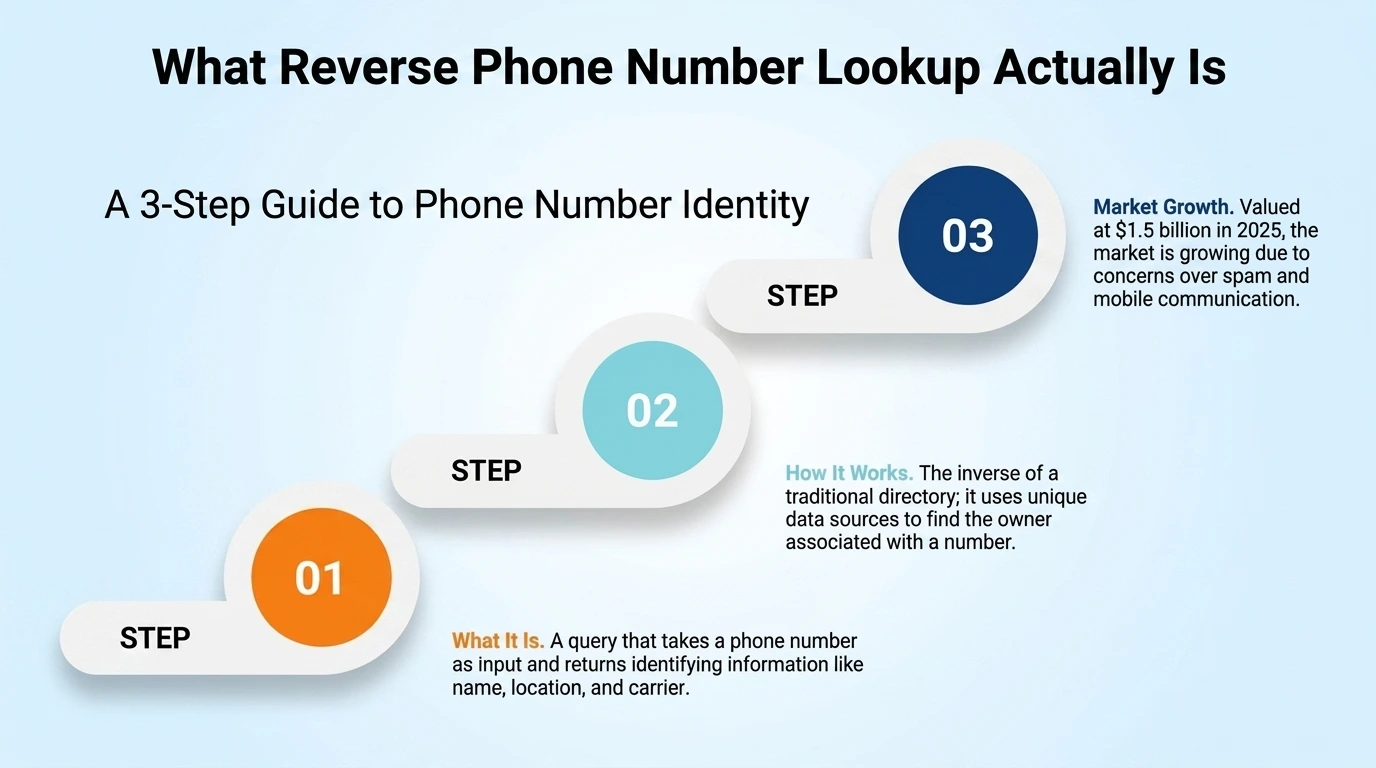
This is the inverse of a traditional directory lookup, which takes a name and returns a number.
The practical challenge of reverse lookup is that traditional directories were designed for the other direction: subscribers registered themselves by name to receive a listing, not by number.
Reverse lookup databases had to be built from scratch using entirely different data sources — a complexity that explains both why some tools work so well and why others return empty results for the same number.
The reverse phone number lookup market reached approximately $1.5 billion in 2025 and is projected to grow at a compound annual rate of 8.9% through 2033, driven by rising consumer concern about spam calls, robocall volume, and the expansion of mobile-first communication globally.
Businesses building an outbound caller-ID presence typically start with dedicated local phone numbers.
The Five Data Layers Behind Every Lookup
When a reverse phone lookup returns results, those results come from some combination of five distinct data layers. Understanding which layers are present — and which your target number appears in — predicts how much information you will get back.
Layer 1 — CNAM (Caller Name) Database: CNAM is the carrier-maintained database that populates caller ID displays. Lookup services that ping CNAM directly get the most current, carrier-verified name data available.
This layer is highly reliable for landlines and inconsistent for mobile, because mobile carriers update CNAM records less frequently.
Layer 2 — Public Records: Voter registration records, property ownership filings, court documents, business registrations, and government databases are public in most US states and are regularly scraped, licensed, and indexed by lookup platforms.
Layer 3 — Licensed Data (Credit Header): Some platforms access credit header data — the name and address fields from credit applications — sold under license from financial data providers. Its use is tightly regulated under the FCRA.
Layer 4 — Social Media Aggregation: Spokeo and similar platforms index over 100 social networks for phone numbers that users have attached to public profiles.
When a number appears in a Facebook profile, LinkedIn contact record, or business directory listing, it enters this layer.
Layer 5 — Crowdsourced Community Data: Truecaller's database is built from the contact books of over 400 million registered users in 190+ countries.
This layer excels at mobile numbers and international numbers that never appear in carrier or public record databases.
Why Accuracy Varies by Number Type
The five-layer model explains the accuracy gap between number types that most lookup guides never address:
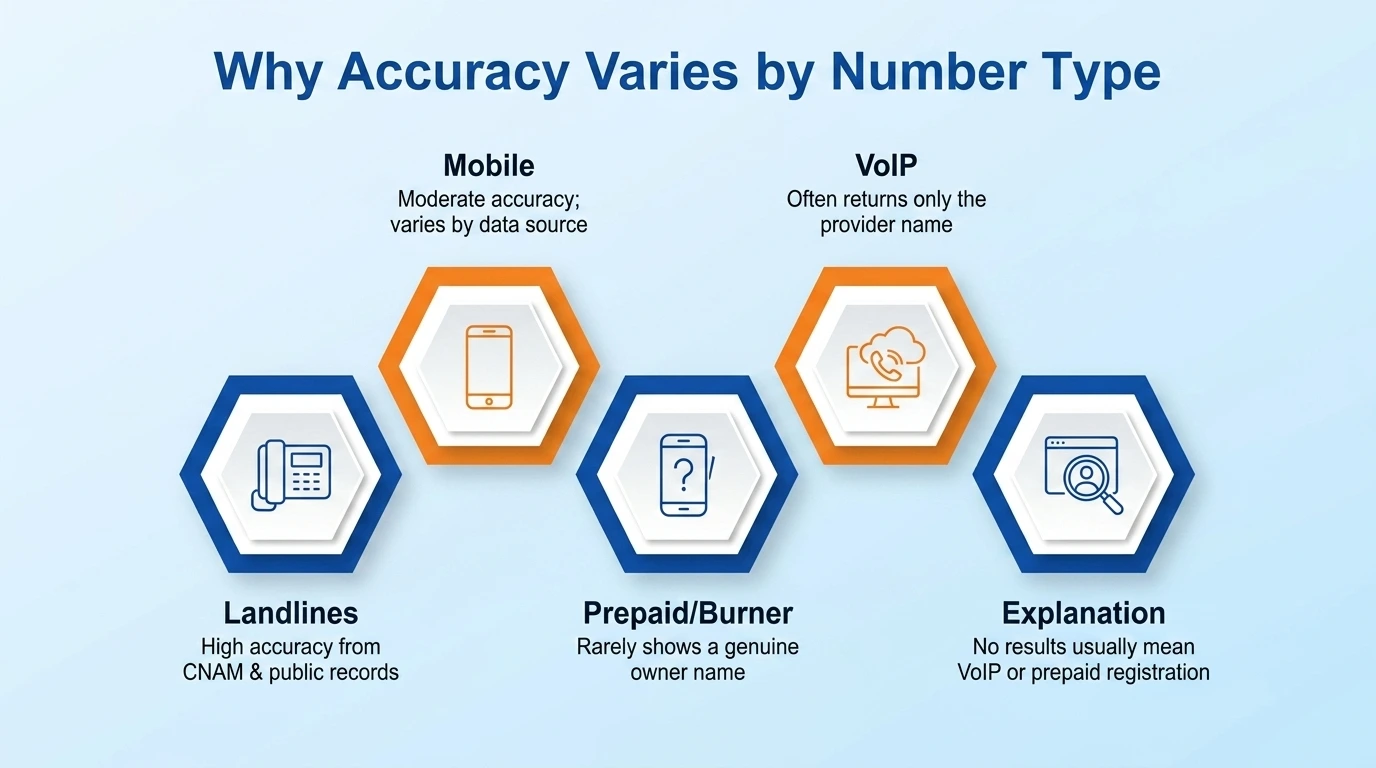
Landlines typically appear in CNAM, public records, and sometimes credit header data. Three strong layers pointing at the same registered subscriber produces high accuracy — most free tools return correct names for landlines in seconds.
Registered mobile numbers appear in CNAM (inconsistently), sometimes in social media if the owner listed the number publicly, and in crowdsourced data if enough people have the number saved.
Accuracy is moderate and varies by tool's data sourcing emphasis.
VoIP numbers — assigned by providers like Google Voice, Twilio, or Vonage — often have no CNAM record and no public-records footprint. Most free tools return only the provider name (Google Voice, Twilio) with no personal owner data.
Prepaid and burner numbers are registered with minimal or no verified identity in most US states. They rarely appear in any of the five layers with a genuine owner name.
If a number returns no results across multiple tools, prepaid or VoIP registration is the most common explanation.
For background on how these lookup databases are structured, see Wikipedia's entry on the reverse telephone directory.
Choosing the Right Tool for Your Use Case
The "best" reverse phone number lookup tool depends entirely on what you are trying to accomplish. Treating the category as a single ranked list causes most people to use the wrong tool for their actual need.
Personal caller ID and unknown call identification — Use NumLookup (no account required, returns carrier-verified name and line type for US numbers in seconds) or Truecaller (crowdsourced global database, best for mobile and international numbers).
Both are completely free.
Spam and fraud detection — Use IPQualityScore, which connects directly to carrier network backbones rather than aggregating public records. It returns real-time spam scores, line type, and risk indicators.
Full background research on an individual — Use Spokeo (60+ billion records, 100+ social networks), BeenVerified, or TruthFinder. These return address history, associated relatives, linked social accounts, and court records.
For businesses handling inbound call volume: The verification problem runs in a different direction — your callers are looking up your number before answering.
For inbound caller verification at scale, Teloz's cloud contact center platform integrates STIR/SHAKEN caller authentication, spam risk scoring, and CRM-connected call logging — turning every incoming number from a question mark into a verified, documented interaction.
See the full platform at teloz.com. Pair that with AI-driven routing to automatically direct verified callers to the right team based on their identity and history.
Best Free Reverse Phone Number Lookup Tools
NumLookup — The strongest completely free option for US numbers. No account, no credit card, no sign-up barrier.
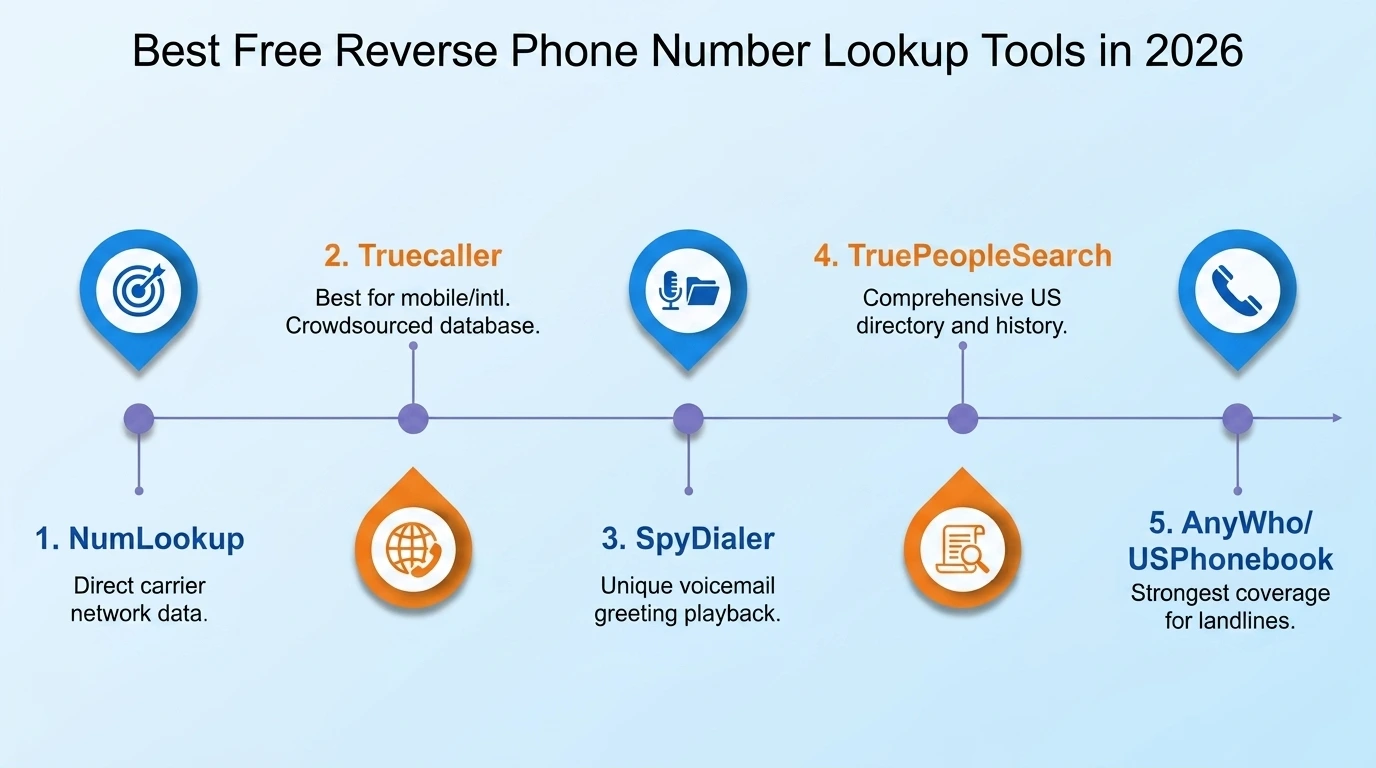
Enter a number and receive the owner's name, carrier, and line type in under five seconds. Queries carrier network data directly, making it more current than tools relying solely on static directory aggregations.
Truecaller — Best free option for mobile and international numbers. The 400-million-user crowdsourced database covers numbers that CNAM and public records miss entirely, particularly newer mobile registrations and numbers outside the US.
Also provides real-time caller ID on Android and iOS.
SpyDialer — Unique capability: plays back the voicemail greeting recorded on the number being searched, providing audio confirmation of ownership without placing a call or leaving a trace. Returns name, carrier, and line type alongside the audio.
Entirely free, no account required.
TruePeopleSearch — Comprehensive free people-search directory returning name, address history, and associated relatives for most US registrations.
AnyWho and USPhonebook — Traditional white-pages-style directories with strongest coverage for landlines and older mobile registrations. Useful as secondary checks when primary tools return limited data.
Best Paid Reverse Lookup Platforms
Spokeo — The most complete paid consumer reverse lookup. Builds a full profile from a phone number using 60+ billion public and open-source records across addresses, social accounts, court records, and historical data.
Subscription pricing makes it cost-effective for anyone performing more than occasional lookups.
BeenVerified and TruthFinder — Comprehensive background-check-style reports including criminal records, bankruptcy filings, and property records linked to the number's registered owner. Both use subscription models rather than per-report pricing.
Searchbug — Offers per-search pricing at $1.95 per successful result, with bulk API access starting lower for high-volume clients. The per-search model suits businesses needing occasional verified lookups without a subscription commitment.
Cognism and UpLead (B2B) — For business contact verification rather than consumer reverse lookup.
Cognism claims 98% data accuracy; UpLead offers a 95% accuracy guarantee with real-time email and phone verification at query time — not cached results that may be months old.
“Learn how reverse phone number lookup works — the data layers behind every search, the best free and paid tools available, and what the CFPB withdrawal means.”
Legal and Privacy Framework: What Changed
Reverse phone number lookup sits at the intersection of two federal statutes: the FCRA (Fair Credit Reporting Act) and the TCPA (Telephone Consumer Protection Act).
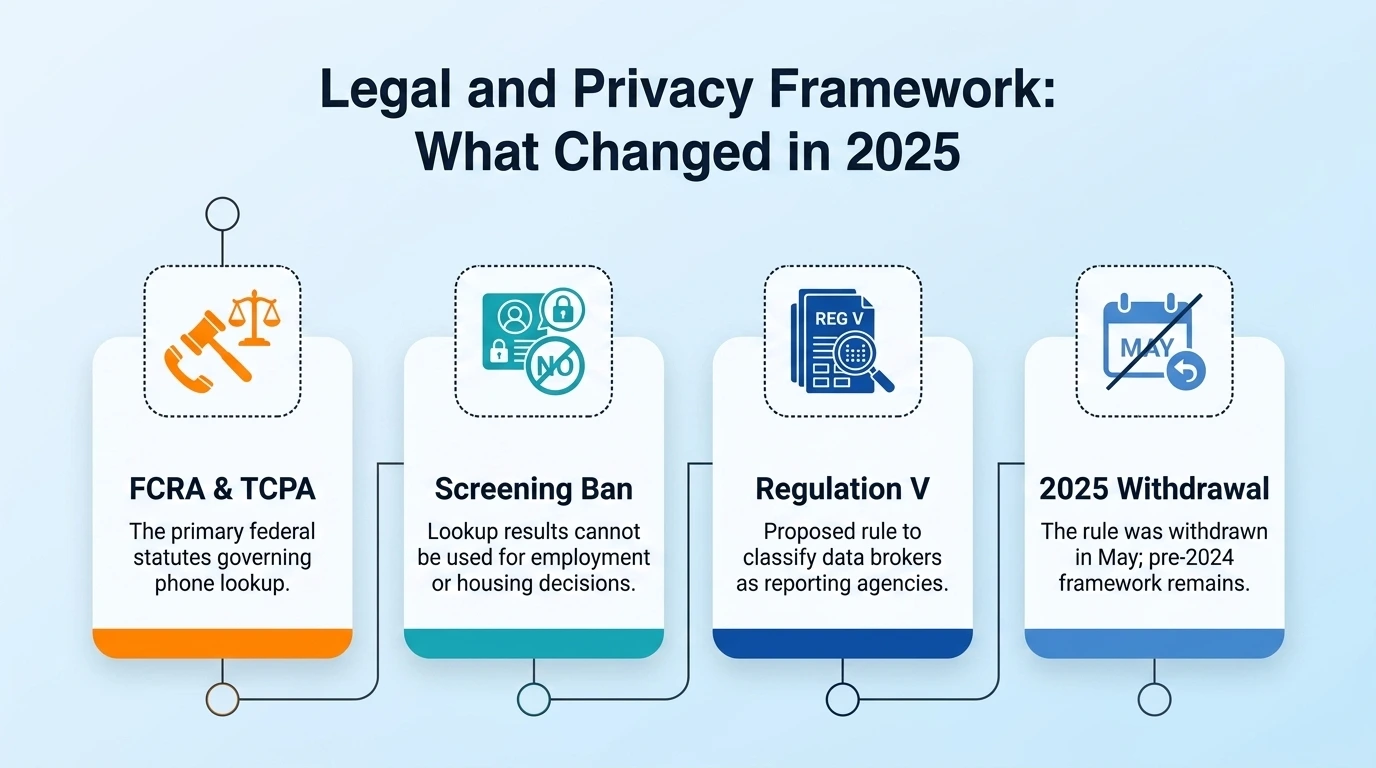
FCRA prohibits using lookup results for employment screening, housing decisions, or credit assessments unless sourced from an FCRA-certified consumer reporting agency.
Consumer reverse lookup tools — Spokeo, BeenVerified, TruthFinder — are explicitly not FCRA-certified for these permissible purposes. Using their results for hiring decisions violates the statute regardless of the information's accuracy.
The CFPB's Proposed Regulation V (December 2024) would have significantly expanded FCRA coverage over data brokers.
The rule proposed that companies selling personal identifiers — including phone numbers — collected to prepare consumer reports would be classified as consumer reporting agencies subject to full FCRA oversight.
Had it passed, most reverse lookup platforms would have faced new consent, accuracy, and dispute-resolution obligations.
Withdrawal (May 2025): The CFPB withdrew the proposed rule on May 15, 2025, citing concerns raised by commenters regarding the rule's alignment with existing FCRA statutory authority.
The reverse phone lookup industry continues to operate under the pre-2024 regulatory framework. Consumers who want phone numbers removed from data broker databases must currently opt out with each aggregator individually.
Businesses needing verified caller ID across regions often rely on virtual phone numbers instead.
Conclusion
Reverse phone number lookup is not a single technology — it is a query across up to five distinct data layers, each with different coverage by number type.
Understanding that stack explains why the same tool returns a full name for one number and nothing for another, and why matching the right tool to your specific use case matters more than any ranked list.
For personal caller ID, NumLookup and Truecaller cover most use cases for free. For full background research, Spokeo and BeenVerified go deeper. For B2B contact verification, Cognism and UpLead provide accuracy guarantees that consumer tools cannot match.
For businesses handling inbound call volume, Teloz's cloud contact center platform integrates STIR/SHAKEN caller authentication, spam risk scoring, and CRM-connected call logging — turning every incoming number from a question mark into a verified, documented interaction.
See the full platform at teloz.com.


