Introduction
Every wholesale voice provider claims global reach, competitive rates, and reliable quality. Almost none of them differ meaningfully on paper.
This guide skips the basics — how wholesale voice termination actually works is covered in full there — and focuses on the part buyers actually struggle with: telling providers apart, vetting them properly, and knowing which named players fit which traffic profile.
Teloz has operated as a wholesale voice and cloud contact center provider since 2005.
This guide covers the provider landscape, a practical vetting checklist, and the compliance posture that separates a serious operator from a reseller with a rebranded dashboard.
- The provider landscape: Tier 1, Tier 2, Tier 3, and VoIP-focused cloud platforms
- How to choose the right provider — a practical five-criteria checklist
- Core services and advanced features to compare across shortlisted providers
- Where the market is heading — trends shaping wholesale voice through 2026
- A named look at leading providers, from Tier-1 carriers to cloud-native platforms
- Security, compliance, and STIR/SHAKEN requirements for US businesses
Understanding the Types of Wholesale Providers
The wholesale voice providers market has several provider categories. Each one is built to meet specific business needs. These categories offer different levels of network ownership, pricing flexibility, service quality, and geographic coverage.
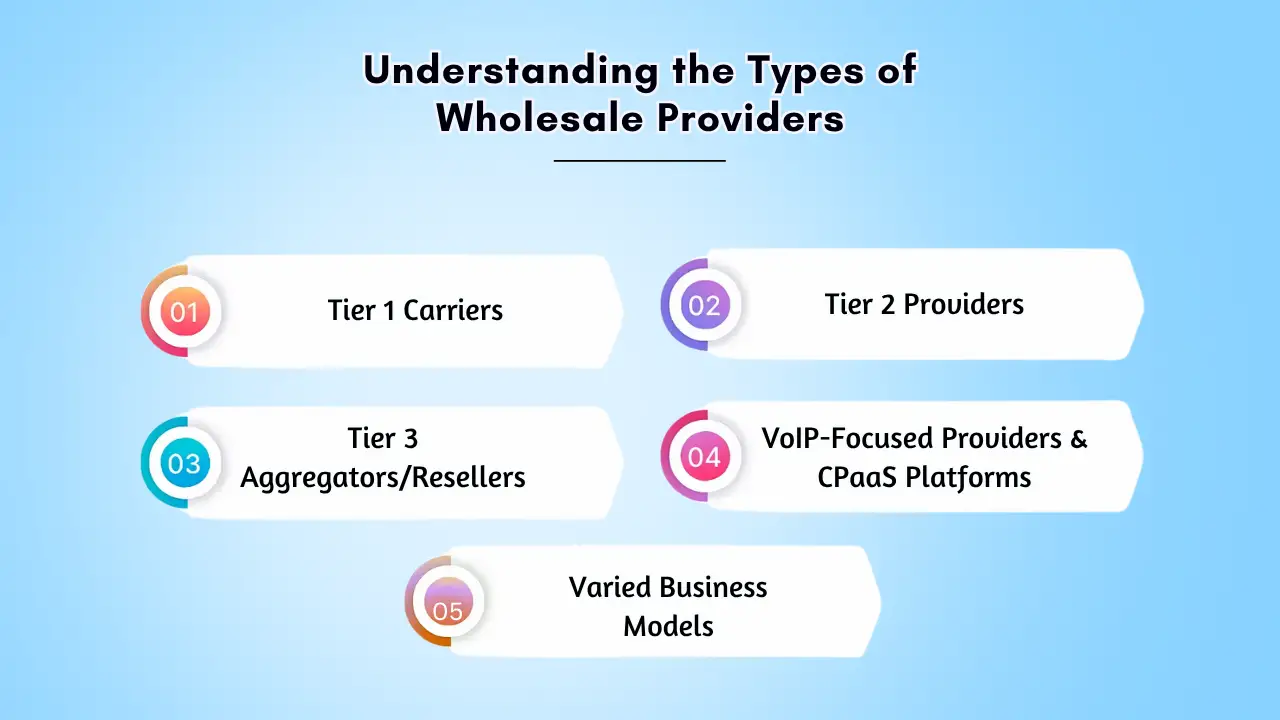
- Tier 1 Carriers — own and operate extensive global networks. They interconnect directly with other Tier-1 carriers and control major international routes. Serve large carriers and multinational enterprises requiring maximum capacity and reliability.
- Tier 2 Providers — own some network infrastructure but also lease capacity from Tier-1 carriers. Balance quality, coverage, and cost. Serve regional carriers and enterprises seeking competitive pricing without sacrificing reliability.
- Tier 3 Aggregators and Resellers — focus on aggregating routes from multiple upstream carriers, optimizing pricing for specific destinations. Popular with smaller VoIP companies and startups.
- VoIP-Focused Providers and Cloud Platforms — specialize in VoIP and cloud communication, delivering APIs, analytics, and automation tools. Teloz sits in this category, combining wholesale voice capacity with AI-powered NLP routing and real-time analytics in a fully hosted cloud contact center. Founded in 2005, Teloz brings telecom infrastructure expertise to a cloud-native platform.
Key Advantages of Using Wholesale Voice Services
Wholesale voice provider services offer several advantages for businesses. These include better communication efficiency, lower operational costs, more scalability, and wider global reach.
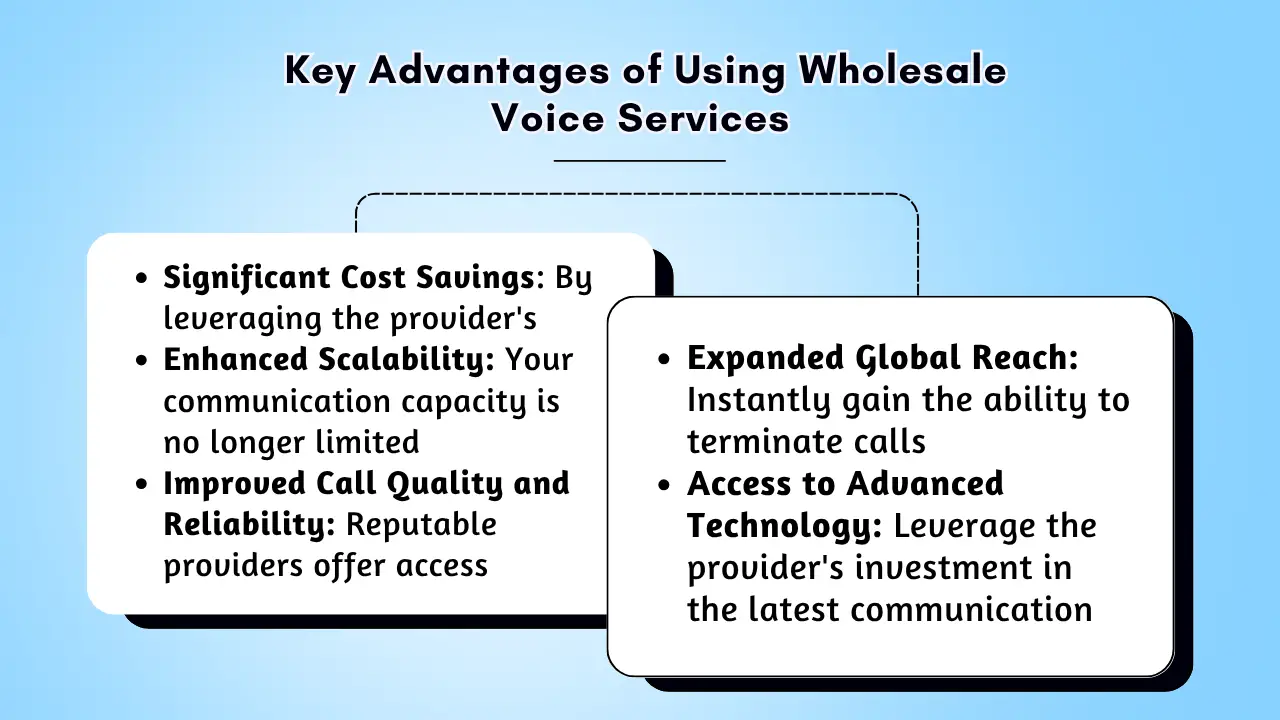
Providers also deliver reliable call quality without a heavy investment in network infrastructure.
- Significant Cost Savings — bulk pricing reduces per-minute calling costs, particularly for international destinations. US businesses processing millions of minutes per month see cost reductions that compound significantly over time.
- Enhanced Scalability — businesses add call capacity without procuring hardware or building infrastructure. Volume scales up or down based on demand with no procurement lead times and no stranded assets.
- Improved Call Quality and Reliability — intelligent routing and built-in redundancy maintain consistent quality across fluctuating traffic volumes. Real-time monitoring catches quality issues before they affect customer experience.
- Expanded Global Reach — wholesale networks support reliable calling to international destinations, including US-to-US high-volume traffic and cross-border enterprise communication.
- Access to Advanced Technology — quality providers invest in analytics, automation, and fraud prevention tools. Teloz adds NLP and machine learning-powered routing, AI self-service capabilities, and real-time analytics dashboards — capabilities that would cost significantly more to build independently.
How to Choose the Right Wholesale VoIP Provider: A Checklist
Selecting the right wholesale voice provider means careful evaluation across five criteria.
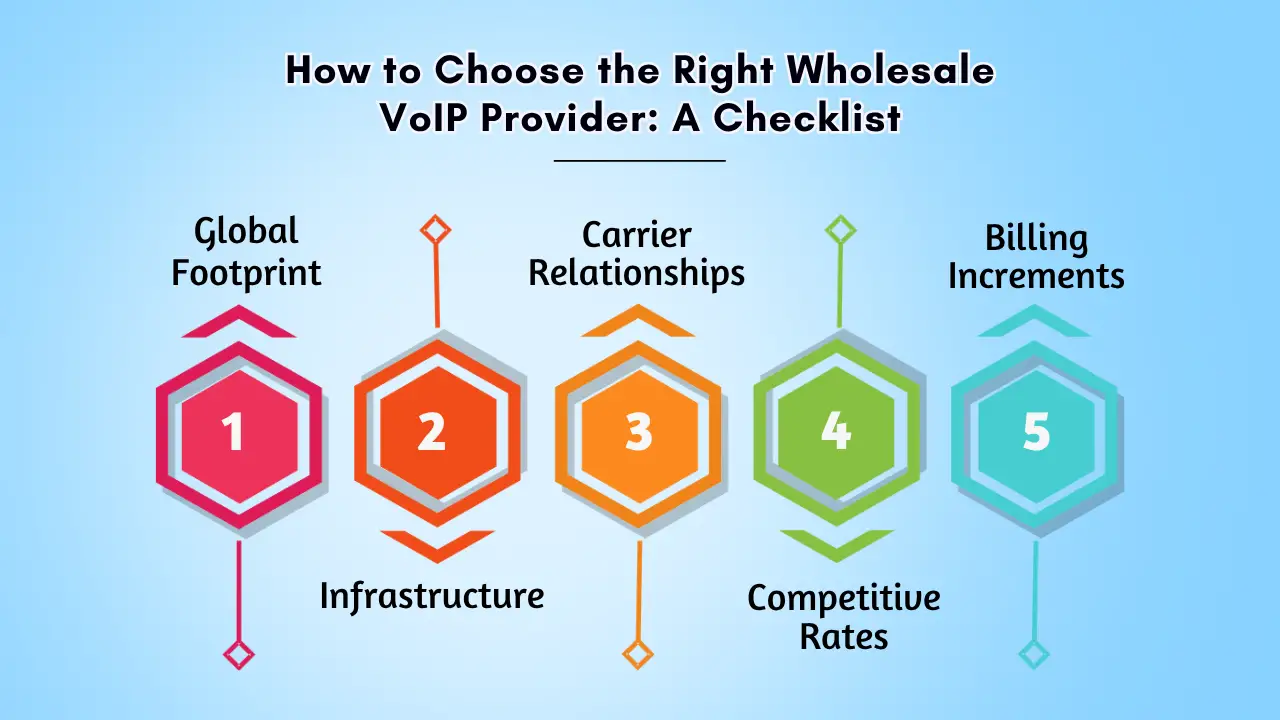
- A. Network Quality, Coverage, and Reliability — consistent coverage across key US regions and international destinations, backup network infrastructure for outage protection, clear SLAs defining uptime commitments, and direct carrier connections for better quality and routing efficiency.
- B. Flexibility, Scalability, and Customization — flexible service configurations for different traffic types (inbound, outbound, international), easy capacity scaling as call volumes change, and month-to-month contract options without long-term lock-in.
- C. Pricing, Billing, and Transparency — competitive per-minute rates with volume-based tier pricing, per-second billing for accurate cost tracking, and no hidden fees with transparent itemized billing and full CDR access.
- D. Features and Technology — SIP trunking and DID (virtual number) services, real-time analytics and reporting dashboards, voice APIs for programmatic integration, and fraud protection with STIR/SHAKEN compliance for US traffic.
- E. Customer Support — 24/7 technical support availability, fast response times (not just ticket queues), and experienced telecom teams who understand carrier-grade voice infrastructure.
Core Services and Advanced Features in Wholesale VoIP
Wholesale voice providers deliver a wide range of communication services. These include call routing, termination, numbering solutions, and scalable connectivity.
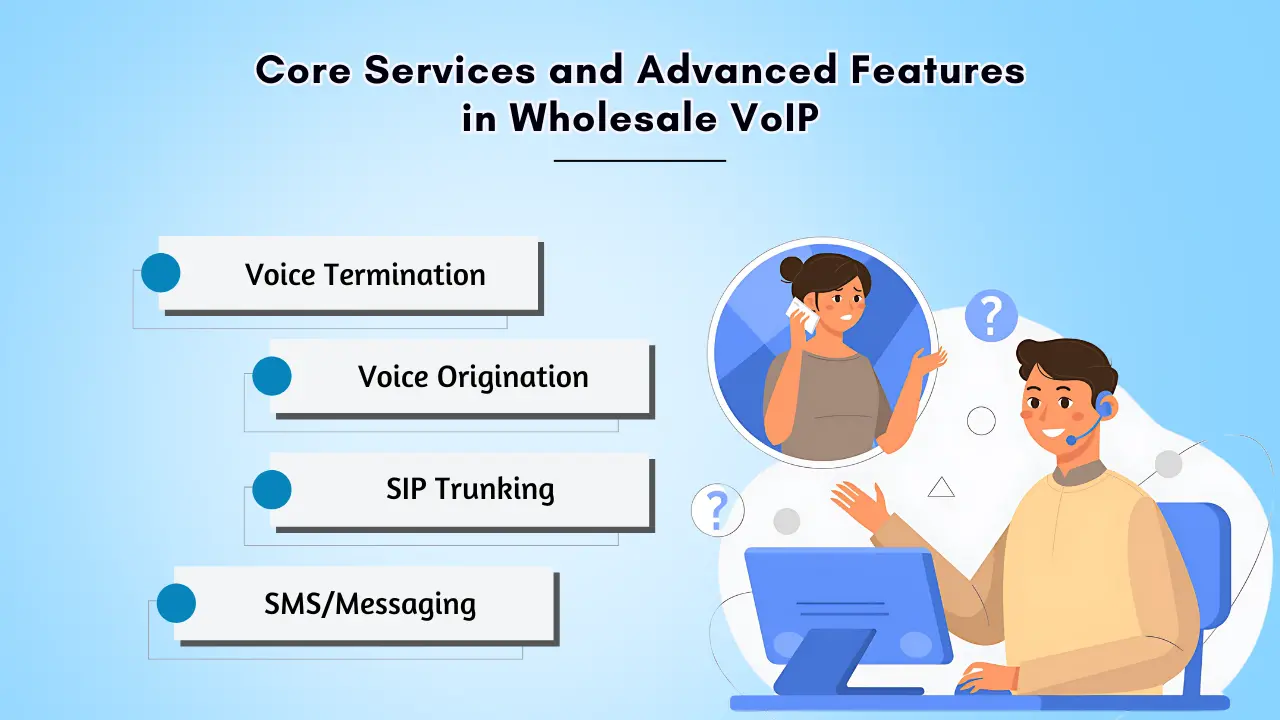
Teloz combines wholesale voice with a full AI-powered cloud contact center. It includes NLP-driven routing, machine learning for call distribution, real-time supervisor dashboards, and 100+ app integrations.
US businesses get wholesale voice capacity and contact center software in one platform, with no hardware required. Founded in 2005, Teloz brings 20 years of telecom infrastructure knowledge to every deployment.
- Core: Voice termination — CLI and Non-CLI routes for outbound call delivery
- Core: Voice origination — inbound call handling from any destination
- Core: Local and toll-free numbers (DIDs) for geographic presence
- Core: SIP trunking — IP-based connectivity replacing traditional phone lines
- Advanced: Custom routing rules and LCR configuration for cost optimization
- Advanced: Real-time analytics dashboards for traffic visibility and quality monitoring
- Advanced: Voice APIs for programmatic call management and integration
- Advanced: Cloud PBX solutions and A2P SMS messaging at scale
The Evolving Market: Wholesale Voice Trends & Predictions
The wholesale voice providers industry keeps evolving. Businesses are adopting cloud technologies, shifting toward VoIP solutions, and demanding stronger security. They also want more flexible, scalable, and cost-efficient communication services.
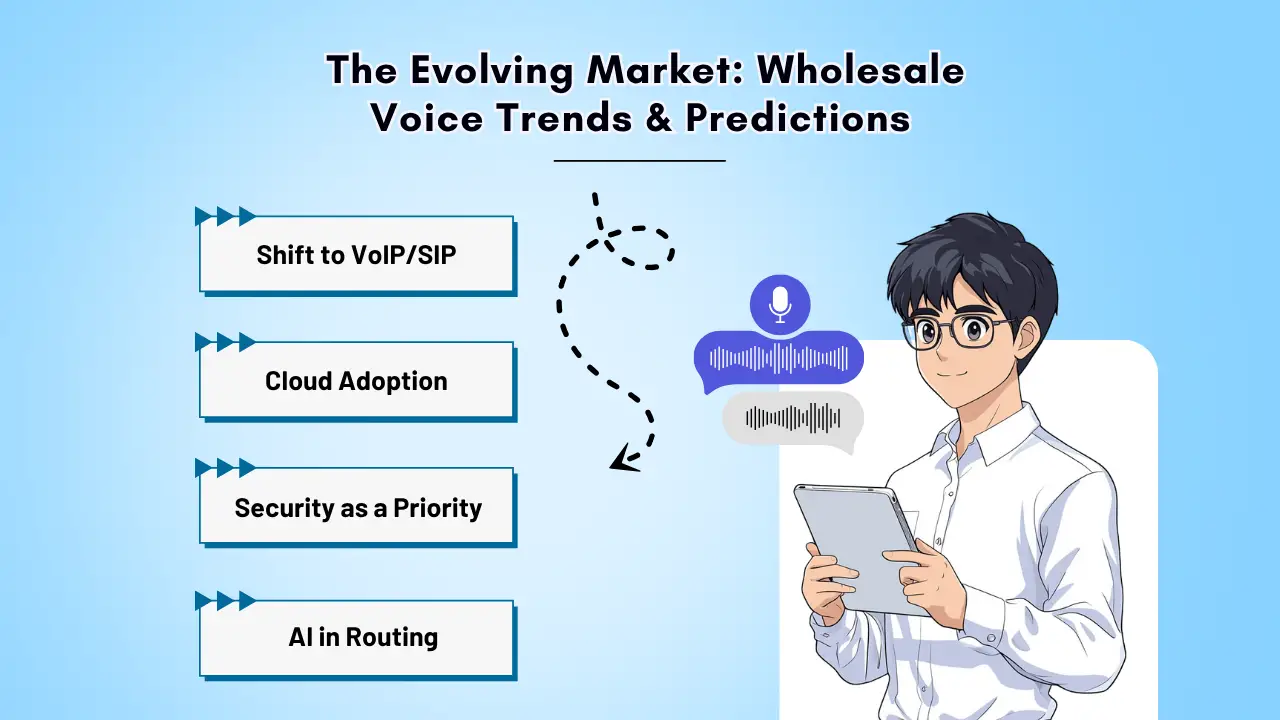
Current Trends.
- Shift from legacy TDM/PSTN to VoIP across US carriers
- Increased cloud contact center adoption replacing on-premise systems
- Stronger security focus — STIR/SHAKEN enforcement and fraud detection requirements
- AI-driven routing reducing manual configuration and improving quality
- Future: Deeper UCaaS and CCaaS integration with wholesale voice capacity
- Future: Growth of CPaaS platforms building voice capabilities via API
- Future: AI-powered voice intelligence for proactive fraud detection and route optimization
- Future: Per-second billing becoming the standard as transparency demands increase
A Glance at Leading Wholesale Voice Providers
The wholesale voice market includes many providers with different strengths. These range from Tier-1 carriers with global network ownership to cloud-native platforms built for API-driven voice.
Knowing where each provider sits in the stack helps businesses match their traffic profile to the right supplier.
Teloz operates as a VoIP and API-driven cloud communication platform with wholesale voice capacity and a full contact center stack. MyCountryMobile offers a full range of wholesale VoIP solutions for carriers and resellers.
Twilio focuses on CPaaS and developer-facing APIs for programmatic voice. Verizon Partner Solutions and AT&T Wholesale run Tier-1 global networks built for high-capacity international traffic.
Choosing the right provider depends on your priorities: flexibility, coverage, or integration capabilities.
“Wholesale voice services make global communication viable for businesses that cannot justify retail pricing at scale.”
The Critical Role of Security and Compliance
Security and compliance are critical in wholesale voice operations. They ensure data protection, regulatory compliance, and reliable global communication. Providers holding ISO 27001 and SOC 2 certifications show a formal commitment to security management.
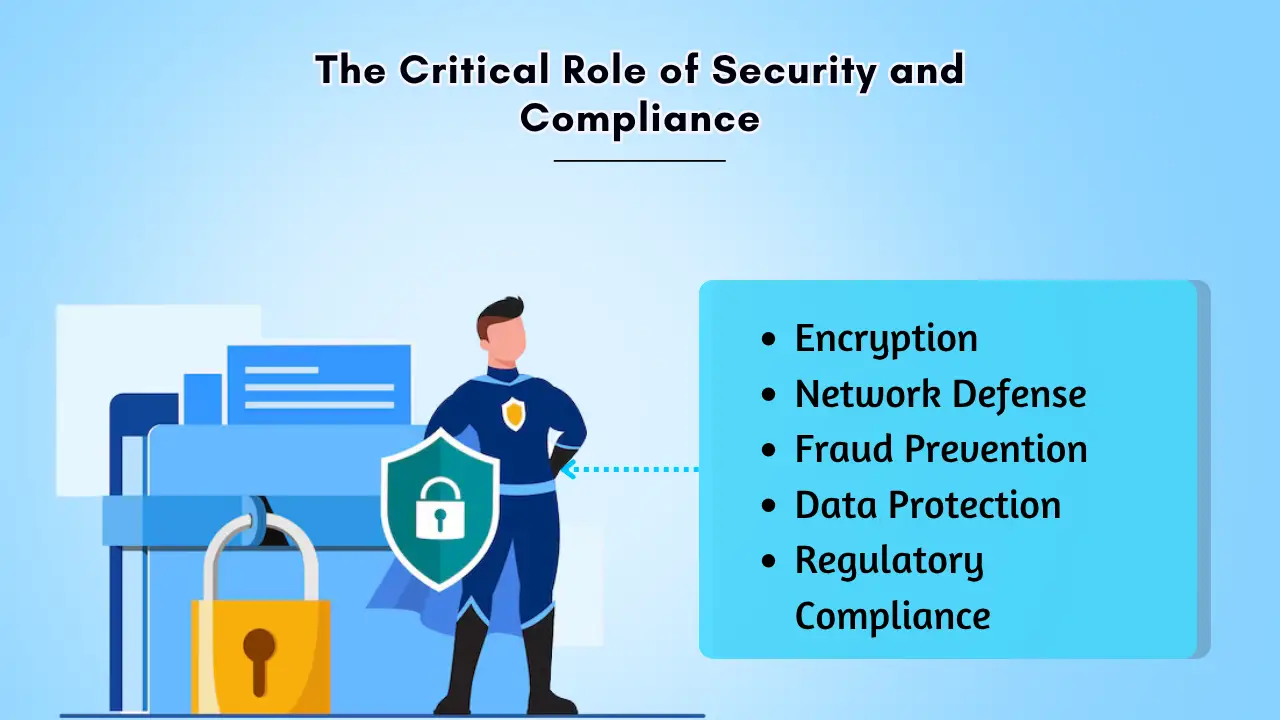
Essential Security Measures.
- TLS and SRTP encryption for call signaling and media protection
- Firewalls and SIP-aware intrusion prevention systems blocking malicious traffic
- Real-time fraud detection for unusual traffic patterns (toll fraud, SIM swap attacks)
- STIR/SHAKEN — FCC-mandated caller ID authentication to prevent spoofing on US IP networks. Providers that cannot fully implement must register with the Robocall Mitigation Database (RMD).
- CALEA — Communications Assistance for Law Enforcement Act lawful intercept capability required for US voice providers
- CPNI — Customer Proprietary Network Information protections required under FCC rules
- GDPR compliance for data privacy on EU-bound traffic
- HIPAA considerations for healthcare communication use cases
Conclusion
Wholesale voice services make global communication possible for businesses that cannot afford retail pricing at scale. The right provider delivers scalability, reliability, and cost efficiency.
It turns voice infrastructure into a business advantage instead of a cost center.
Choosing a provider means checking network quality, pricing transparency, route options, compliance posture, and support depth. For US businesses, STIR/SHAKEN compliance and FCC registration are non-negotiable.
Teloz has operated in this space since 2005, bringing 20 years of telecom network expertise through a cloud-native platform. The platform delivers wholesale voice, AI-powered contact center routing, and NLP-driven automation.
It adds real-time analytics and 100+ integrations, with no hardware, no hidden fees, and no long-term contracts.


