Introduction
Roughly 470 billion minutes of international voice traffic crisscross carrier networks every year, and almost none of it lands on its destination without passing through a wholesale voice termination layer.
What's changing is who relies on that layer and how it operates: AI-driven routing, an all-IP core, and a buyer base that now stretches far past traditional carriers.
For the mechanics of how a call actually travels from origination to termination, see our technical breakdown — this guide focuses on the part that changes year over year: who is actually buying wholesale voice termination today, and where AI, IP, and RCS are taking the market next.
- The full buyer landscape — resellers, contact centers, MVNOs, CPaaS, and more
- How AI, an all-IP core, and RCS are reshaping wholesale termination this decade
- What separates retail voice from the wholesale termination layer
- The quality and security baseline every serious carrier should meet
- How to choose a wholesale voice termination partner built for what's next
What Is Wholesale Voice Termination?
Wholesale voice termination is the carrier-to-carrier service that delivers a voice call from the originating network to the final destination network, where it rings the dialed phone.
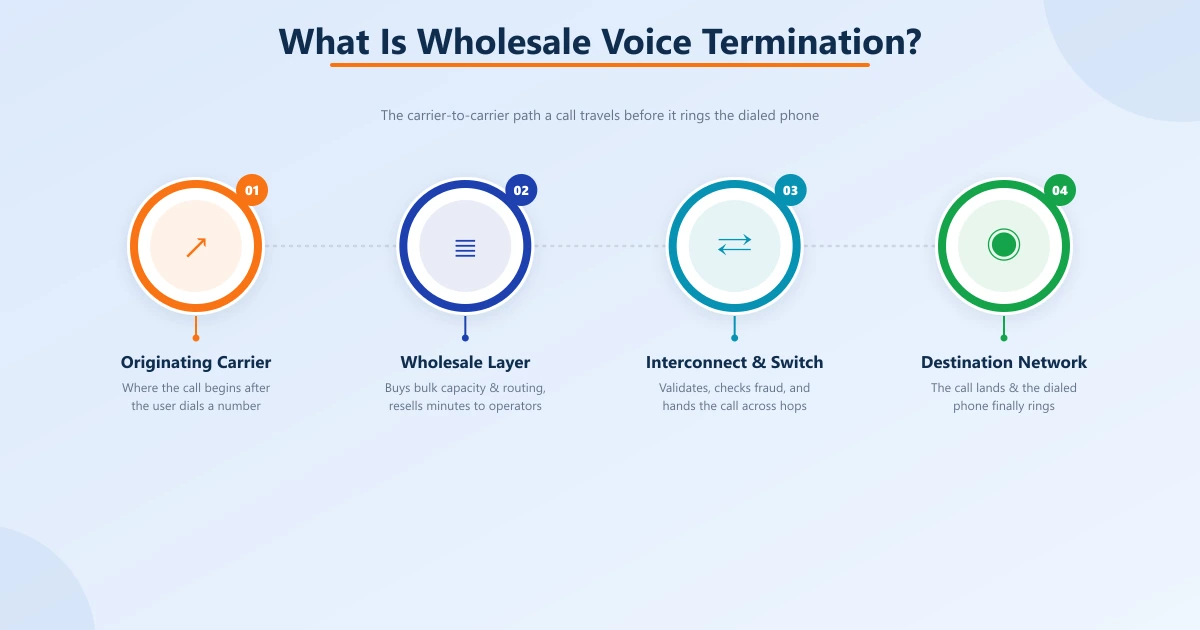
Unlike retail voice services, which sell minutes directly to end users, wholesale termination sells capacity and routing to other telecom operators — a reseller in Texas might purchase millions of minutes of A-Z termination from a global wholesaler, then resell those minutes to small businesses through a hosted PBX product.
The end caller never knows the wholesaler exists, but the wholesaler is the reason the call connects in the first place.
Who Relies on Wholesale Voice Termination Services
The buyer base for wholesale voice termination is broader than most outsiders realize. Resellers and ITSPs purchase A-Z minutes to power their hosted PBX, SIP trunking, and UCaaS products.
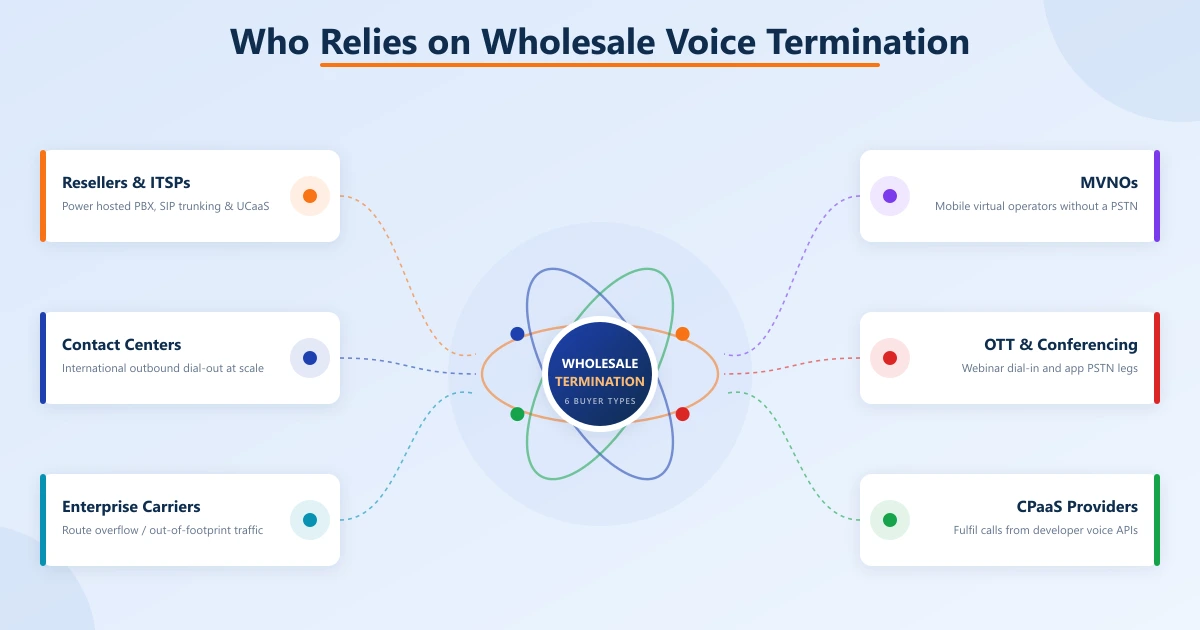
Contact centers rely on it for outbound campaigns, especially those running international dial-out across dozens of markets.
Enterprise carriers route overflow or out-of-footprint traffic through wholesale partners rather than building their own interconnects worldwide.
Mobile virtual network operators (MVNOs), OTT communication apps, and even conferencing platforms all consume wholesale voice termination behind the scenes.
Every time someone joins a webinar by dialing in, a wholesale carrier is likely delivering that PSTN leg.
CPaaS providers that expose voice APIs to developers also depend on wholesale carriers to fulfill the calls those APIs initiate.
The common thread: any organization that needs to deliver voice calls without owning a global PSTN footprint relies on a wholesale termination layer to do the heavy lifting.
Quality and Security Baseline: What Any Serious Partner Should Meet
A serious call termination provider publishes ASR, ACD, PDD, and MOS in real time and treats fraud monitoring as a hard requirement, not an add-on — our technical guide to VoIP termination walks through each of those KPIs, plus the CLI-versus-non-CLI tradeoff, in depth.
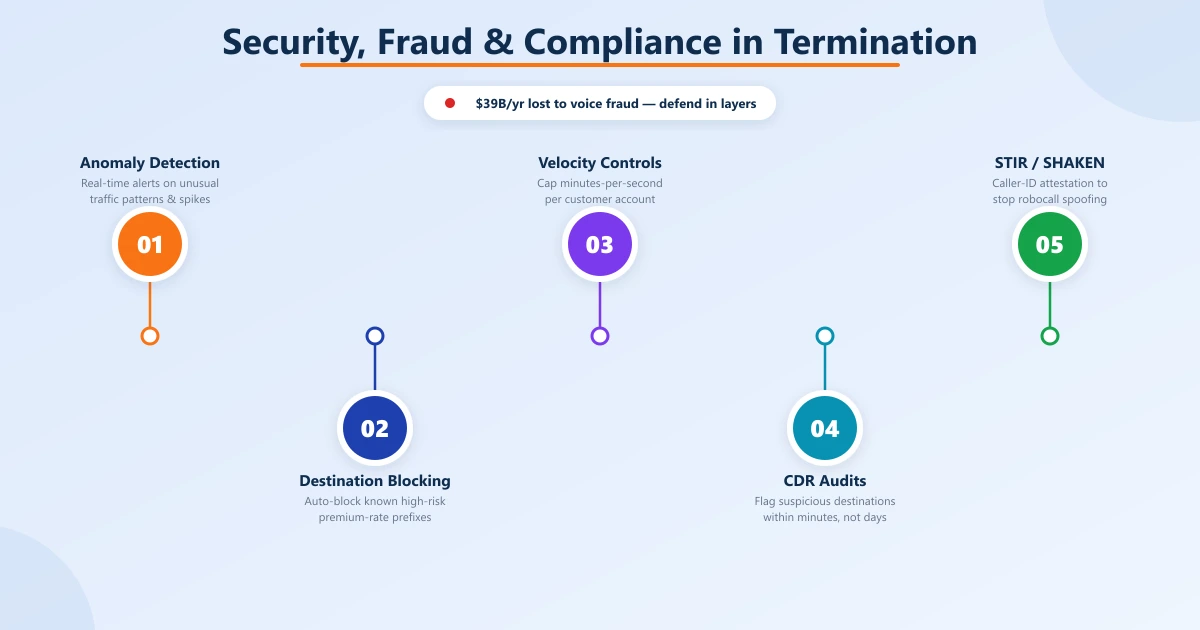
On the security side, voice termination fraud costs the industry an estimated $39 billion a year, chiefly through International Revenue Share Fraud (IRSF) and PBX hacking, so layered defenses — anomaly detection, destination blocking, velocity controls, and STIR/SHAKEN attestation on US-bound traffic — are baseline expectations, not differentiators.
The Future of Wholesale Voice Termination: AI, IP, and Beyond
Wholesale voice termination is undergoing its quietest revolution in 20 years. Legacy TDM circuits are nearly gone — almost all major routes now run on IP from end to end, which lowers cost and unlocks features like dynamic codec switching and HD voice.
AI is reshaping routing decisions: machine learning models predict route degradation before it shows up in CDRs and reroute traffic proactively to protect ASR and MOS.
Fraud detection has moved from rule-based to AI-driven, catching patterns that human analysts would miss.
The rise of Rich Communication Services (RCS) and WebRTC is also blurring the line between traditional voice termination and modern messaging-plus-voice flows.
Teloz, founded in 2005, has watched this market shift from analog gateways to cloud-native softswitches, and the next decade will favor providers that pair deep interconnect coverage with AI-driven quality control.
The carriers winning today are the ones investing in data, not just minutes.
- Legacy TDM is nearly gone — almost all major routes now run IP end to end
- AI models predict route degradation before it shows up in a CDR
- Fraud detection has shifted from rule-based to AI-driven pattern matching
- RCS and WebRTC are blurring the line between voice termination and messaging
- The next decade favors carriers that pair interconnect depth with AI-driven quality control
“The buyers who treat wholesale voice termination as a strategic capability — not a commodity buy — build durable margins, fewer customer complaints, and stronger trust with their downstream users.”
Choosing the Right Wholesale Voice Termination Partner
Selecting a wholesale partner is less about who offers the lowest spot price and more about who can sustain quality, support, and security across years of growing volume — see our full provider vetting checklist for the criteria to run every shortlist candidate through.
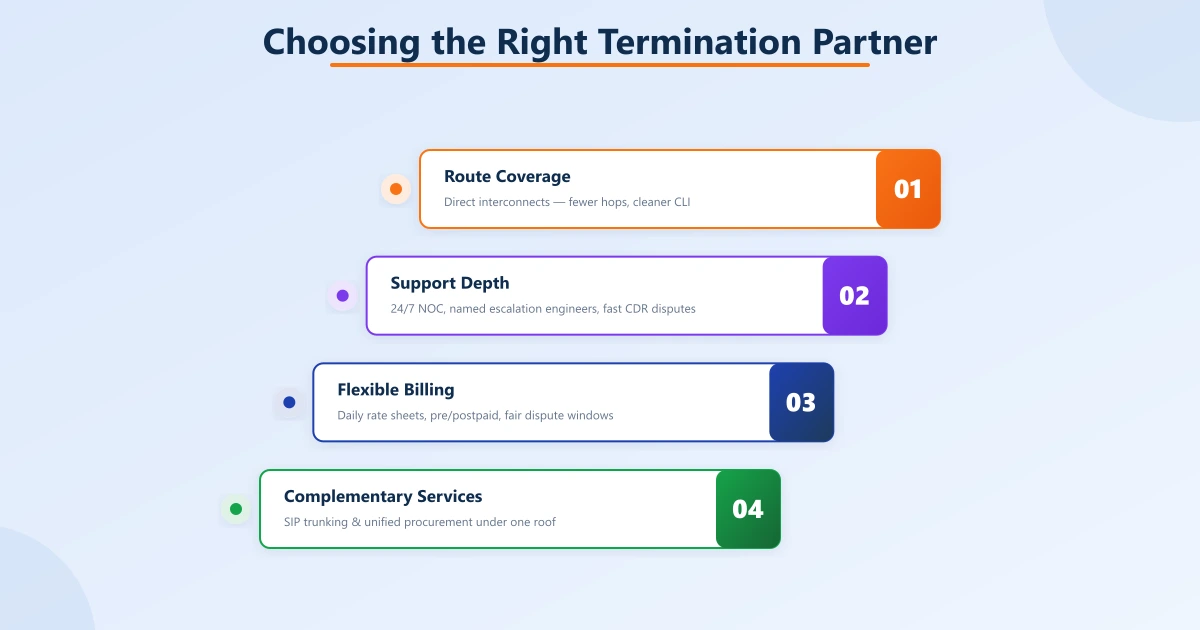
At minimum, start with route coverage: does the provider offer direct interconnects in your top destinations, or are they reselling through third parties? Direct interconnects mean fewer hops, lower latency, and cleaner CLI preservation.
Teloz brings wholesale and retail voice services under one roof, helping buyers reduce vendor count while gaining deeper service integration. The best partnerships are the ones that grow with you — not the cheapest invoice this month.
Conclusion
Wholesale voice termination is the invisible infrastructure behind every international business call, every conference dial-in, and every contact center outbound campaign.
Focus on quality metrics, security posture, route coverage, and complementary services rather than chasing the cheapest rate sheet. The right wholesale voice termination partner becomes part of your platform, not just a vendor.
Explore how Teloz powers global voice delivery at teloz.com.


