Introduction
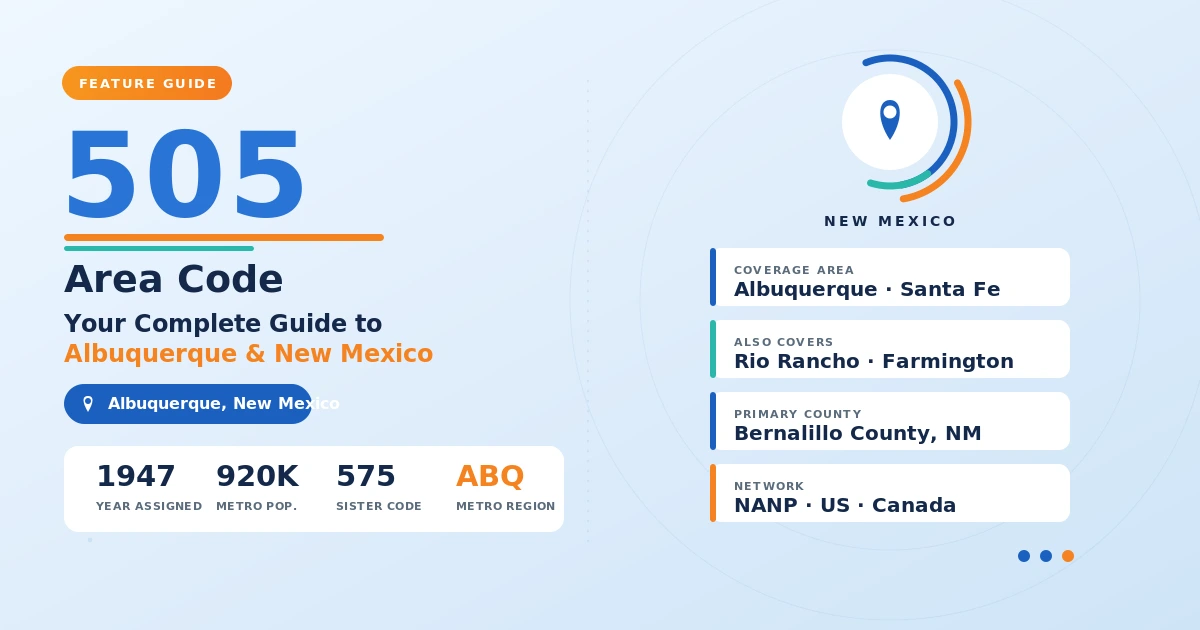
Since 1947 — 78 years of uninterrupted service — the 505 area code has been New Mexico's original telephone identifier.
Few area codes in the United States carry that kind of longevity, and fewer still cover a region as economically diverse as Albuquerque, Santa Fe, and the state's northwestern corridor.
The 505 area code serves the central and northwestern parts of New Mexico, including the state's largest city, its capital, and key defense and technology hubs.
In 2007, a geographic split created the 575 area code for southern and eastern New Mexico, drawing a clear line between the two halves of the state that businesses need to understand before choosing a local number.
Whether you're a healthcare provider targeting Albuquerque patients, a defense subcontractor near Kirtland Air Force Base, or a tech startup eyeing New Mexico's growing innovation economy, this guide covers everything you need to know about the 505 area code — its history, cities, the 505 vs 575 distinction, business benefits, and how to get a number.
- What Is the 505 Area Code?
- The History of the 505 Area Code
- 505 vs 575: New Mexico's Geographic Split Explained
- Key Cities and Industries in the 505 Region
- Why Businesses Choose a 505 Area Code
What Is the 505 Area Code?
The 505 area code is a North American Numbering Plan (NANP) geographic code assigned to central and northwestern New Mexico.
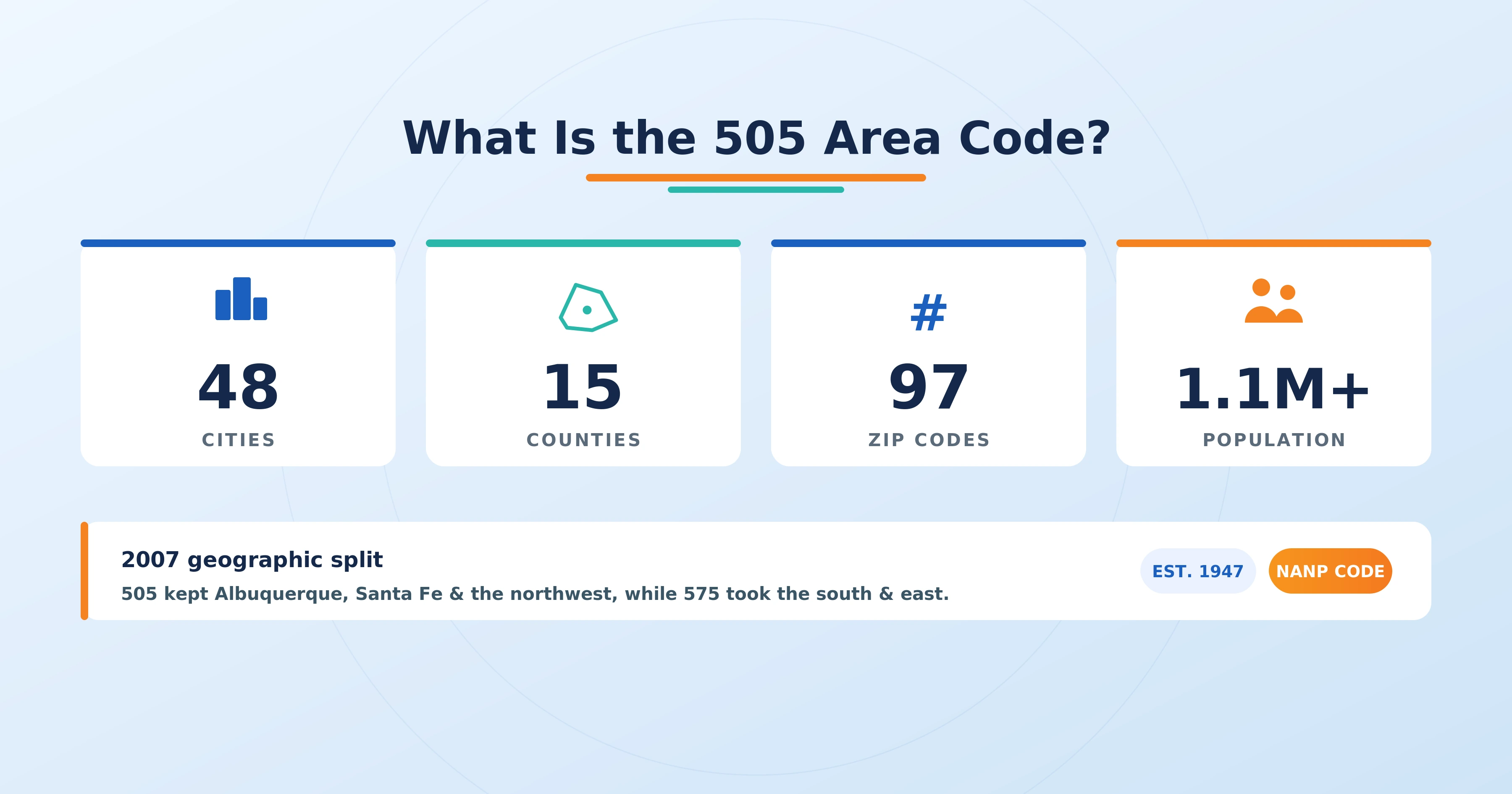
After a 2007 geographic split, it covers approximately 48 cities, 15 counties, and 97 zip codes, serving an estimated population of over 1.1 million people.
The 505 region is anchored by the Albuquerque Metropolitan Statistical Area and extends north through Santa Fe and the Rio Grande corridor, west to Gallup and the Four Corners region, and northwest into Farmington and San Juan County.
The region operates in the Mountain Time Zone (UTC−7 / UTC−6 DST).
Businesses that want to activate service right away can start with local phone numbers.
- Albuquerque — New Mexico's largest city and economic hub
- Rio Rancho — Albuquerque's fast-growing neighbor and Intel's New Mexico base
- Santa Fe — the state capital, arts hub, and government center
- Farmington — an energy and trade center in the San Juan Basin
- Gallup — a commerce hub and gateway to Navajo Nation
- Los Lunas — a growing Valencia County community south of Albuquerque
- Las Vegas, NM — a historic northeastern New Mexico city
The History of the 505 Area Code
The story of the 505 area code begins at the very founding of the North American Numbering Plan itself.
When NANPA introduced the 10-digit telephone system in 1947, New Mexico was assigned a single area code to cover the entire state: 505.
For six decades, one code served all of New Mexico — from the Albuquerque metro to the Carlsbad Caverns, from Farmington in the northwest to Hobbs in the southeast.
That arrangement worked for generations. New Mexico's population was relatively small and dispersed, and a single area code sufficed.
But the 1990s changed everything. Mobile phones, fax machines, pagers, and internet dial-up lines created an explosion in demand for telephone numbers.
By the early 2000s, the 505 number pool was approaching exhaustion.
Rather than introduce an overlay — as many other states did — New Mexico chose a geographic split. On October 7, 2007, NANPA reduced the 505 area code to cover only the high-population centers of central and northwestern New Mexico.
The remainder of the state — the southern and eastern regions — was renumbered with the new 575 area code.
This split was one of the last geographic splits executed in the United States under NANPA's modern plan. It preserved 505's identity in Albuquerque and Santa Fe while giving the southern half of the state a fresh start with 575.
For a detailed numbering history, see Wikipedia's overview of the 505 area code.
505 vs 575: New Mexico's Geographic Split Explained
New Mexico is one of the simplest states to navigate when it comes to area codes — it has exactly two, cleanly divided by the 2007 geographic split.
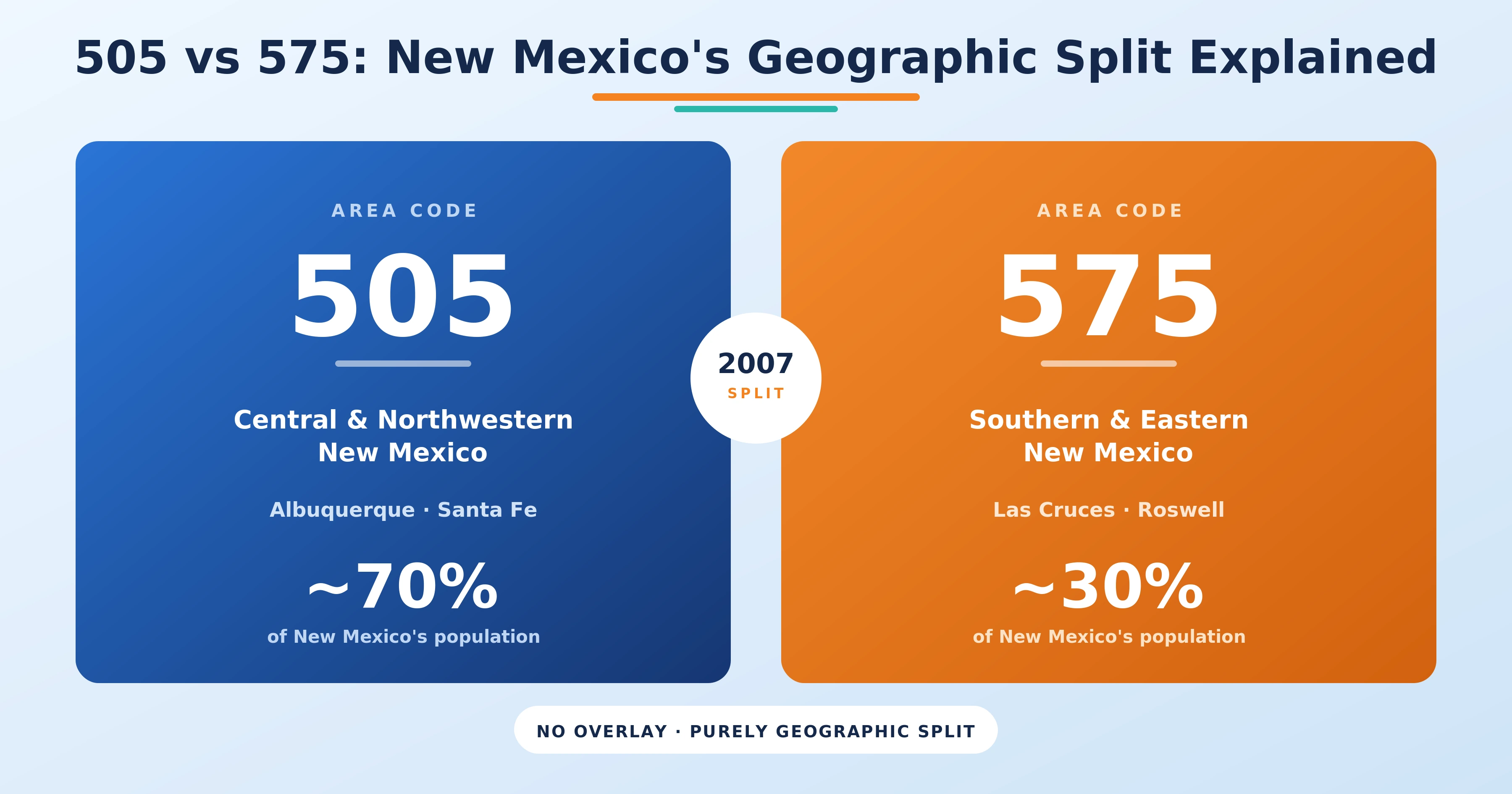
Unlike overlay systems — where multiple codes serve the same geographic footprint — New Mexico's codes are purely geographic. A 505 number signals Albuquerque, Santa Fe, and northwestern New Mexico.
A 575 number signals the southern and eastern half of the state.
There is no 10-digit mandatory dialing requirement within the 505 territory alone, unlike triple-overlay markets such as Maryland's 410/443/667 region.
| Area Code 505 | Area Code 575 | |
|---|---|---|
| Active Since | 1947 (statewide) / 2007 (reduced) | 2007 |
| Coverage | Central & northwestern NM | Southern & eastern NM |
| Key Cities | Albuquerque, Rio Rancho, Santa Fe, Farmington, Gallup | Las Cruces, Roswell, Alamogordo, Clovis, Carlsbad |
| Population Share | ~70% of New Mexico's population | ~30% of New Mexico's population |
| Overlay? | No | No |
| 10-digit dialing? | Not required within 505 territory | Not required within 575 territory |
Key Cities and Industries in the 505 Region
The 505 area code region punches well above its size in terms of economic and technological significance.
Defense and National Laboratories form the backbone of the Albuquerque economy.
Sandia National Laboratories, operated by National Technology & Engineering Solutions of Sandia (a subsidiary of Honeywell), employs over 14,000 scientists, engineers, and support staff at its Kirtland Air Force Base–adjacent campus.
Kirtland AFB itself supports tens of thousands of military and civilian personnel. Together, these two institutions make the 505 region one of the most defense-dense mid-size metros in the United States.
For defense subcontractors and technology vendors building New Mexico customer relationships, deploying AI-powered call routing to route calls by cleared-personnel status or contract type delivers measurable efficiency in this high-compliance procurement environment.
Technology and Cybersecurity are expanding rapidly. Rio Rancho hosts Intel's largest US manufacturing facility.
Albuquerque's growing tech corridor is attracting cybersecurity firms, software developers, and clean energy companies drawn by New Mexico's favorable business tax climate and STEM workforce.
Healthcare is the largest employment sector in Albuquerque. The University of New Mexico Health System, Presbyterian Healthcare Services, and Lovelace Health System operate major hospitals and medical networks across the 505 region.
Government and Education round out the picture. The State Capitol in Santa Fe, multiple federal agencies, and the University of New Mexico all drive professional services demand and call traffic throughout the region.
Why Businesses Choose a 505 Area Code
For companies targeting customers in Albuquerque or Santa Fe, a local area code is one of the fastest ways to establish credibility — and the 505 area code is the only signal that says 'we're here, in New Mexico's economic core.' Teloz's cloud contact center platform lets businesses pair a 505 number with AI-powered call routing, omnichannel communications, CRM integration, and real-time analytics — so your local New Mexico presence scales from a single rep to a full contact center without changing your number.
Explore the full platform at teloz.com.
Instant Local Recognition
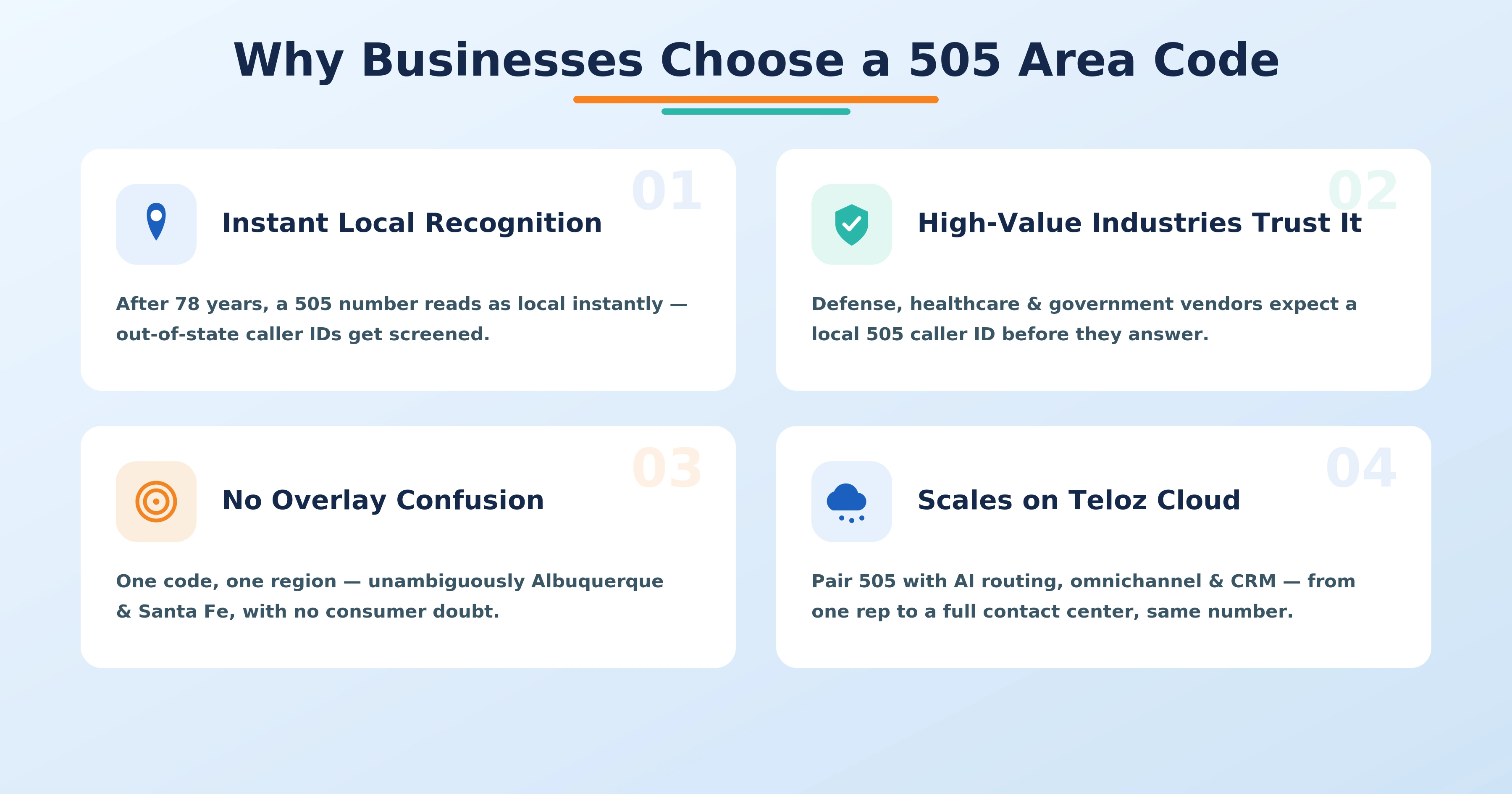
The 505 area code has been ringing in New Mexico for 78 years. Albuquerque residents, Santa Fe businesses, and Farmington energy clients all recognize a 505 number as local without a second thought. An out-of-state number gets screened; a 505 number gets answered.
High-Value Industries Demand Local Trust
Defense contractors, healthcare providers, and government vendors operating in the 505 region face clients who are particularly cautious about unknown callers. A 505 business number establishes geographic legitimacy before the call even connects.
No Overlay Complexity
Unlike many US metro areas juggling two or three overlapping area codes, the 505 region has no overlay. Your 505 number is unambiguously Albuquerque-and-Santa-Fe — no consumer confusion about whether your code 'really' means local.
“Since 1947 — 78 years of uninterrupted service — the 505 area code has been New Mexico's original telephone identifier.”
How to Get a 505 Area Code Number
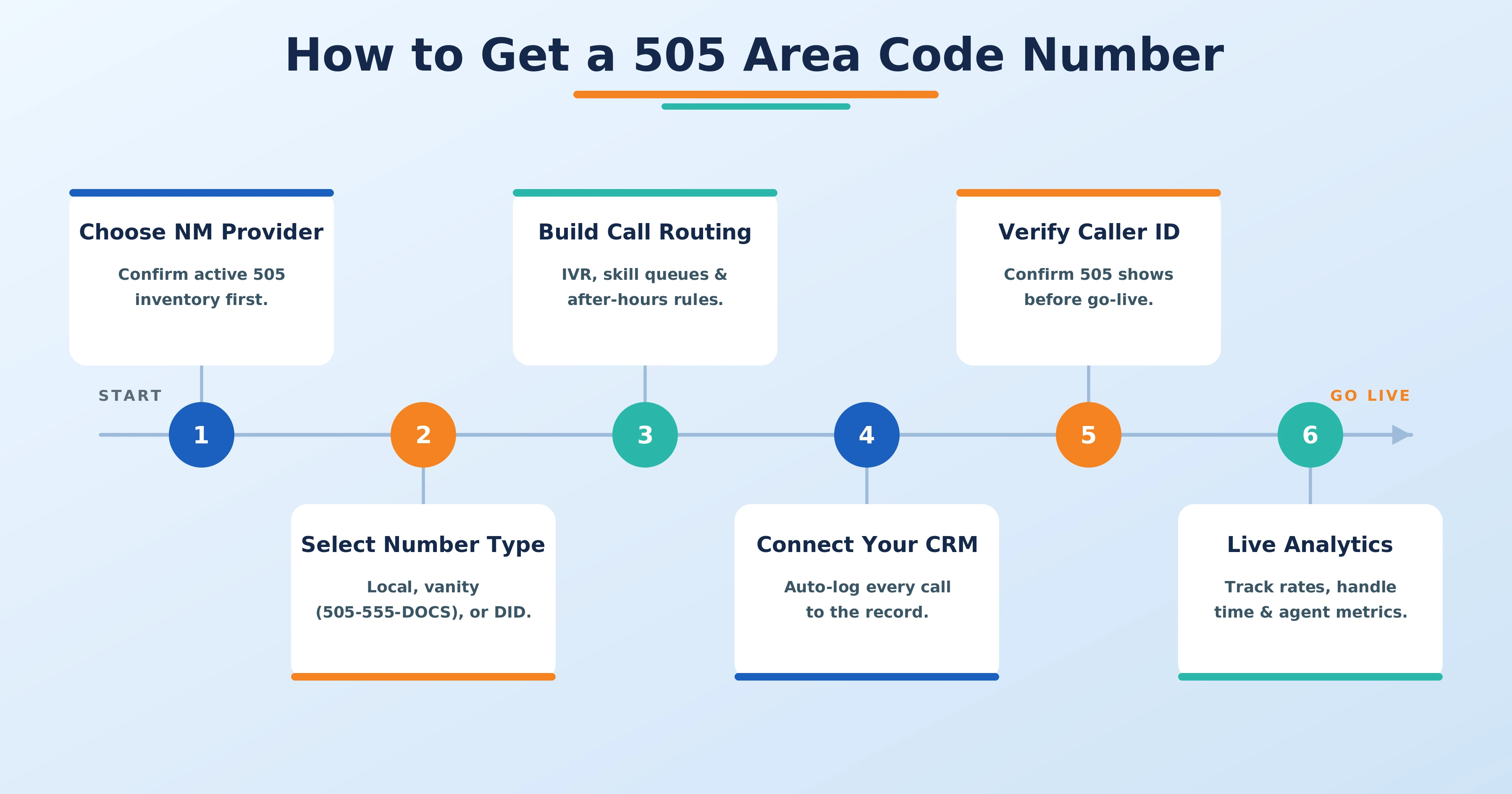
Securing a 505 number through a cloud VoIP provider takes minutes. Here is the six-step process:
If your team also needs multi-region reach, compare international virtual numbers.
Step 1: Choose a Provider with NM Number Inventory
Select a cloud VoIP provider that holds active 505 area code numbers. Confirm inventory before beginning — 505 is a legacy code with high demand in Albuquerque.
Step 2: Select Your Number Type
Choose between a standard local number, a vanity number (e.g., 505-555-DOCS for a medical practice), or a direct inward dialing (DID) number for individual departments.
Step 3: Build Your Call Routing Logic
Configure IVR menus, skill-based call queues, and after-hours routing. Route calls by department, agent availability, customer language preference, or prior interaction history.
Step 4: Connect Your CRM
Link your 505 number to your CRM so inbound and outbound calls are automatically logged per customer record — eliminating manual entry and building a complete interaction history.
Step 5: Verify Outbound Caller ID
Test that your 505 number appears correctly on outbound calls before going live. This is the frontline trust signal your New Mexico prospects will see.
Step 6: Track Performance with Live Analytics
Monitor answer rates, average handle time, queue depth, and agent metrics using real-time dashboards from day one.
Conclusion
The 505 area code is New Mexico's original telephone code — active since 1947, serving Albuquerque, Santa Fe, and the state's northwestern economic core.
Unlike overlay markets, 505 and 575 occupy cleanly separate geographic territories, making your choice of area code a straightforward, meaningful decision: 505 means central and northwestern New Mexico, full stop.
For businesses operating in defense contracting, healthcare, technology, or government services within the 505 region, a local number is one of the fastest credibility signals available.
Pair it with intelligent call routing, CRM integration, and AI-driven contact center tools to convert local recognition into measurable business outcomes. See how Teloz delivers that infrastructure at teloz.com.


