Introduction
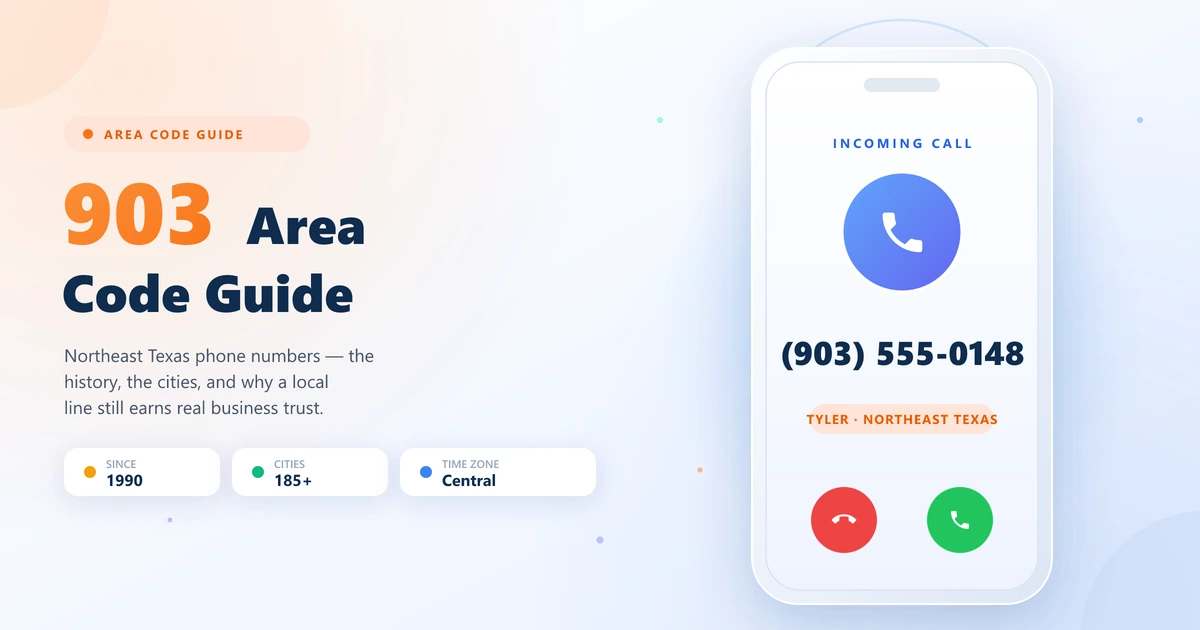
Here is a claim that surprises people: a single three-digit prefix can carry more regional pride than a state flag. In northeast Texas, the 903 area code does exactly that.
Stretching from the Piney Woods to the Red River, it is the calling identity of Tyler, Longview, Texarkana, and dozens of smaller towns that consider it part of who they are.
In this guide you will learn precisely where the 903 area code reaches, how it split from Dallas's old code, which cities and counties it covers, why a local number still earns business trust, and how to dodge the scams that abuse those familiar digits.
Let us dig in.
- Where the 903 area code reaches across northeast Texas
- How it split from 214 in 1990 and gained the 430 overlay in 2003
- The Tyler, Longview, and Texarkana cities and counties it serves
- Why a local 903 number builds business trust in tight-knit Texas towns
- How to get a 903 phone number from anywhere
- Common 903 spoofing scams and how to stay safe
Where Is the 903 Area Code?
The 903 area code serves northeastern Texas, a broad rural and small-city region east of the Dallas metro and stretching to the Arkansas, Louisiana, and Oklahoma borders.
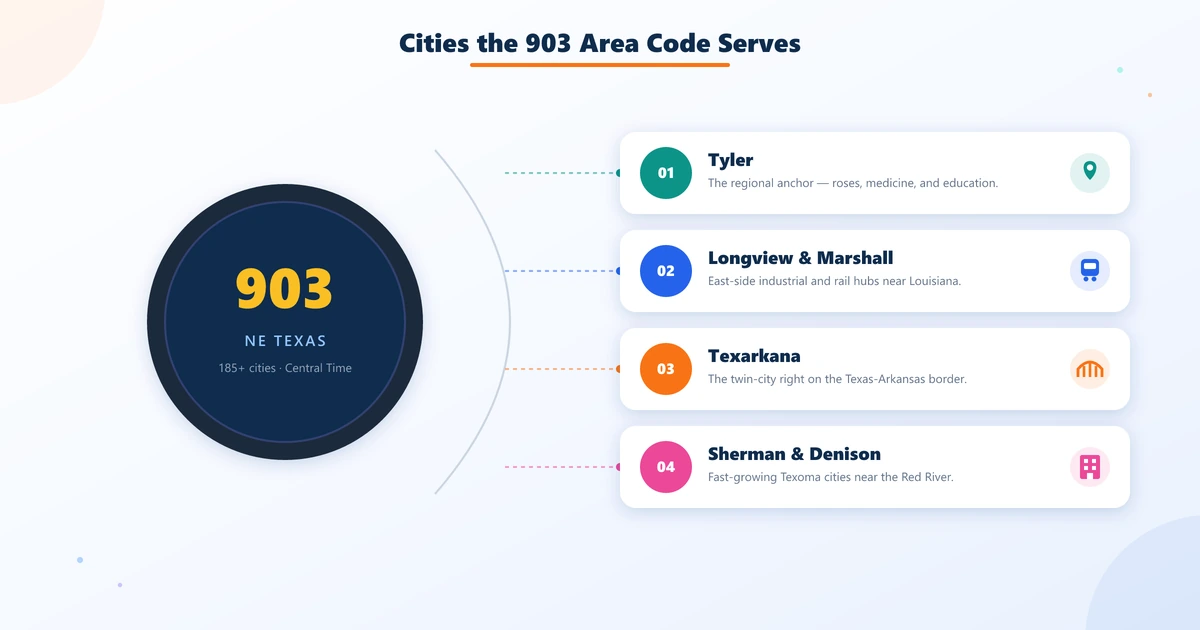
Its best-known hubs are Tyler, Longview, Marshall, Texarkana, Sherman, and Paris, with dozens of smaller towns filling the spaces in between.
This is the land of the East Texas Piney Woods, oil-and-timber country dotted with college towns, lake communities, and county seats rather than a single sprawling metropolis.
The whole region runs on Central Time, observing Central Standard Time in winter and Central Daylight Time in summer, the same clock as Dallas and Houston.
What gives the code its character is that breadth. It is not the badge of one big city but of an entire corner of Texas. So when those three digits appear on your screen, picture the rolling, forested northeast of the state rather than any one downtown.
That regional scope is worth keeping in mind. Because the coverage spans so many counties, two businesses with the same prefix might sit ninety minutes apart, one in a college town and one in a lakeside community.
The shared code becomes a thread of regional identity that links them, which is part of why East Texans treat a local 903 phone number as more than a dialing convenience.
- Anchor region: Northeastern Texas, east of the Dallas metro
- Time zone: Central Time (CST / CDT)
- Borders reached: Arkansas, Louisiana, and Oklahoma
- Does not cover: Dallas, Houston, or central Texas
A Short History of the 903 Area Code
The code has roots in the explosive growth of North Texas. For decades, much of the region shared 214, the Dallas code that dated back to 1947. By the late 1980s, the rise of fax machines, pagers, and early mobile phones was draining 214's supply of numbers.
To relieve the strain, the 903 area code went into service on November 4, 1990, becoming the 136th area code in North America.
It was carved out of 214 in a geographic split, taking the northeastern counties while 214 kept the Dallas core.
Growth did not stop there. As demand kept rising, regulators added the 430 area code on February 15, 2003, as an overlay covering the very same territory.
Because two codes now share the region, ten-digit dialing is required — you must dial the full area code even when calling a neighbor down the road.
The overlay was a deliberate, less disruptive choice. Splitting the region again would have forced thousands of homes and businesses to change numbers, reprint everything, and notify every contact.
Layering 430 on top of 903 instead let existing lines stay exactly as they were while new numbers drew from the fresh code, an approach that has become the standard way growing regions add capacity.
- 1947: 214 — one of Texas's original area codes, covering Dallas and the northeast
- 1990: 903 split from 214 to serve northeast Texas exclusively
- 2003: 430 added as an overlay, requiring ten-digit dialing across the region
Cities and Counties the 903 Area Code Serves
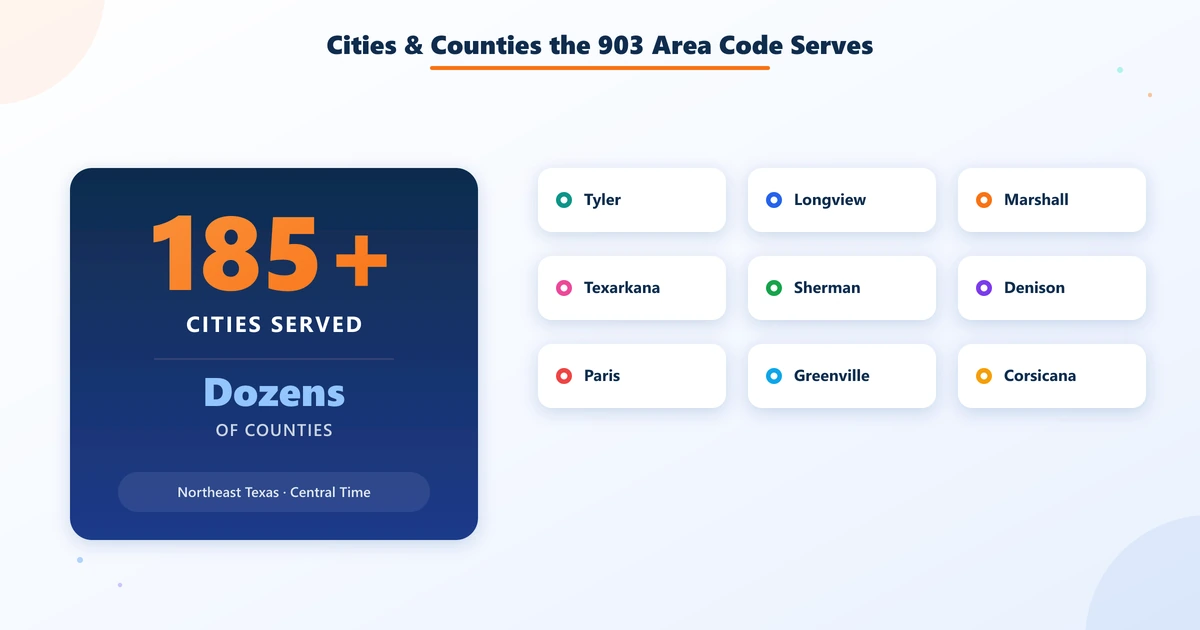
The 903 area code blankets a remarkably large footprint, roughly 185 cities and dozens of counties across northeast Texas. Together these towns give the 903 area code a grounded, small-city feel that locals are fiercely loyal to.
For a customer in Tyler or Longview, a local 903 number on a business signals that the company belongs to East Texas rather than calling in from somewhere far away.
The diversity of these markets is striking.
A logistics firm near Texarkana, a dental office in Sherman, and a café in Paris all share the same prefix yet serve very different customers — which is why businesses across industries work hard to keep a recognizable northeast Texas number on their signage and ads.
- Tyler — the regional anchor, famous for its roses and its medical and education hubs
- Longview and Marshall — east-side industrial and rail centers near the Louisiana line
- Texarkana — the twin-city on the Texas-Arkansas border
- Sherman and Denison — fast-growing cities in the Texoma area near the Red River
- Paris, Greenville, and Corsicana — historic county seats anchoring rural communities
Why a Local 903 Number Wins Business Trust
In a region where community ties run deep, a local number is a genuine competitive edge.
Studies of caller behavior consistently show that people answer and trust calls from familiar local numbers far more than calls from unknown or out-of-state ones, and that instinct is especially strong in tight-knit Texas towns.
A 903 phone number tells customers across northeast Texas that you understand their market, share their time zone, and are reachable in their community.
That sense of nearness lifts answer rates, speeds up callbacks, and fuels the word-of-mouth that small businesses live on in places where reputation travels fast.
This is where the right platform earns its keep. A provider like Teloz, which has built business communication systems since 2005, lets a company pair a local 903 number with a cloud-based, AI-assisted contact center.
A small team can then field calls from Tyler to Texarkana with the polish of a much larger operation, routing every caller intelligently instead of letting the phone ring out.
How to Get a 903 Area Code Number
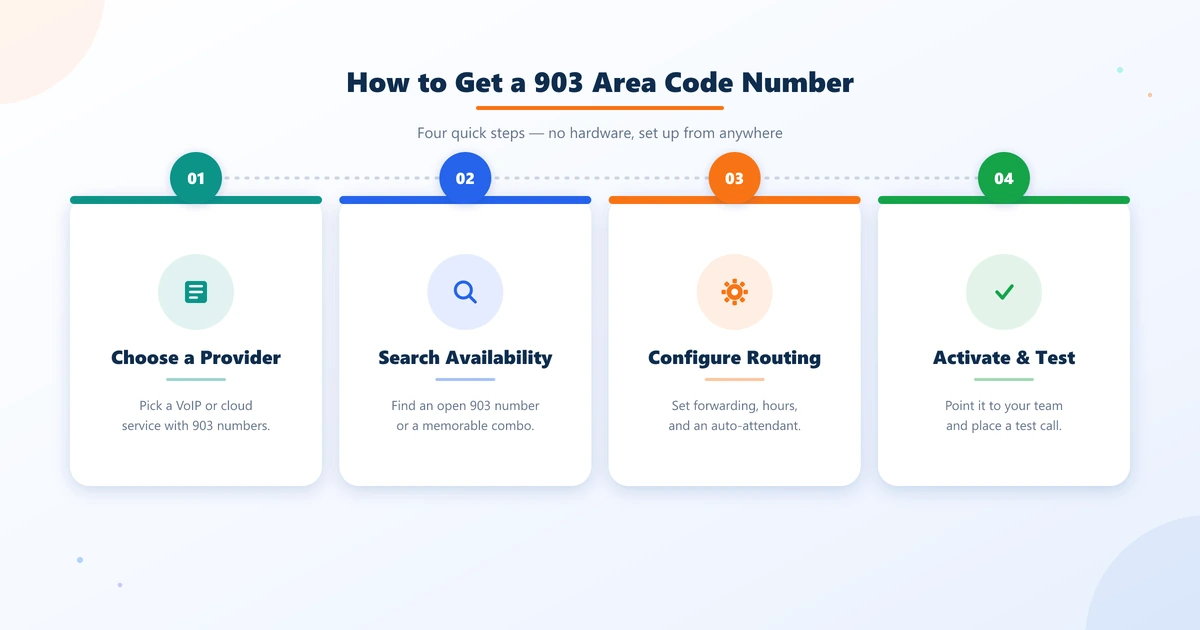
You do not need a storefront in Tyler to use a 903 number. Virtual and cloud providers can assign one to a business located anywhere and route the calls to whatever device your team prefers. The process is usually quick.
Because everything lives in the cloud, you can answer 903 calls from a desk phone, a laptop, or a mobile app, and add lines as your presence grows.
With no hardware to install and, from most providers, no long-term contract, testing an East Texas presence carries little risk.
- Choose a provider — pick a VoIP or cloud service offering northeast Texas numbers plus IVR, voicemail, and analytics
- Search availability — look for an open 903 number, or a memorable combination if one is free
- Configure routing — set call forwarding, business hours, and an auto-attendant so every call reaches the right person
- Activate and test — point the number at your team and place a test call to confirm it connects
“The 903 area code is the phone identity of northeast Texas — from the rose gardens of Tyler to the border streets of Texarkana.”
903 Area Code Scams and Spoofing
The 903 area code is completely legitimate, used by hundreds of thousands of real residents and businesses. But its local familiarity makes it a favorite disguise for scammers.
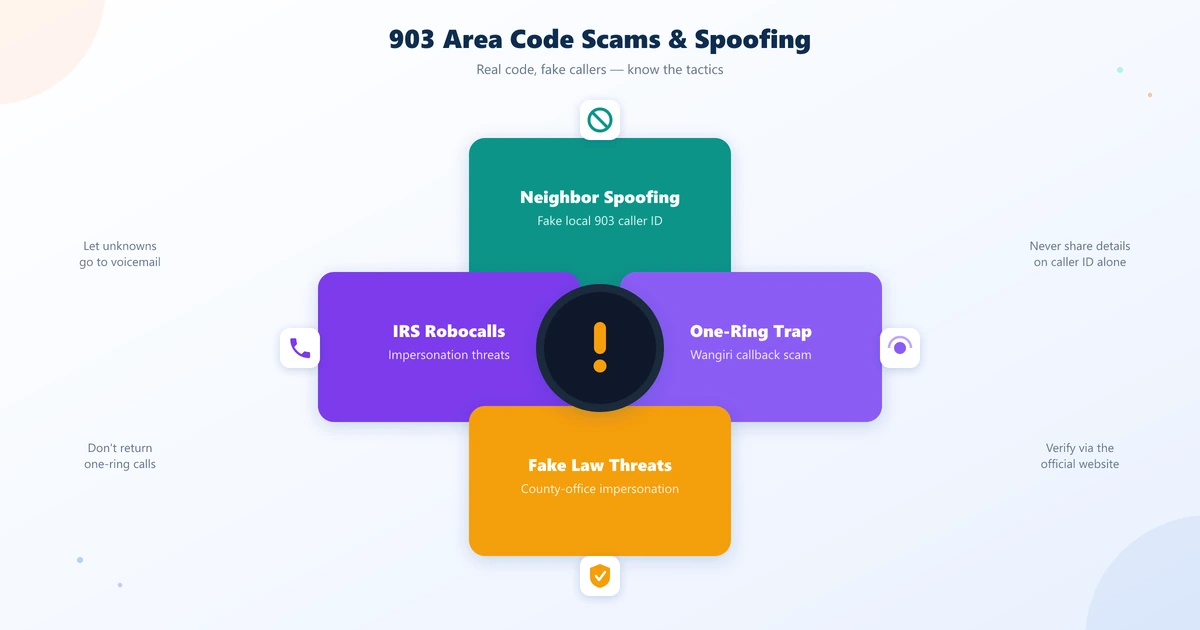
With cheap VoIP tools, fraudsters fake a 903 caller ID through "neighbor spoofing," betting that East Texans will answer a call that appears to come from their own county.
Local reports tie 903 spoofing to fake law-firm and county-office threats, aggressive IRS-impersonation robocalls, Amazon account scams, and "Wangiri" one-ring callback traps designed to trigger toll charges.
None of these reflect the genuine residents and businesses that use 903 area code numbers every day.
Protecting yourself is simple. Let unknown calls go to voicemail, never share personal or payment details based on caller ID alone, and do not return a suspicious one-ring call — instead verify the company through its official website.
Treating 903 area code scams with healthy caution keeps you safe while still welcoming the real local calls that matter.
- Let unknown calls go to voicemail and judge callers by the message they leave
- Never share personal or payment details based on caller ID alone
- Do not return a suspicious one-ring call — verify through the company's official website
- Be wary of any call demanding urgent action or immediate payment
Conclusion
The 903 area code is the phone identity of northeast Texas, from the rose gardens of Tyler to the border streets of Texarkana.
Split from the Dallas 214 code in 1990 and later joined by the 430 overlay, it now anchors hundreds of communities across the Central Time Zone, and a local 903 number remains one of the simplest ways for a business to earn regional trust and a faster answer.
Just stay alert to the spoofing scams that exploit that trust, and choose a provider that backs your number with smart call handling. Ready to sound unmistakably East Texan?
See how Teloz handles this at teloz.com.


