Introduction
Seventy percent of the world's internet traffic passes through a single corridor in Northern Virginia every day.
Every Google search query, every Netflix stream, every AWS cloud API call from the Eastern Seaboard, and every transatlantic packet — a majority of it all routes through the data centers concentrated in Loudoun County, Virginia.
That territory is served by the 703 area code. By Q1 2025, that corridor had surpassed 4,900 megawatts of commissioned data center capacity — more than twice the size of its nearest global rival.
The 703 area code is not merely a Northern Virginia prefix. It is the telephone identifier of the most strategically concentrated piece of digital and governmental real estate in the Western world.
This guide covers the complete geography, history, economy, and business case for the 703 area code.
- What Is the 703 Area Code?
- The History of the 703 Area Code
- Data Center Alley: The 703 Territory Runs the Internet
- Government, Defense, and Intelligence: The 703 Institutional Core
- Tysons Corner, Reston, and the Commercial Economy
What Is the 703 Area Code?
The 703 area code is a geographic North American Numbering Plan (NANP) code serving Northern Virginia, one of the most economically powerful suburban corridors in the United States.
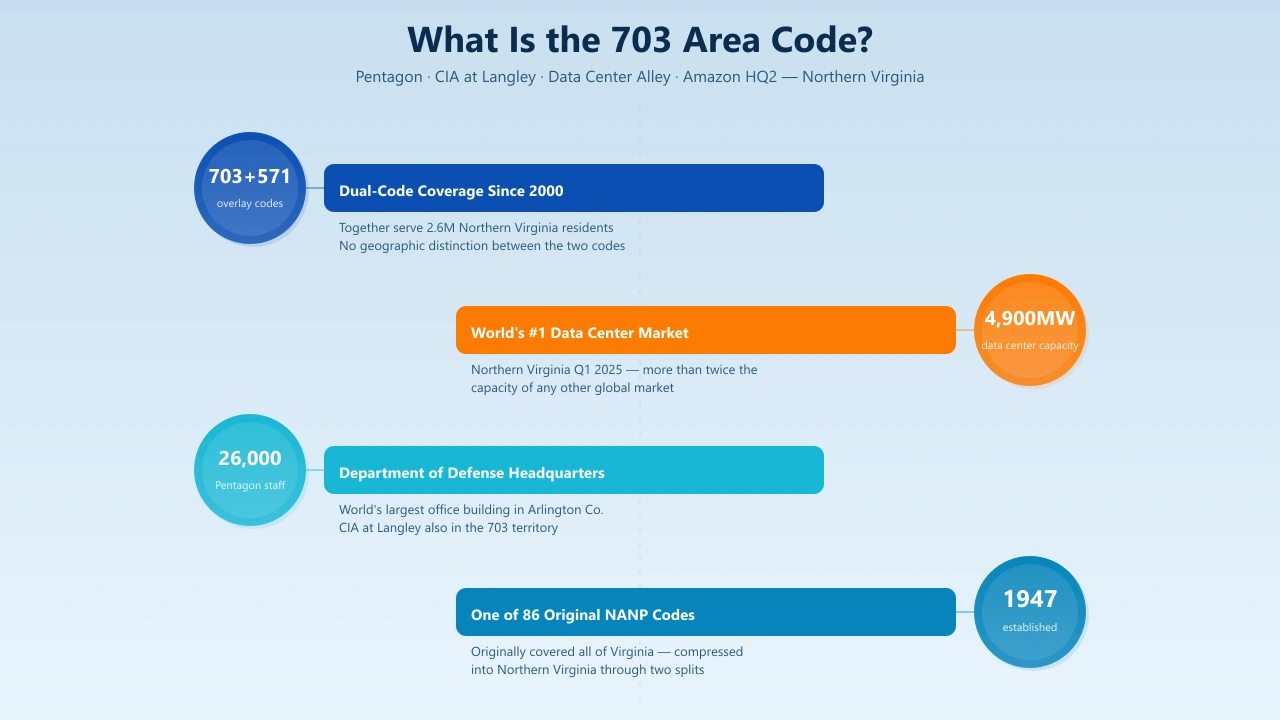
It operates as an overlay alongside area code 571, which was introduced in March 2000 to address number exhaustion. Together, the two codes serve about 2.6 million residents in one of the nation's highest-income metro regions.
All of the 703 territory operates in the Eastern Time Zone (UTC−5 / UTC−4 EDT). All local calls require 10-digit dialing.
Businesses that want to activate service right away can start with local phone numbers.
- Arlington County — home to the Pentagon, Amazon HQ2's National Landing campus, Reagan National Airport, and the Rosslyn and Crystal City corridors
- Alexandria — independent city with historic Old Town district and a major federal contractor presence
- Fairfax County — the economic engine of Northern Virginia; Tysons Corner, McLean, Reston, Herndon, Fairfax City, and more than 15,000 technology companies
- Falls Church — home to Northrop Grumman's corporate headquarters
- Loudoun County — home of Dulles International Airport and the Ashburn Data Center Alley; the fastest-growing county in Virginia
- Parts of Prince William County — Woodbridge, Manassas, and surrounding communities
The History of the 703 Area Code
Area code 703 is one of the eighty-six original NANP codes established in October 1947. Its evolution is a four-decade story of Virginia's growth compressing into a single high-density corridor.
1947 — Area Code 703 covers all of Virginia: The original NANP assignment gives 703 to the entire Commonwealth of Virginia — a state of roughly 2.8 million people.
June 24, 1973 — 804 splits off eastern Virginia: Population growth in the Richmond and Hampton Roads corridor forces the first geographic split. Area code 804 takes eastern Virginia; 703 retains the western and northern portions.
July 15, 1995 — 540 splits off western and central Virginia: The defense buildup of the 1980s and the early internet economy exhaust 703's supply. Area code 540 takes Roanoke, Harrisonburg, and western Virginia.
Area code 703 is now restricted entirely to Northern Virginia.
March 1, 2000 — 571 overlay introduced: Within just five years of the 1995 split, 703 approaches exhaustion again. Growth in mobile phones, internet dial-up, and Northern Virginia's explosive dot-com-era economy drives the surge.
Rather than a geographic split, regulators choose an all-services overlay.
For a detailed numbering history, see Wikipedia's overview of the 703 area code.
| Area Code | Event | Year | Territory |
|---|---|---|---|
| 703 | Original NANP assignment | 1947 | All of Virginia |
| 804 | Geographic split from 703 | 1973 | Eastern Virginia |
| 540 | Geographic split from 703 | 1995 | Western/central Virginia |
| 571 | All-services overlay on 703 | 2000 | Same territory as 703 (Northern VA) |
Data Center Alley: The 703 Territory Runs the Internet
No geographic area code in the world is associated with more internet infrastructure than 703.
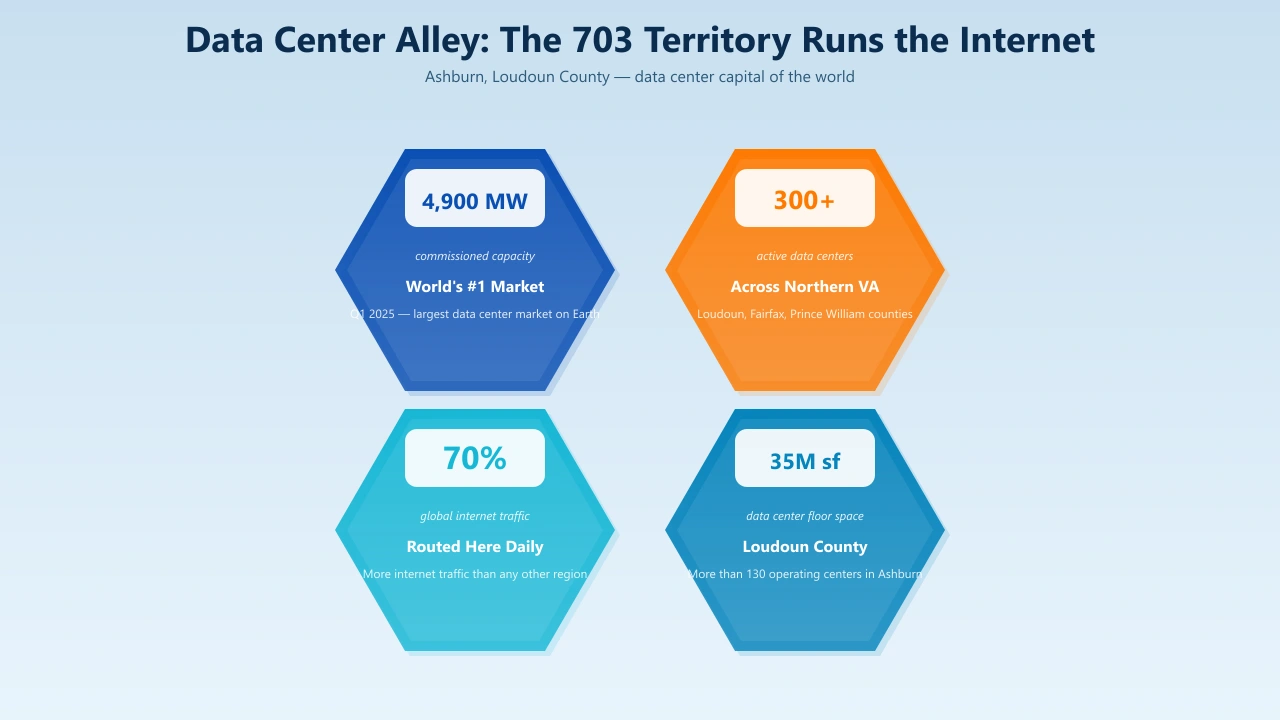
The Ashburn-centered 'Data Center Alley,' anchored in Loudoun County but extending across Fairfax and Prince William counties, is the acknowledged data center capital of the world.
For any business in the technology supply chain, government IT procurement, or cloud services sector, AI-driven call routing gives you an edge.
It helps you handle inbound procurement volumes from these hyperscale facilities better than competitors using manual call handling.
By Q1 2025, Northern Virginia's data center market had topped 4,900 megawatts of commissioned power capacity. That's the largest market in the world — more than twice the capacity of its nearest global competitor.
Nearly 300 data centers are scattered across Loudoun, Fairfax, and Prince William counties. Loudoun County alone hosts over 130 operating centers totaling more than 35 million square feet.
About 5,500 megawatts is in planned development, much of it pre-leased through 2028. AI workloads and hyperscale cloud demand are driving most of that growth.
Today, the major hyperscalers all maintain massive footprints in the 703 territory. These include Amazon Web Services (including dedicated GovCloud operations for the CIA), Microsoft, Google, and hundreds of colocation and enterprise operators.
Government, Defense, and Intelligence: The 703 Institutional Core
The 703 area code also encompasses the densest concentration of federal defense and intelligence infrastructure in the United States.
That cluster of institutions defines Northern Virginia's economy as fundamentally different from any other US suburban corridor.
The Pentagon in Arlington County is the world's largest office building by floor area. It houses the Department of Defense headquarters and about 26,000 military and civilian employees.
CIA Headquarters at Langley sits in McLean, Fairfax County — within the 703 territory. The CIA's campus, officially George Bush Center for Intelligence, is the operational center of the US civilian foreign intelligence apparatus.
The defense contractor ecosystem surrounding these institutions is extraordinary in its concentration. Northrop Grumman (Falls Church), General Dynamics (Reston), Booz Allen Hamilton (the largest US government IT and consulting contractor, headquartered at Reston Station), and SAIC (Reston) are all headquartered in the 703 territory.
Amazon HQ2 in National Landing, Arlington, opened Phase 1 in June 2023 with capacity for 14,000 employees. Fairfax County alone is home to more than 15,000 technology companies.
Tysons Corner, Reston, and the Commercial Economy
Beyond government and data infrastructure, the 703 area code encompasses two of the most significant commercial employment centers in the mid-Atlantic region.
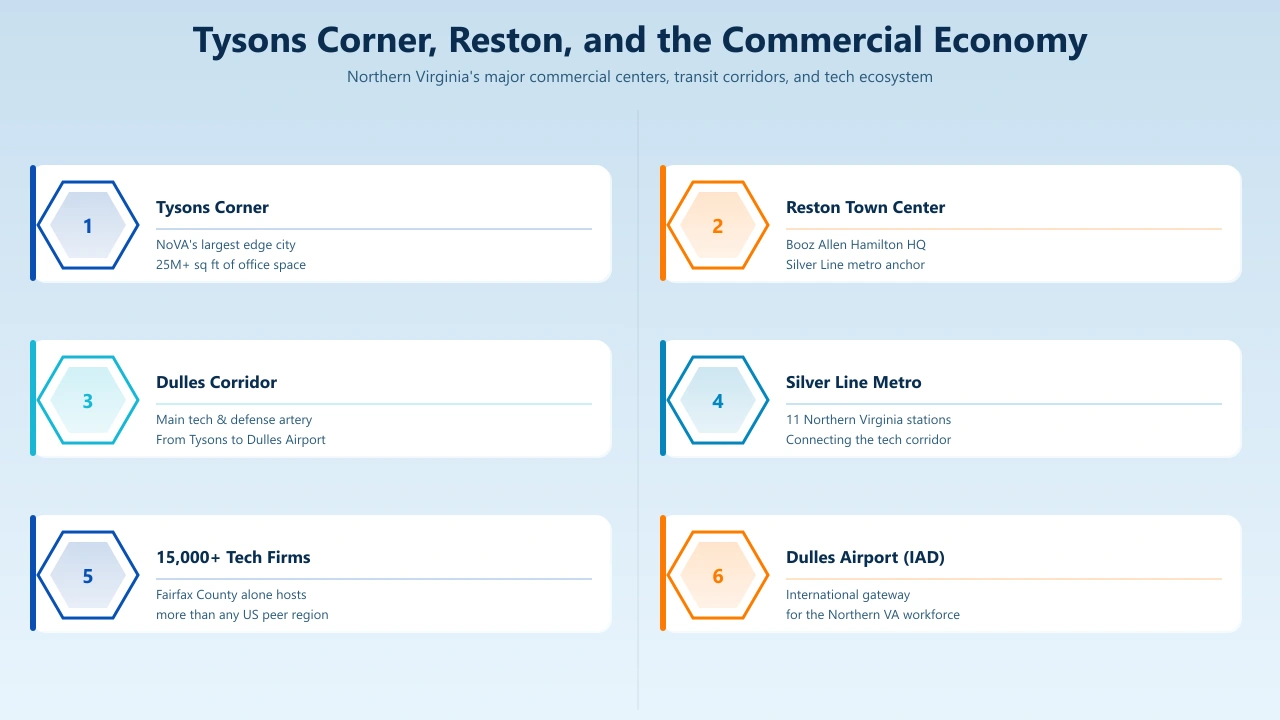
Tysons Corner in Fairfax County is one of the largest edge cities in the United States. It is a high-density commercial district that has grown from a suburban shopping crossroads into a major employment center.
It now has millions of square feet of office space and multiple metro stations on the Silver Line.
Reston was developed in the 1960s as one of America's first planned communities and has matured into a major technology and defense corridor. Reston Station is anchored by Booz Allen Hamilton and served by the Silver Line.
It is the commercial core of a dense office and mixed-use district, housing dozens of major tech and government contractors.
The Dulles Corridor stretches from Tysons through Reston and Herndon to Dulles International Airport.
It is one of the most active commercial real estate submarkets in the eastern United States, serving the technology, defense, aviation, and professional services sectors.
Why Businesses Choose a 703 Area Code Number
Companies targeting the defense procurement ecosystem, federal IT supply chain, intelligence community vendor market, or the technology services corridor connecting Northern Virginia to Washington D.C. all rely on a 703 number.
It's the standard credential of regional market presence. Pair a 703 number with Teloz's AI-driven call routing, CRM integration, and real-time analytics.
Your NoVA professional services operation then operates at enterprise scale from day one. Explore the full platform at teloz.com.
Defense and Federal Contracting
The Pentagon, CIA, and dozens of federal agencies in the 703 territory collectively generate hundreds of billions of dollars in annual contract spend. Vendors, subcontractors, staffing firms, legal and financial advisors, and technology integrators serving this procurement ecosystem benefit from a 703 number. It gets them immediately recognized as embedded regional participants — not out-of-area solicitors.
Data Center and Cloud Services Supply Chain
With nearly 300 data centers in active operation, the 703 territory hosts an enormous ecosystem of power engineering, facilities management, networking hardware, fiber connectivity, and managed services vendors. A 703 number signals physical proximity to the infrastructure your clients operate.
“Seventy percent of the world's internet traffic passes through a single corridor in Northern Virginia every day.”
How to Get a 703 Area Code Number
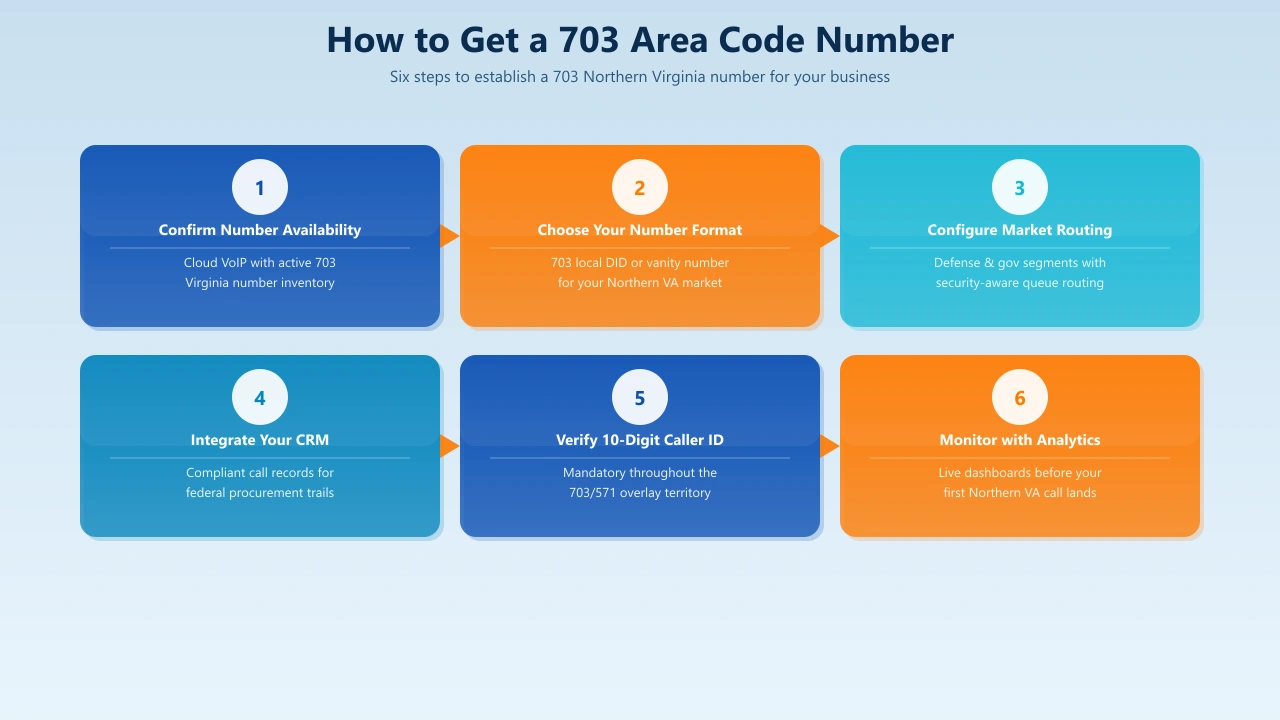
Here is the six-step process for establishing a 703 Northern Virginia number for your business:
If your team also needs multi-region reach, compare international virtual numbers.
Step 1: Confirm Number Availability
Work with a cloud VoIP provider holding active 703 Virginia inventory. Both 703 and 571 serve the same Northern Virginia territory — confirm your provider can source 703 specifically if the established code is important for your market positioning.
Step 2: Choose Your Number Format
Select a standard 703 local DID or a vanity number that reflects your Northern Virginia market position — defense contracting, data center services, professional services, or technology consulting.
Step 3: Configure Market-Specific Routing
Northern Virginia's government and defense clients often have distinct calling patterns, security-aware communication needs, and compliance requirements. Build routing queues by market segment with skills-based assignment.
Step 4: Integrate Your CRM
Link every inbound and outbound 703 call to your CRM. In the defense contractor and federal IT market, documented call records and compliant communication logs are procurement differentiators.
Step 5: Verify 10-Digit Caller ID
Confirm your outbound 703 caller ID displays all 10 digits. Ten-digit dialing is mandatory throughout the 703/571 territory.
Step 6: Monitor with Real-Time Analytics
Track call answer rates, campaign performance, handle times, and conversion from live dashboards before your first Northern Virginia call lands.
Conclusion
Area code 703 started as the phone prefix for an entire state in 1947. Through two splits and an overlay, it was compressed into a Northern Virginia corridor.
That corridor now hosts the Pentagon, the CIA, Amazon's second headquarters, and a data center ecosystem that routes 70% of the world's daily internet traffic.
No other three-digit prefix in America concentrates more federal institutional power, more defense contract spend, or more internet infrastructure in a single metropolitan area.
For any company entering the government contracting, intelligence community, data center services, or Northern Virginia technology market, the 703 number is not merely an area code.
It is the credential that says you operate in the country's most strategically important commercial corridor. See how Teloz powers your Northern Virginia presence at teloz.com.


