Introduction
An unknown number calls. You miss it.
No voicemail.
The question — who owns this number? — leads most people to Google, where they quickly discover that "free reverse phone lookup" results range from genuinely useful free tools to upsell funnels that promise unlimited reports and charge before showing anything.
The truth is more nuanced: some methods return accurate owner information for free in under a minute, while others hit a structural wall for certain number types — VoIP lines, prepaid phones, and burner numbers that are deliberately designed to be untraceable.
Choosing the right method depends on what type of number you're looking up and how much detail you actually need.
This guide covers seven methods to find a phone number owner in 2026, from the fastest free approaches to the most thorough paid options, including which techniques work for landlines versus mobile versus VoIP, and what the law says about using the information you find.
- Why People Look Up Phone Number Owners
- Method 1: Google and Search Engine Search
- Method 2: Free Reverse Phone Lookup Tools
- Method 3: CNAM and Carrier Databases
- Method 4: Truecaller and Crowdsourced Caller ID Apps
Why People Look Up Phone Number Owners
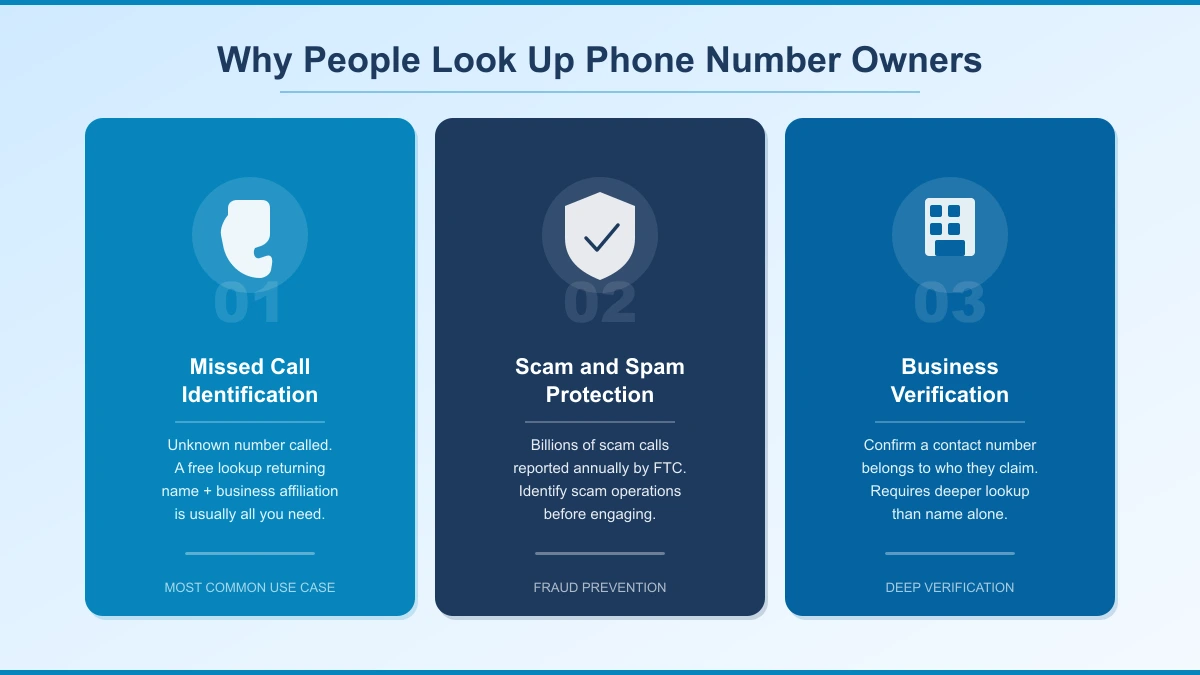
The need to find a phone number's owner falls into three distinct situations, each calling for a different level of investigation:
Businesses that need to establish a verifiable, lookup-friendly presence usually start with dedicated local phone numbers.
Missed Call Identification
The most common reason — you received a call from an unfamiliar number, missed it, and want to know whether to call back before your voicemail reveals you as a live answer target. A free lookup returning a name and business affiliation is usually all you need.
Scam and Spam Protection
Robocall and phone scam volume reached record highs in recent years, with the FTC recording billions of reported scam calls annually. Identifying whether an inbound number is a known scam or spam operation — before engaging — protects you from fraud.
Business Verification
Confirming that a contact number on a form submission, invoice, or inbound inquiry belongs to the person or organization they claim to represent. The appropriate tool here runs deeper than name lookup — you want full business verification.
Method 1: Google and Search Engine Search
The fastest starting point for any phone number lookup is a direct search engine query.
Businesses, freelancers, journalists, healthcare providers, and individuals who publicly list their phone number on websites, directories, LinkedIn profiles, or forum posts are immediately findable this way.
This method works best for numbers associated with businesses, professionals, or individuals with a public web presence. For purely personal mobile numbers with no online presence, move to dedicated lookup tools.
- Enter the number in quotation marks: Searching "555-867-5309" forces Google to return pages containing that exact string — filtering out irrelevant matches and surfacing business listings, personal websites, and public records where the number appears.
- Try multiple formats: US numbers appear in multiple formats online — 555-867-5309, (555) 867-5309, 5558675309, +15558675309. Run the search in at least two formats before concluding the number is not indexed.
- Check Google's cached pages: When a directory listing or contact page has been updated or removed, Google's cached version often retains the original phone number. Access it via the Cached option in desktop search results.
- Site-specific operator: If you suspect the number belongs to someone at a specific company, searching site:companyname.com with the number in quotes limits results to that domain — surfacing staff directories, contact pages, and press releases where the number may appear.
Method 2: Free Reverse Phone Lookup Tools
Several specialized reverse lookup platforms maintain large US number databases and return owner names, carrier information, and line type for free:
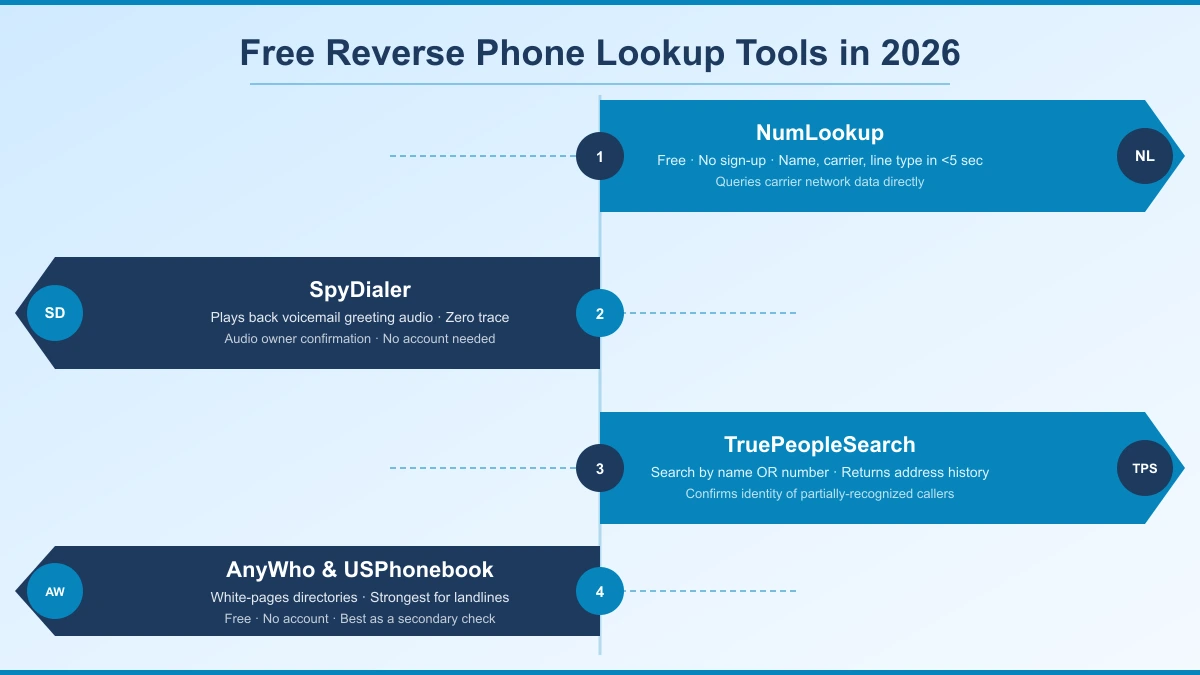
NumLookup
The most reliable completely free tool in 2026. No account, no credit card, no sign-up. Enter a US number and receive the owner's full name, carrier, line type (mobile, landline, or VoIP), and location in under five seconds. NumLookup queries carrier network data directly rather than relying solely on outdated directory aggregations.
SpyDialer
Offers a unique capability that no other free tool matches: it plays back the voicemail greeting of the number being looked up, providing audio confirmation of ownership without placing a call or leaving a trace. If the number's owner has recorded a personalized greeting, SpyDialer returns that audio along with name and carrier data. Entirely free, no account required.
TruePeopleSearch
Comprehensive free people-search directory that works in both directions: search by name to find a number, or search by number to find a name. Returns address history and associated relatives alongside the name — useful for confirming the identity of a caller you partially recognize.
AnyWho and USPhonebook
Traditional white-pages style directories, strongest for landline numbers and older mobile registrations. Free with no account needed; useful as a secondary check when other tools return limited results.
Method 3: CNAM and Carrier Databases
Understanding CNAM (Caller Name) explains why some reverse lookups return instant, accurate results while others return nothing — and why the number type matters more than the tool you choose.
CNAM is the name database maintained by US telephone carriers. Every time a call is placed, the receiving carrier performs a CNAM dip — a query to the originating carrier's database to retrieve the subscriber name associated with the calling number.
This is the same system that populates your phone's caller ID display.
CNAM databases are highly accurate for traditional landlines because landline subscribers have persistent registrations that carriers update when ownership changes. For these numbers, a CNAM-based reverse lookup reliably returns the registered owner name.
For mobile numbers, CNAM data exists but is less consistently maintained. Mobile number ownership changes frequently — number porting, prepaid activation, carrier transfers — and not all carriers update CNAM records in real time.
For VoIP numbers assigned by internet-based providers like Google Voice, Twilio, or Vonage, CNAM records are often absent entirely.
VoIP providers can programmatically provision numbers without the same registration infrastructure that traditional carriers maintain, leaving the CNAM database empty for many VoIP assignments.
Method 4: Truecaller and Crowdsourced Caller ID Apps
Where CNAM databases thin out — particularly for mobile and VoIP numbers — crowdsourced caller ID platforms fill the gap using a fundamentally different data source: the contact books of hundreds of millions of smartphone users worldwide.
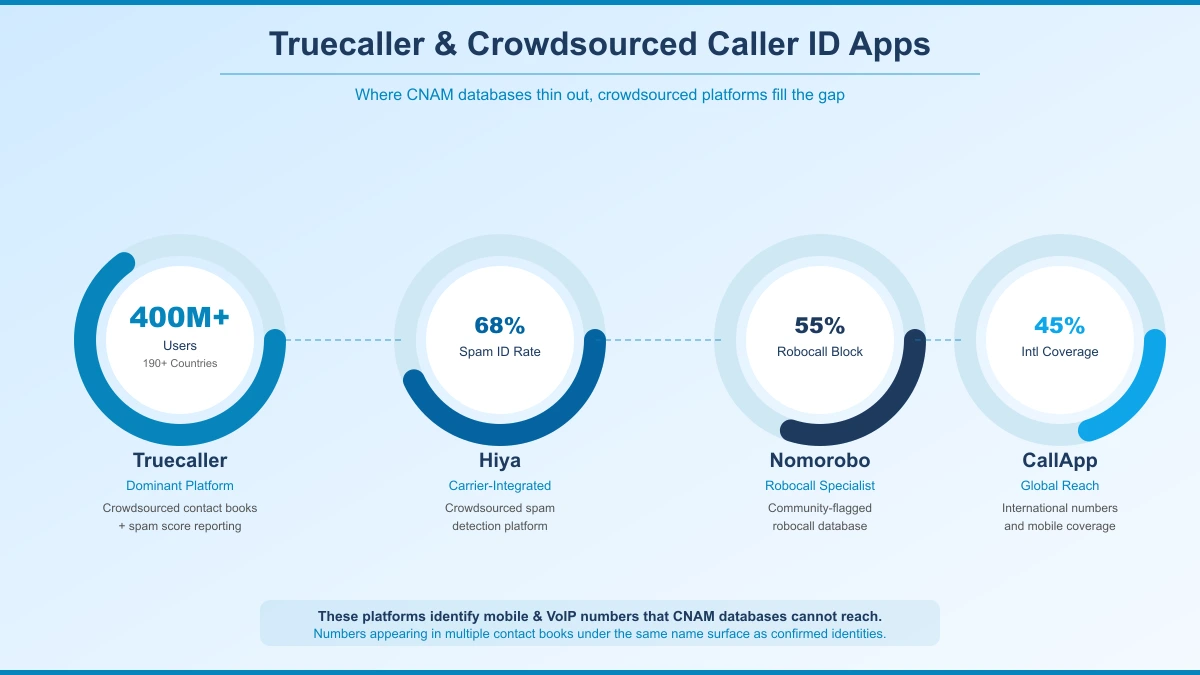
Truecaller is the dominant platform: with over 400 million registered users across 190+ countries contributing their contact data, Truecaller has assembled one of the world's largest phone number databases.
When a number appears in multiple users' contact books under the same name, that name surfaces in Truecaller's lookup results — providing owner identification even for mobile and VoIP numbers that return nothing from CNAM or traditional directories.
Truecaller also surfaces spam scores driven by community reporting: numbers that a significant number of users have flagged as spam, robocalls, or scams display warning labels — an immediate signal of whether the number is likely legitimate before you decide to return the call.
Hiya, Nomorobo, and CallApp operate on similar crowdsourced models, with varying database sizes and geographic coverage.
For identifying unknown callers from international numbers or newer mobile registrations, these apps consistently outperform traditional directory-based tools.
Method 5: Paid People-Search Platforms
When a name is not enough — when you need an address, address history, associated relatives, linked social accounts, or background records — paid people-search platforms provide depth that free tools structurally cannot:
For guidance on identifying and reporting suspicious calls, see the FTC's consumer guide to phone scams.
Spokeo
Builds a full profile from a phone number, pulling from over 60 billion public and open-source records including addresses, social media accounts, court records, professional licenses, and historical data. Lookup by number, name, email, or address interchangeably. Most appropriate when you need to confirm whether the person who called you matches the identity they claimed.
BeenVerified and TruthFinder
Offer similar comprehensive profiles including criminal record checks, bankruptcy filings, and property records linked to the number's registered owner. Both use subscription models rather than per-report pricing, making them cost-effective for anyone who performs multiple lookups per month.
Whitepages Premium
Remains the longest-running US phone directory, with particular strength in landline records and business number verification. The premium tier adds carrier-verified data and spam risk scoring to the basic name/location result.
When Reverse Lookup Fails: VoIP and Prepaid Numbers
Three categories of numbers return limited or no results from virtually every reverse lookup tool. If a number consistently returns no owner data across multiple tools, these are the most likely explanations — not a tool failure.
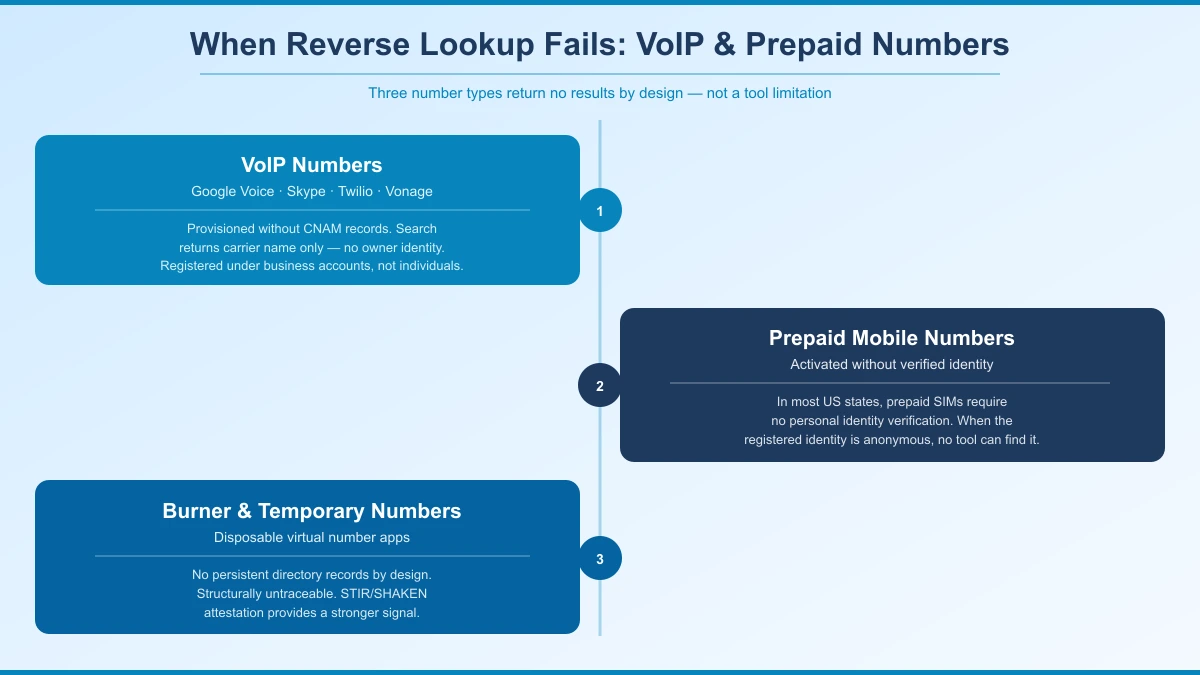
VoIP Numbers
Numbers assigned by internet-based providers — Google Voice, Skype, Twilio, Vonage, and thousands of smaller services — are often registered under business or service account names rather than individual identities, and many are provisioned without CNAM records. A VoIP number search frequently returns only the carrier name without an associated person.
Prepaid Mobile Numbers
Prepaid SIM cards can be activated without verified personal identity in most US states. When the registered identity is anonymous or a minimal pseudonym, no lookup tool can surface a real owner name — because one was never provided.
Burner and Temporary Numbers
Virtual number apps that provide disposable temporary numbers leave no persistent records in any directory. By design, they are untraceable. Businesses that need to verify unknown inbound callers benefit from cloud contact center platforms with built-in STIR/SHAKEN attestation — a stronger signal than any reverse lookup can provide.
“Learn 7 ways to find a phone number owner — from free reverse lookup tools and Google search to CNAM databases, Truecaller, and paid people-search platforms.”
Legal Considerations When Using Found Information
Finding a phone number's owner using publicly available tools is legal in the United States. Using that information is governed by a separate body of law:
If you need coverage across several regions, compare virtual phone numbers as well.
- FCRA compliance: The Fair Credit Reporting Act prohibits using people-search results for employment screening, housing decisions, or credit assessments without the subject's consent and without using an FCRA-certified provider. Consumer reverse lookup tools are not FCRA-certified for these purposes.
- TCPA: If you use a found number to initiate unsolicited commercial contact, the Telephone Consumer Protection Act applies — including prior written consent requirements for automated or prerecorded calls and texts to mobile numbers. Violating the TCPA carries statutory penalties of $500 to $1,500 per violation.
- Harassment and stalking laws: Using reverse lookup results to locate, monitor, or repeatedly contact someone without consent may constitute harassment or stalking under state law regardless of how the information was obtained.
Conclusion
Finding a phone number's owner in 2026 is fast and free for most US landlines and registered mobile numbers — NumLookup and SpyDialer cover the majority of personal and business lookups without an account or a credit card.
For international and mobile-heavy searches, Truecaller's crowdsourced database reaches numbers that traditional directories miss. When you need a full profile beyond a name, Spokeo and BeenVerified go deeper.
And when a number returns nothing across every tool — VoIP, prepaid, or burner — the architecture of those number types explains the wall, not the method.
For businesses handling inbound calls at volume, Teloz's cloud contact center platform integrates caller ID authentication, STIR/SHAKEN verification, and CRM-connected call records — turning every inbound number into a verified, logged customer interaction.
See the full platform at teloz.com.


