Introduction
You hit "go" on a new outbound campaign, traffic spikes 4x in 48 hours, and suddenly your post-dial delay creeps past three seconds and your ACD nosedives.
The wholesale VoIP providers behind your termination are the difference between converting that traffic and losing it — and most buyers learn that lesson the expensive way.
This guide is written for carriers, ITSPs, contact center operators, and resellers who buy voice minutes at scale.
It covers the numbers that actually matter — not the marketing brochure ones — and the operational tells that separate a serious wholesale carrier from a flipped rate deck.
By the end, you will know exactly what to ask before committing a single dollar to your next provider.
- What wholesale VoIP actually is — and how it differs from retail voice
- Who buys from wholesale providers and what each buyer profile needs
- The five KPIs that define route quality: ASR, ACD, PDD, MOS, and margin
- Why CLI routes beat cheap grey routes on any campaign that matters
- DID inventory, origination, and toll-free — the inbound side of wholesale
- Six operational red flags that signal a wholesale partner will fail you
What "Wholesale VoIP" Actually Means
Wholesale VoIP is the business-to-business layer of voice.
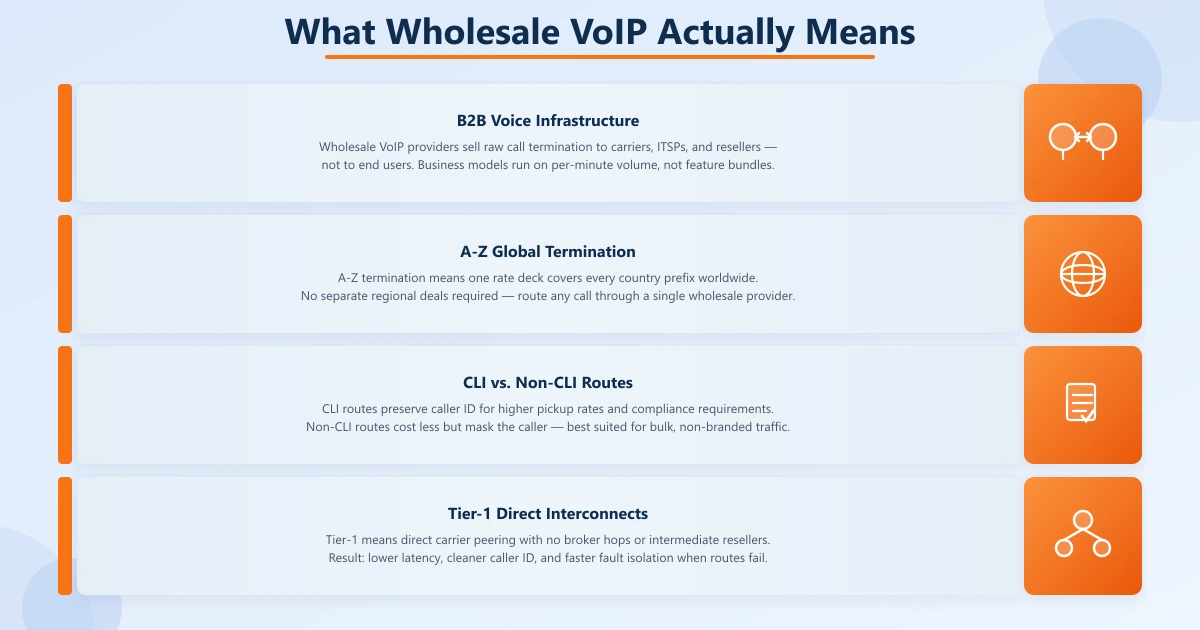
Instead of selling a phone system to an end user, VoIP wholesale termination services sell raw call termination, origination, and DID inventory to other companies that resell or embed voice in their own products.
Statista global VoIP services market data confirms the segment is growing faster than retail voice.
The transaction is denominated in fractions of a cent per minute, contracts run on rate decks that update monthly, and buyers care about three numbers above all: cost per minute, Average Success Rate (ASR), and Average Call Duration (ACD).
Everything else — UI, features, integrations — is secondary.
This market has its own vocabulary. "A-Z termination" means the provider can route a call to any destination globally. "CLI routes" preserve caller ID; "non-CLI" routes are cheaper but mask it. "Tier-1 interconnect" means the provider peers directly with major carriers rather than routing through brokers.
Knowing this language is the price of admission.
Who Buys From Wholesale VoIP Providers
The customer profile is narrower than retail. Each buyer has different priorities.
A BPO obsesses over termination rates and ASR. A UCaaS platform cares more about DID inventory depth and origination quality.
A CPaaS vendor needs APIs, real-time CDRs, and instant provisioning. Pick wholesale VoIP providers whose product is engineered for your buyer profile, not against a generic "best of" list.
- CLECs and resold long-distance carriers building out their PSTN footprint.
- ITSPs and UCaaS platforms that need underlying termination for hosted PBX and SIP trunking for carriers offerings, a segment the Statista VoIP market overview shows growing fastest among business buyers.
- Contact centers and BPOs dialing high outbound volumes where every fraction of a cent matters. Pair with an AI contact center platform for maximum yield per dial.
- CPaaS and SaaS platforms embedding voice features in their products.
- MVNOs and IoT carriers routing voice from cellular networks to the PSTN.
The Numbers That Define a Good Wholesale Provider
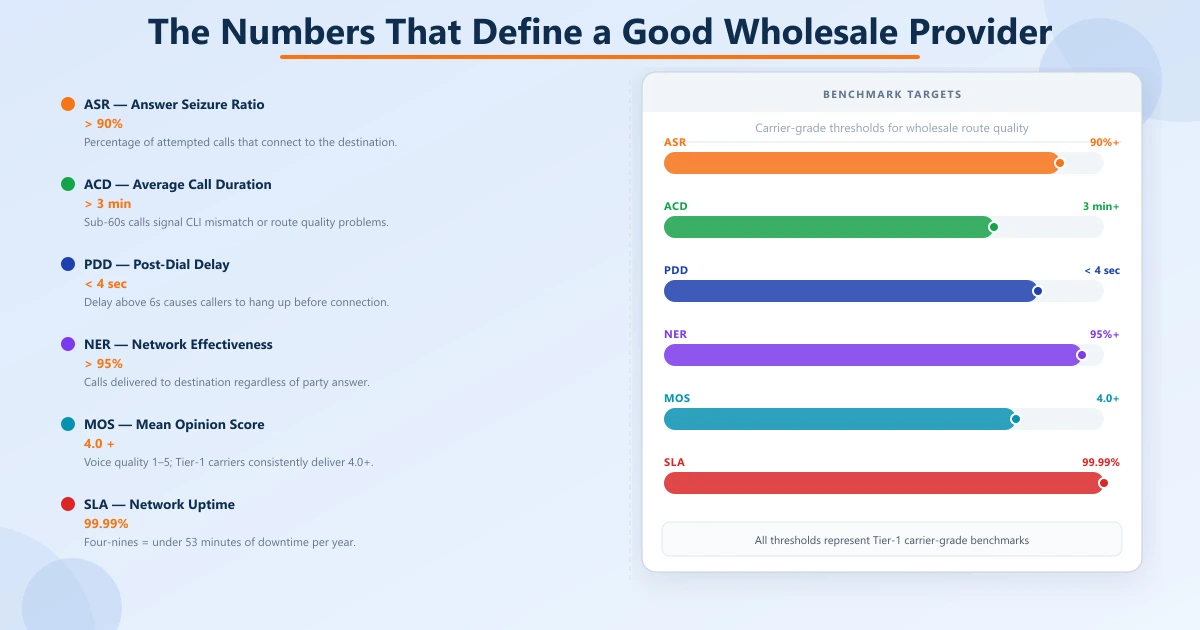
When you evaluate carrier-grade VoIP partners and shortlist wholesale VoIP providers, ignore the homepage and look at the numbers below. Ask for a 30-day historical sample of these metrics across your top 20 destinations before you sign.
Providers that cannot produce that data do not measure it — which means they cannot fix it either.
- ASR (Answer-Seizure Ratio): percentage of calls answered. Healthy CLI routes deliver 45–65% ASR on a clean rate deck. Sub-30% means a route is broken or stuffed with grey traffic.
- ACD (Average Call Duration): mean call length. Anything under 30 seconds is a red flag — short ACD signals false answer supervision.
- PDD (Post-Dial Delay): seconds between dial and ring. Good tier-1 routes sit under 4 seconds.
- MOS (Mean Opinion Score): voice quality scoring. Production-grade routes target 4.0 or better.
- Margin on rate deck: the gap between your rate-in and rate-out across A-Z destinations. This is what determines whether you make money.
Routes, Rate Decks, and Why Quality Beats Price
A rate deck is just a spreadsheet of destination prefixes and per-minute prices, but inside that spreadsheet is the entire economics of your business. Two rate decks at the same price can produce wildly different P&Ls because of route quality.
Review transparent wholesale pricing models before committing to any deck.
Cheap routes get cheap by accident or design. "Grey routes" use SIM banks and VoIP-to-GSM gateways that look like legitimate termination until calls start being blocked by carriers.
They show low cost on the deck and high ASR on day one, then quality collapses in week three.
Premium CLI routes cost more but deliver consistent ASR, real caller ID, and clean carrier handoff. For sales dialers, voicemail drops, and any campaign that depends on pickup rates, premium routes pay back the price difference in conversion lift.
Always test new routes on a small sample of live traffic before you commit volume. The deck is a hypothesis; the call detail records are the truth.
DID Inventory, Origination, and Toll-Free
The other half of what wholesale VoIP providers sell is inbound — DID origination, toll-free numbers, and number portability. Buyers underestimate this side until they need 2,000 local US numbers across 14 area codes by next Tuesday.
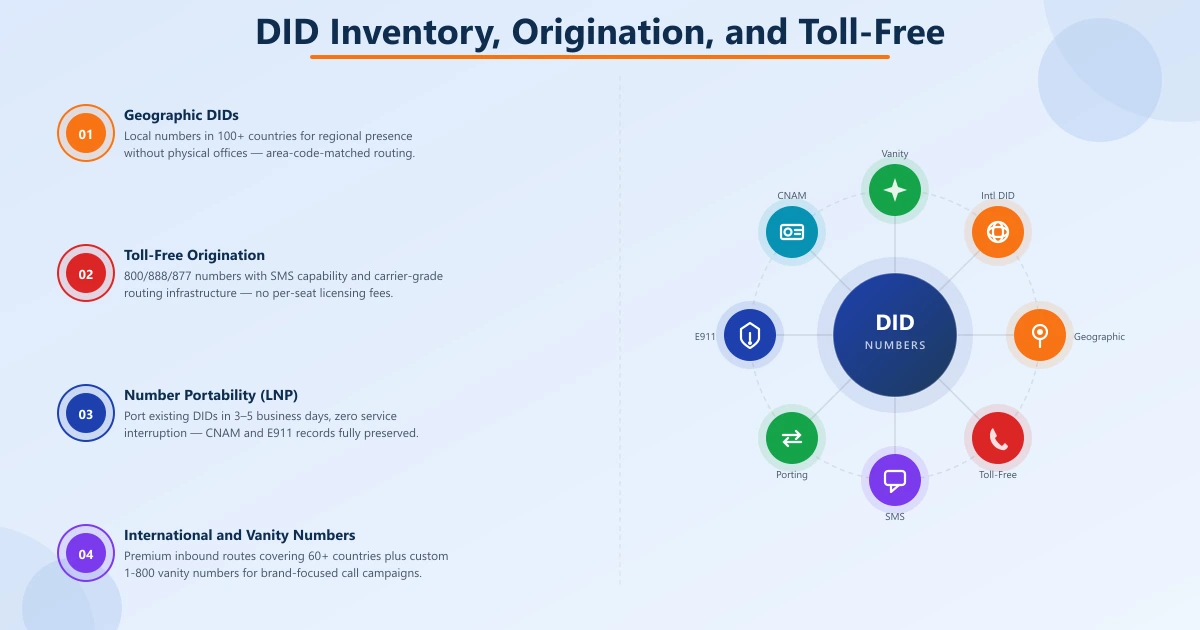
Teloz, which has operated as a wholesale and retail VoIP carrier since 2005, runs an inventory and provisioning stack engineered for this profile — direct API ordering, A-Z termination, two-way porting, and DID coverage across major US, Canadian, and international markets.
The dual wholesale and retail positioning matters because the same network that serves end-customers gives bulk SIP termination buyers a more stable underlying route.
Key questions to ask any wholesale VoIP provider on the inbound side:
- How deep is the DID inventory in the markets you sell into?
- Is provisioning instant via API, or ticket-based with a 48-hour SLA?
- Can the provider port numbers in both directions without per-port fees?
- What is the SMS-enablement story on DIDs? Native? Through a partner? Not at all?
- Is toll-free origination supported with real-time CDRs?
Geographic Coverage and Tier-1 Interconnects
The map matters.
Two wholesale VoIP providers can both claim "global reach" and route the same call through completely different paths — one direct to the destination carrier, one through three intermediate brokers that each shave a fraction of a cent and a fraction of quality.
Good geographic coverage is not about having the most country flags on a webpage. It is about owning the path your specific traffic actually takes.
- Direct interconnects with tier-1 carriers in your top destination markets. Direct peering means lower latency, cleaner CLI, and faster fault isolation when something breaks.
- Points of presence (PoPs) close to your traffic origin. If your dialers run in Dallas and your provider's nearest PoP is in Frankfurt, every call pays a latency tax.
- Diversity in your origin region. A provider with one PoP per region is a single point of failure. Ask for redundancy details.
- Local presence in tightly regulated markets. Some countries require in-country routing for certain traffic types; verify compliance before you commit.
- Carrier relationships on record. Reputable wholesale VoIP providers will name (under NDA) which tier-1 carriers they peer with. Vague answers usually mean grey-route exposure.
“The right wholesale VoIP providers are not the cheapest on the rate deck — they are the ones whose network, NOC, and inventory match the way your traffic actually flows.”
Red Flags Specific to Wholesale Deals
Retail VoIP red flags are about marketing. Red flags from wholesale VoIP providers are about operations. A wholesale relationship is an operational dependency, not a software purchase. Treat the diligence accordingly.
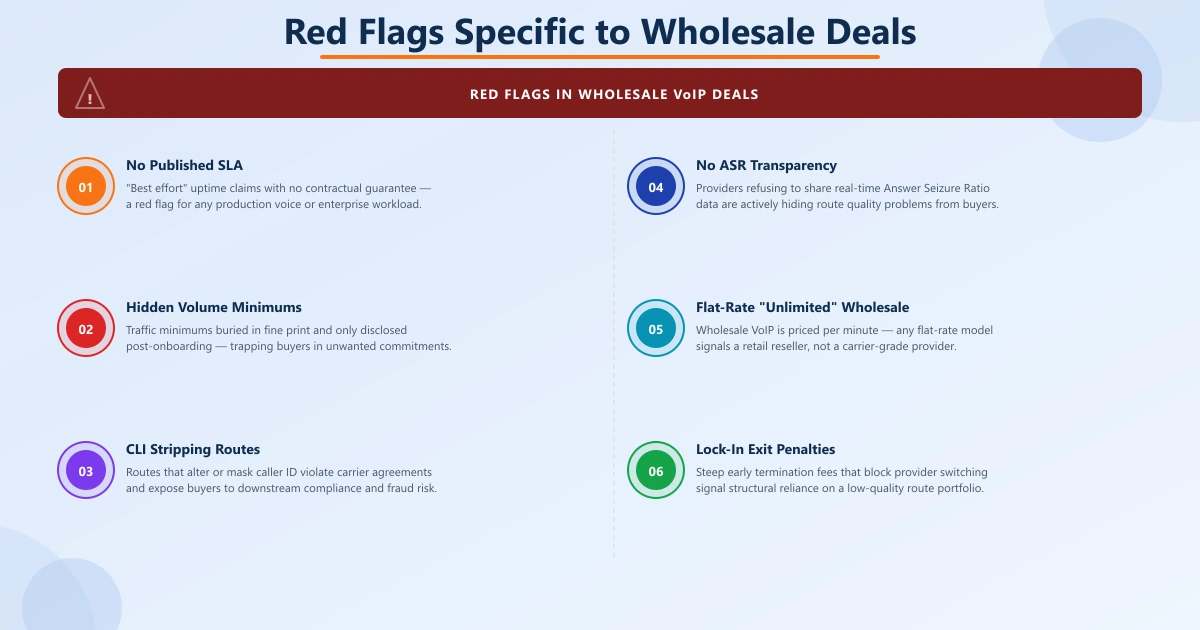
- No live NOC. A wholesale carrier without 24/7 network operations is one outage away from losing your business.
- No published ASR/ACD by destination. If they cannot show last month's numbers, you are flying blind.
- Heavy prepay requirements with no credit option. Reasonable for new accounts; suspicious as a permanent structure.
- No fraud monitoring. International revenue share fraud can run six figures of liability in a single weekend if your traffic is not monitored.
- Vague answers on grey traffic. Ask directly. The good ones say no and explain why.
- No SIP trunk authentication options. STIR/SHAKEN caller authentication requirements demand proper authentication; lack of it limits flexibility and compliance.
Conclusion
The right wholesale VoIP providers are not the cheapest on the rate deck or the loudest on LinkedIn.
They are the ones whose network, NOC, and inventory match the way your traffic actually flows — at peak, at night, and during the campaign that doubles your volume next quarter.
Ask for historical ASR and ACD. Test routes before you commit. Read the fraud-monitoring policy. And pick a wholesale partner whose business model gets stronger when yours does, not one quietly hoping you will not notice when route quality drops.
See how Teloz delivers wholesale voice at teloz.com.


