Invoering
Het gemiddelde bedrijf verandert nu elke 4,7 jaar van telefoonsysteem – en de meesten hebben binnen de eerste zes maanden spijt van de overstap. De reden is simpel: VoIP-serviceproviders zijn niet uitwisselbaar.
Twee providers kunnen dezelfde hoofdfuncties, dezelfde prijs per stoel en dezelfde belofte van "99,99% uptime" bieden, maar toch totaal verschillende ervaringen bieden zodra uw team aan de lijn is met betalende klanten.
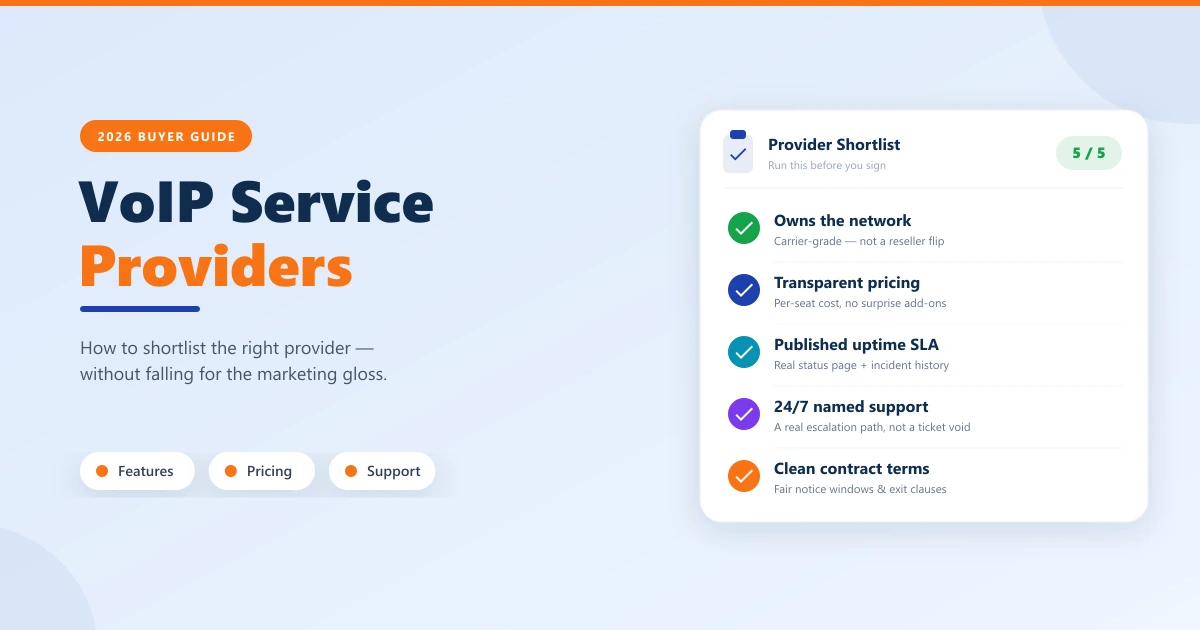
In deze gids wordt uitgelegd hoe de VoIP-markt in 2026 daadwerkelijk werkt, wat serieuze VoIP-serviceproviders onderscheidt van resellers met een nieuwe merknaam, en welke specifieke vragen er opduiken voordat contracten worden ondertekend.
Tegen het einde zul je een raamwerk hebben dat je deze week kunt gebruiken om aanbieders op een shortlist te zetten zonder in marketingglans te vervallen.
- Wat VoIP-serviceproviders eigenlijk zijn – en waarom het eigendom van infrastructuur ertoe doet
- Waarom kopers in 2026 overstappen: AI, hybride teams en realtime analyses
- Onmisbare functies die u moet verifiëren voordat u een contract tekent
- Vier prijsmodelvormen en wat elke beloning oplevert
- Groothandel versus detailhandel: waarom het belangrijk is voor de gesprekskwaliteit en -kosten
- Zes waarschuwingssignalen die op betrouwbare wijze een slechte providerrelatie voorspellen
Wat zijn VoIP-serviceproviders?
Een VoIP-serviceprovider routeert spraakoproepen via internet in plaats van traditionele telefoonlijnen.
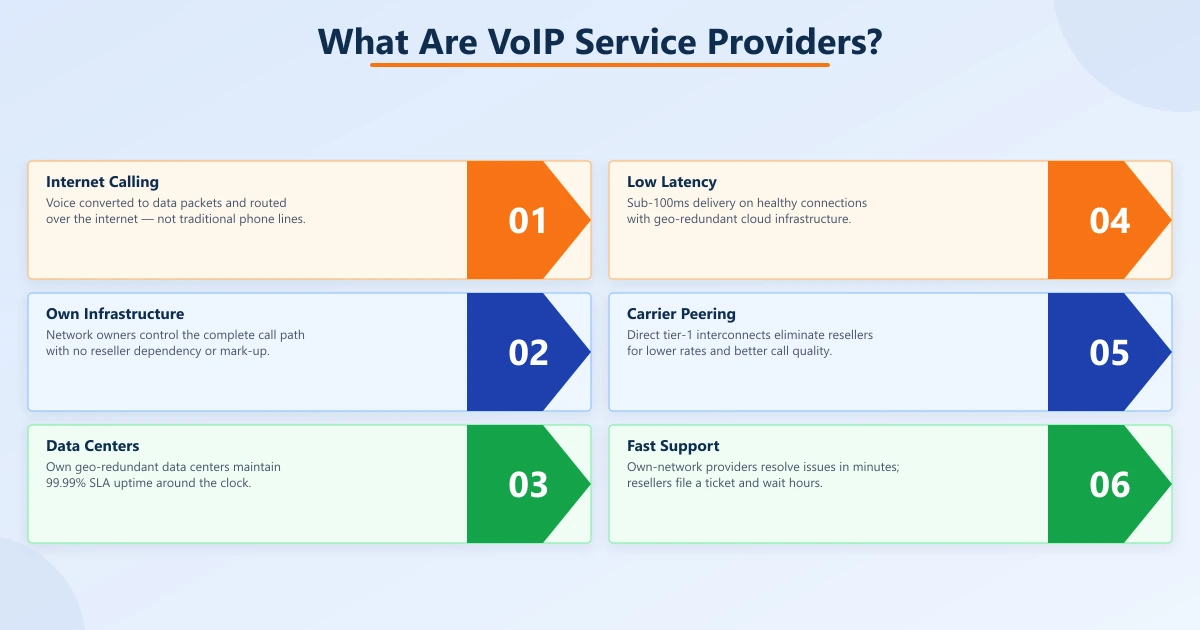
Uw gesprek wordt omgezet in datapakketten, verzonden via het netwerk van de provider en aan de andere kant weer samengevoegd - meestal met een latentie van minder dan 100 milliseconden op een gezonde verbinding.
Maar die technische beschrijving verbergt de echte onderscheidende factor: het eigendom van de infrastructuur. Sommige VoIP-serviceproviders zijn eigenaar van hun kernnetwerk, communiceren rechtstreeks met grote providers en exploiteren hun eigen datacenters.
Anderen zijn wederverkopers die het platform van een ander bedrijf een whitelabel geven, de kosten verhogen en een ondersteuningslaag toevoegen.
Dit onderscheid is belangrijker dan de lijst met functies. Wanneer de gesprekskwaliteit om 15.00 uur afneemt op dinsdag kan een provider die eigenaar is van het netwerk de route traceren, de overdracht van de provider identificeren die het probleem veroorzaakt, en dit binnen enkele minuten oplossen.
Een reseller dient een ticket in bij zijn upstreamprovider en wacht. Voor verkoopteams, supportdesks en contactcenters, vertaalt dat gat tussen minuten en uren zich rechtstreeks in omzetverlies.
Waarom bedrijven in 2026 overstappen op VoIP
De verschuiving van traditionele PBX-systemen gaat niet langer over kostenbesparingen; dat argument werd tien jaar geleden al beslecht. De drijfveer voor 2026 is integratie.
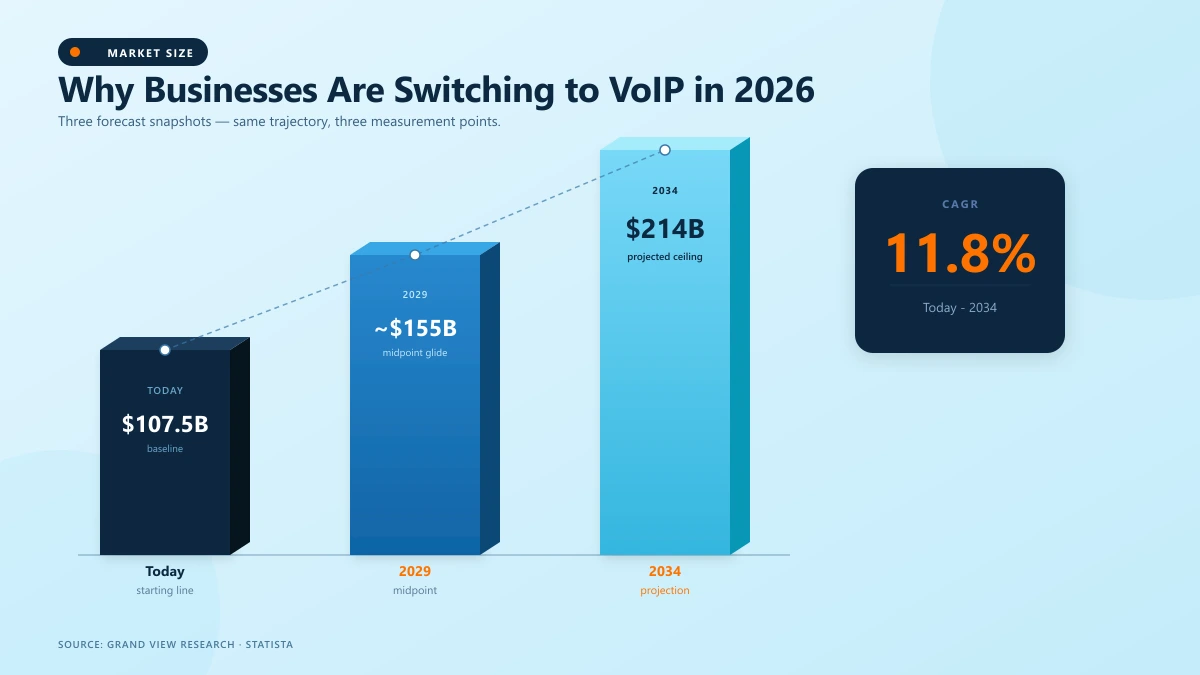
Moderne VoIP-serviceproviders verbinden hun zakelijke VoIP-diensten native met CRM's, helpdesks, AI-agents en analyseplatforms, wat betekent dat elk gesprek gestructureerde gegevens wordt op het moment dat het eindigt. Statistieken over de groei van de VoIP-markt Bevestig dat de adoptie in elk segment versnelt.
Drie trends versnellen de adoptie:
- AI-afhandeling van routineoproepen. Spraakagenten in natuurlijke taal lossen nu 30-40% van de inkomende vragen op zonder menselijke tussenkomst, waardoor vertegenwoordigers vrij zijn voor complexe problemen.
- Hybride en externe teams. Een cloudtelefoonsysteem volgt de werknemer, niet het bureau – cruciaal voor organisaties zonder vast kantoor.
- Realtime analyses. Live wallboards, sentimentscores en dashboards voor gesprekskwaliteit maken van uw stem een meetbaar kanaal, net zoals e-mail en chat dat al zijn.
Onmisbare functies om naar te zoeken
Functiepariteit is misleidend. Bijna elke aanbieder zet op een vergelijkingspagina dezelfde vinkjes, maar de diepgang daarachter varieert enorm. Concentreer u op deze categorieën bij het vergelijken van VoIP-serviceproviders en de VoIP-functies die zij daadwerkelijk leveren.
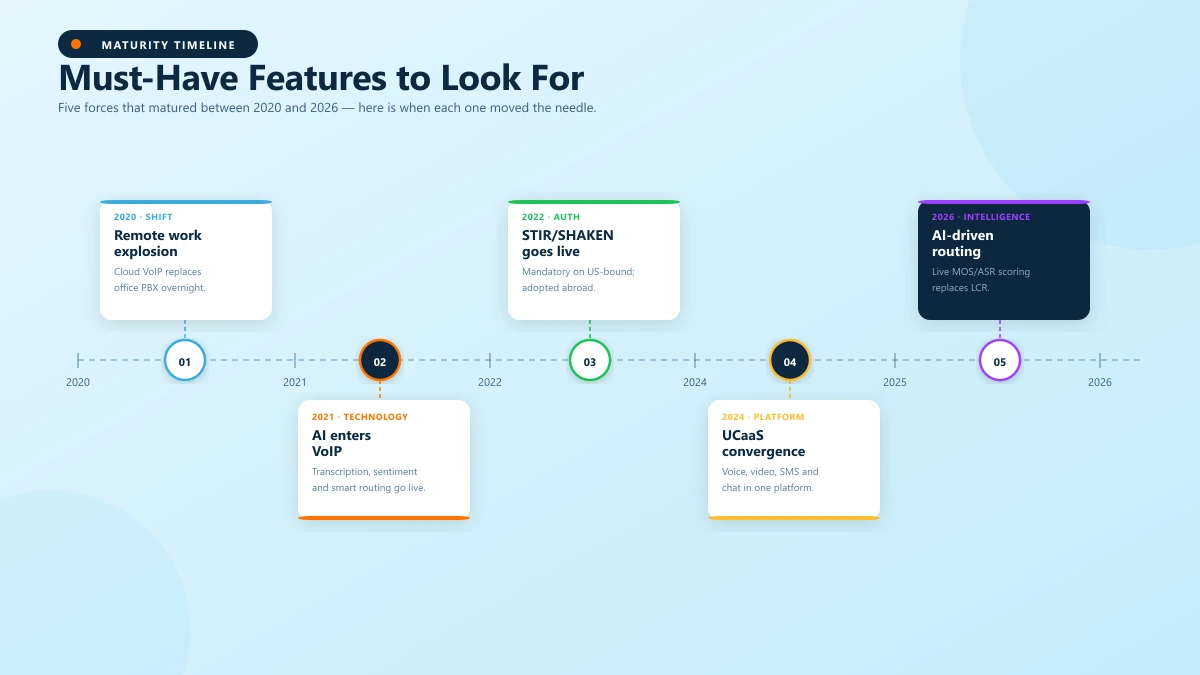
Gesprekskwaliteit en betrouwbaarheid: standaard HD-spraak (G.722- of Opus-codec), geografische redundantie over ten minste twee datacenters en een gepubliceerde gemiddelde opiniescore (MOS) - niet alleen 'carrier-grade' marketing.
Communicatiekanalen: spraak-, sms-, mms- en teamberichten vanuit één interface, webgebaseerde videoconferenties zonder downloads en nummeroverdracht inbegrepen, niet per nummer in rekening gebracht.
AI-aangedreven contactcenter mogelijkheden: NLP-gestuurde IVR die de intentie begrijpt, automatische gesprekssamenvattingen en CRM-updates na het gesprek, en sentiment- en trefwoorddetectie in realtime.
Rapportage en controle: Live dashboards, statistieken per agent en per wachtrij, en API-toegang voor aangepaste integraties. Beveiliging: end-to-end TLS 1.3- en SRTP-codering, SOC 2 Type II-certificering en op rollen gebaseerde toegangscontroles met auditlogboeken.
Als een aanbieder op een van deze punten aarzelt – of deze achter de betaalmuren van het ‘Enterprise’-niveau begraaft – behandel dat dan als een signaal over hoe de rest van de relatie zal verlopen.
Prijsmodellen – wat u kunt verwachten
VoIP-serviceproviders prijzen hun abonnementen in 2026 in vier veel voorkomende vormen, en elke vorm beloont een ander gebruikspatroon.
De verborgen kosten waar u naar kunt vragen: internationale tarieven, gratis inkomende minuten, kosten voor nummeroverdracht, premium ondersteuning, opnameopslag en API-oproeplimieten. Controleer de gehoste PBX-prijsplannen om modellen te vergelijken voordat u zich vastlegt.
Aanbieders die een transparant tariefoverzicht publiceren en een duidelijke lijst van 'wat niet is inbegrepen', zijn over het algemeen eerlijkere aanbieders dan aanbieders die alles als 'op maat' vermelden.
Voor gebruiksscenario's met grote volumes (verkoopteams, BPO's, contactcenters) zijn de per-minuut- of hybride modellen bijna altijd beter dan de prijzen per gebruiker als je eenmaal op schaal rekent.
- Per gebruiker, per maand. De standaard voor gehoste PBX-implementaties bij kleine en middelgrote bedrijven. Reken op $20-$45 per stoel voor volledige geïntegreerde communicatie.
- Per minuut. Gebruikelijk in groothandels- en uitgaande scenario's met grote volumes. Centen per minuut, maar let op de verbindingskosten en de complexiteit van het tariefdek.
- Gebundelde minuten. Vaste maandelijkse kosten met een royale pool van inbegrepen minuten en vervolgens overschotten per minuut.
- Gelaagde platformplannen. Basis-/Pro-/Enterprise-structuren die geavanceerde functies achter hogere niveaus verbergen.
Groothandel versus retail VoIP-providers – waarom het ertoe doet
De meeste kopers realiseren zich niet dat er twee verschillende lagen zijn op de VoIP-markt. Retailaanbieders verkopen aan eindklanten – bedrijven, contactcentra, individuele gebruikers.
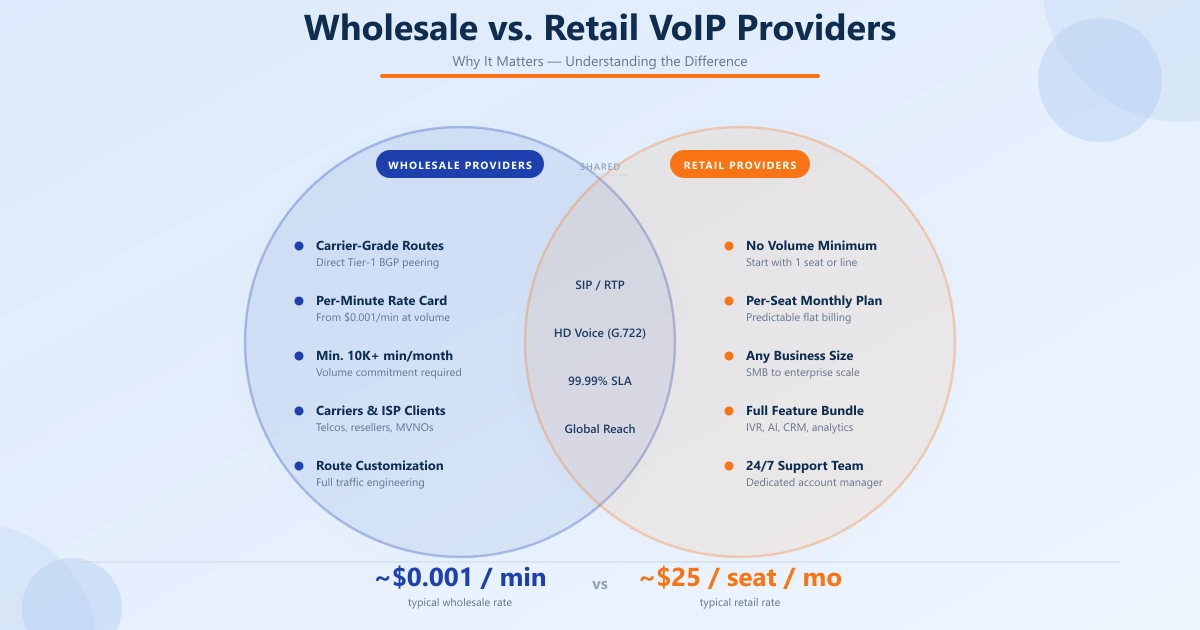
Groothandelaanbieders verkopen gespreksafgifte, -opbouw en DID-inventaris aan andere providers, wederverkopers en grote ondernemingen met hun eigen platforms. Als u VoIP-groothandelsafgifte begrijpt, kunt u beoordelen op welke laag uw provider feitelijk opereert.
Kopen bij een aanbieder die op beide lagen actief is, heeft echte voordelen. Ze hebben een groter deel van het gesprekspad in handen, hebben directe verbindingen met tier-1-providers en kunnen betere tarieven aanbieden omdat ze van niemand in het midden minuten kopen.
Ze hebben doorgaans ook meer volwassen netwerkbeheerscentra, omdat groothandelsklanten meedogenloos zijn als het om kwaliteitskwesties gaat.
Teloz, opgericht in 2005, is een van de VoIP-serviceproviders die zowel in de groothandel als in de detailhandel actief is. Het beschikt over een eigen infrastructuur, werkt rechtstreeks samen met vervoerders en bedient alles, van individuele MKB-bedrijven tot zakelijke contactcenters.
Deze dubbele positionering is zeldzaam en de moeite waard om naar te zoeken, omdat deze meestal samengaat met een betere gesprekskwaliteit, flexibelere commerciële voorwaarden en een snellere foutoplossing.
Wanneer een provider kan antwoorden: "Waar gaat mijn oproep fysiek heen?" met specifieke details – geen algemeenheden – praat u met een serieuze telefoniste.
“De juiste VoIP-serviceproviders zijn niet de goedkoopste of de meest flitsende; zij zijn degenen waarvan de infrastructuur, het prijsmodel en de ondersteuningshouding overeenkomen met hoe uw bedrijf daadwerkelijk spraak gaat gebruiken.”
Rode vlaggen bij het evalueren van VoIP-serviceproviders
Een paar waarschuwingssignalen duiken herhaaldelijk op wanneer kopers later spijt krijgen van hun keuze. Het patroon in dit alles is informatie-asymmetrie.
Aanbieders die transparant opereren – gepubliceerde tarieven, openbare statuspagina’s, infrastructuur op naam, genereuze proefversies – wedden op de kracht van hun product. Degenen die de details verbergen, wedden op uw overstapkosten zodra u vastzit.
- Vage antwoorden over infrastructuur. ‘Wij maken gebruik van toonaangevende datacenters’ is geen antwoord. Vraag naar specifieke namen van faciliteiten en geografische dekking.
- Geen proefperiode of alleen een korte proefperiode. Een betrouwbare provider geeft u 14 tot 30 dagen de tijd om te testen op echt verkeer.
- Ondersteuningsniveaus gekoppeld aan uitgaven. Als 24/7 ondersteuning het beste plan vereist, kunt u er rekening mee houden dat storingen langer zullen duren dan zou moeten.
- Agressieve meerjarige lock-ins. Lange contracten met hoge kosten voor vroegtijdige beëindiging betekenen meestal dat het product geen klanten op basis van verdienste kan behouden.
- "Onbeperkte" minuten met fair-use-clausules. Lees de kleine lettertjes: er is bijna altijd een zachte pet.
- Geen openbare uptime-pagina. Volwassen aanbieders publiceren statusgeschiedenis; onvolwassenen verbergen het.
Conclusie
De juiste VoIP-serviceproviders zijn niet de goedkoopste, de meest opvallende of degenen met de langste lijst met functies.
Zij zijn degenen waarvan de infrastructuur, het prijsmodel en de ondersteunende houding overeenkomen met hoe uw bedrijf de komende vijf jaar daadwerkelijk spraak gaat gebruiken.
Begin met het eigendom van de infrastructuur. Controleer de gesprekskwaliteit met een echte proefperiode.
Lees de kleine lettertjes van de prijs. Stel ongemakkelijke vragen over uptime en ondersteuning en kijk hoe de antwoorden worden gegeven.
De VoIP-serviceproviders die reageren met specifieke gegevens (namen, nummers, contracten) zijn bijna altijd degenen die moeten kiezen.
Kijk hoe Teloz VoIP op ondernemingsniveau benadert op Teloz.com.


