Introduction
Your phone buzzes mid-dinner and the screen just says 1-866. Bank fraud department?
A callback you actually asked for? Or the fortieth robocall this month?
That three-second hesitation is basically the whole story of the 866 area code in miniature.
It is not a city, a state, or even a real place — it is one of several toll-free prefixes companies use to let customers call in for free, and scammers have caught on to how much trust that "toll-free" label still buys.
Below: what 866 actually is, how it came to exist, the mechanics behind the routing, why companies still compete over vanity 866 numbers, and the tells that separate a legitimate call from one that wants your gift card numbers.
- What the 866 area code is and why it has no location
- How toll-free billing flips the call cost to the business
- When 866 joined the 800, 888, and 877 family in 1999
- How 866 call routing works behind the scenes
- Why businesses pick 866 over 800 and what they use it for
- How to get an 866 number and how to avoid 866 scams
What Is the 866 Area Code?
Despite what the digits suggest, 866 is not attached to any city, county, or state.
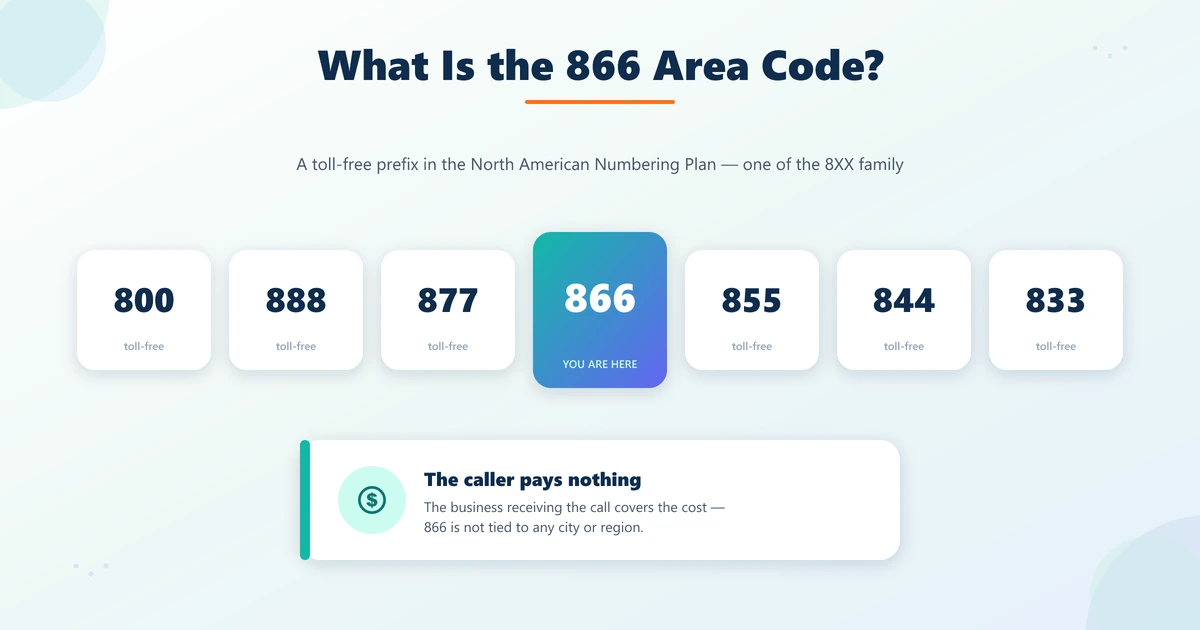
It is one of several toll-free prefixes that work identically across the whole North American Numbering Plan (NANP) — the US, Canada, Bermuda, and a handful of Caribbean territories all dial into the same system.
The mechanic that actually matters is who gets billed. Dial a normal ten-digit number and you are paying for the call. Dial an 866 number and the company on the other end absorbs that cost instead, which is the entire point of the "toll-free" label.
Flip over a credit card, skim a warranty booklet, or scroll to the bottom of almost any company's contact page, and there is usually an 866 (or a sibling prefix) waiting.
It is a small design choice with an outsized effect: strip away the cost of calling, and people call.
- Non-geographic: no single city or state — it works NANP-wide
- Caller pays nothing: the business that owns the line covers the cost
- Coverage: the US, Canada, Bermuda, and parts of the Caribbean
When 866 Joined the Toll-Free Family
866 was not first. That title belongs to 800, which launched in 1966 and became so recognizable that, decades later, the industry ran out of good combinations to hand out.
The fix was to keep adding prefixes as the old ones filled up: 888 in 1996, 877 two years after that, then 866 in 1999. The family kept growing after — 855, 844, and, most recently, 833.
None of that history changes how the numbers behave today. An 866 line is exactly as toll-free, and exactly as legitimate, as an 800 number that has been in service since the 1960s.
The digits just mark when each batch was released, not any difference in what the number can do.
- 1966: 800 — the original toll-free prefix
- 1996: 888 — the first expansion as demand grew
- 1998: 877 — added two years later
- 1999: 866 — joined the toll-free family
- Later: 855, 844, and 833 rounded it out
How an 866 Number Works
Under the hood, every toll-free number lives in a shared industry database that decides where each call actually lands. That routing layer is doing more work than most callers realize.
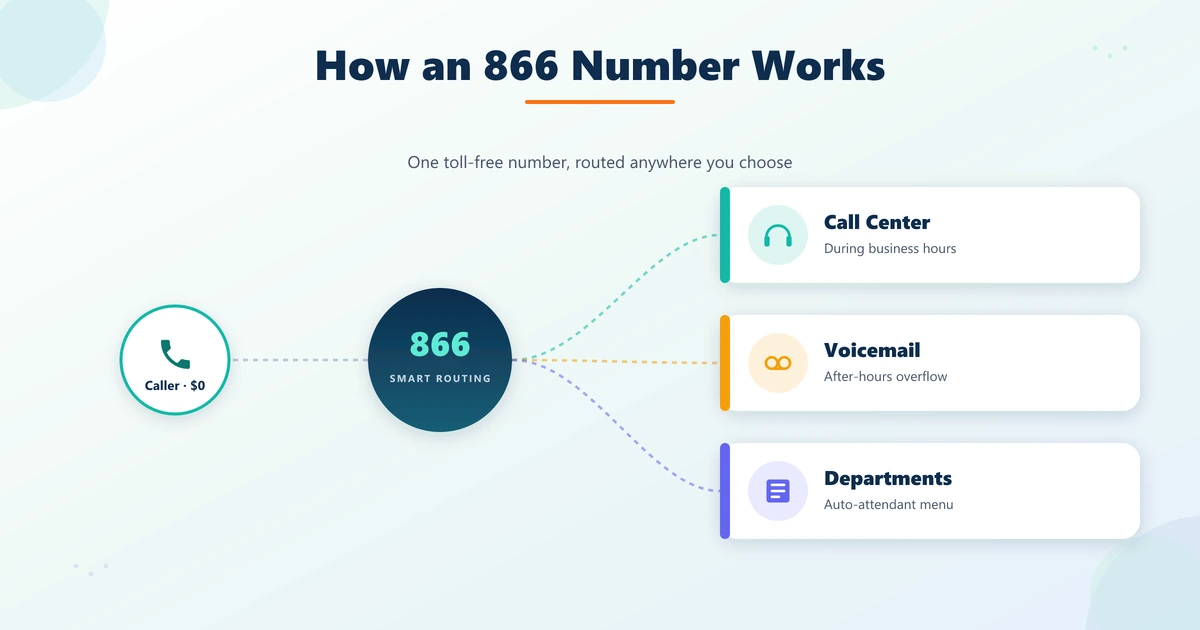
A company might send its 866 line to a live call center during business hours and drop straight to voicemail after that, or fan calls out to different departments through an auto-attendant menu.
Because the number is not tied to geography, it can serve callers on opposite coasts identically, while the team answering sits in one office — or nowhere in particular, if the reps are remote.
It also survives change. A business can switch office buildings, swap phone carriers entirely, or open a second location three states over, and the 866 number printed on years of invoices keeps working without a reprint.
One myth worth killing: an 866 call is not long-distance, and it never costs more just because the number does not "look" local. That is backwards.
The whole reason toll-free prefixes exist is so distance stops mattering — two blocks away or two time zones away, the call costs the caller nothing either way.
866 vs. 800 and What Businesses Use It For
If 866 and 800 work identically, why would anyone pick 866? Mostly because 800 has been claimed for decades and the good combinations — the ones that spell a word or match a brand — got taken long ago.
866 arrived later, so the pool of available, memorable numbers is simply deeper.
The underlying appeal has not changed: a toll-free number still signals that a company is established enough to cover the cost of its own customer calls, and it still removes the one hesitation — will this cost me anything? — that keeps some customers from picking up the phone at all.
Support desks, sales hotlines, and order lines are where these numbers show up most.
There is also a quieter marketing use. Because toll-free numbers are trivial to track, a company can run several ad campaigns with several different 866 numbers and know, without guessing, which one actually made the phone ring.
A number stops being just a way to receive calls and becomes a measurement tool.
What happens after the call connects depends on the platform behind it.
Teloz has built business communication systems since 2005, and pairing an 866 number with that kind of intelligent call handling means a call gets greeted and routed with some actual logic behind it, instead of dropping into a queue and hoping someone picks up.
The number gets the call in the door; everything after that is the technology's job.
How to Get an 866 Number
Getting an 866 number takes less time than most people assume — with most cloud providers, the whole process wraps up in well under an hour, sign-up to first ring.
Pair it with an AI-assisted contact center from the start and every inbound call gets greeted and routed with some intelligence behind it, rather than bolting that on later.
Pricing usually breaks down into a small monthly base fee plus per-minute charges that shift with volume, and high-traffic lines often negotiate better per-minute rates once usage climbs.
If the exact 866 combination someone wants is already gone, 855 or 877 does the identical job under a different set of digits.
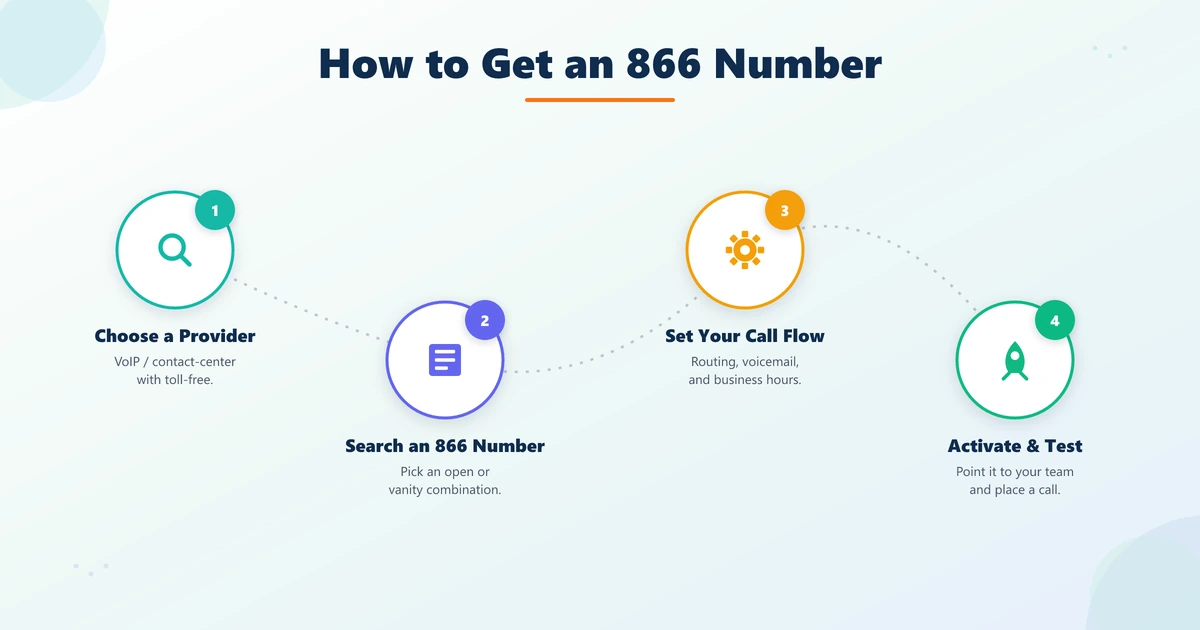
- Choose a provider — a VoIP or contact-center service with toll-free provisioning, IVR, recording, and analytics
- Search for an 866 number — browse open numbers or grab a memorable vanity combination before it goes
- Set your call flow — routing, voicemail, business hours, and optional SMS or call recording
- Activate and test — point the number at your team and place a test call to confirm it connects
“866 was never a place on a map — it is a promise that calling a business costs the customer nothing, full stop.”
Is the 866 Area Code Safe? Scams to Watch
866 itself is completely clean — banks, airlines, retailers, and support desks use it constantly. The problem is that scammers know customers trust toll-free numbers, so they spoof an 866 caller ID and borrow that trust for a few seconds.
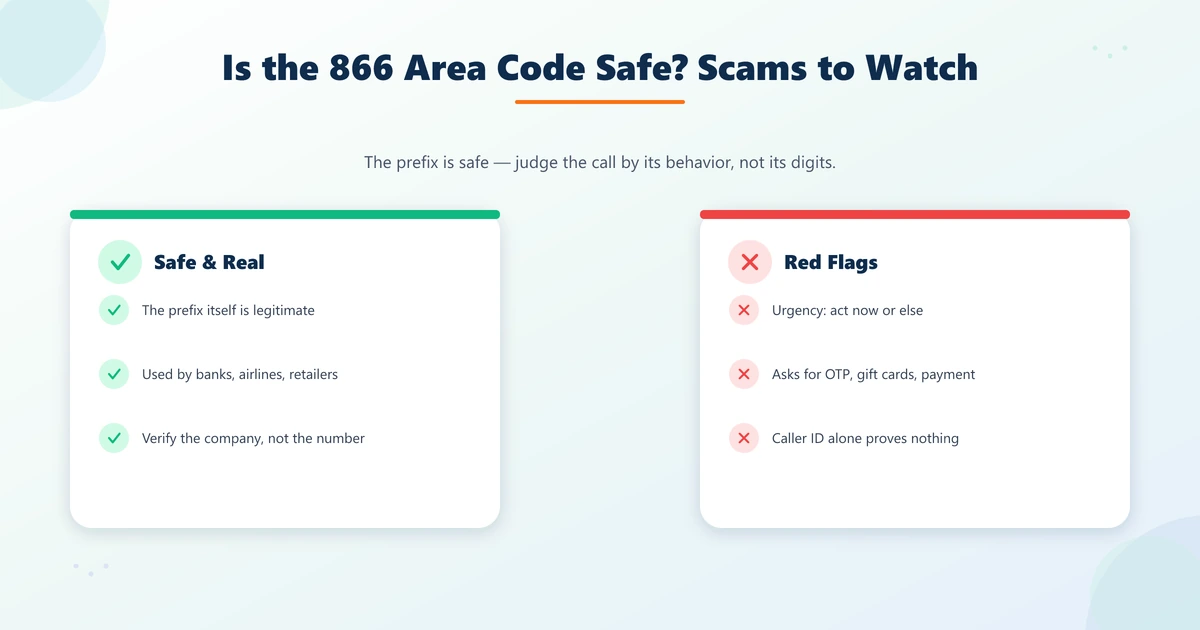
The prefix never gives it away; the ask does. A fake 866 call usually pushes urgency ("your account closes in an hour"), gets cagey when questioned, or asks for a password, a gift card code, or payment through some unusual channel.
Legitimate companies do not operate that way, regardless of what number they are calling from.
Here is the uncomfortable part: your bank's real fraud line and someone impersonating it could both show up as the exact same 866 digits.
The number tells you nothing on its own, which is precisely why scammers gravitate toward toll-free prefixes instead of inventing something more suspicious-looking. What the caller wants from you matters far more than what is on the caller ID.
The safest move is to never act on instructions from a call you did not expect. Hang up, then dial the number printed on your card or pulled from the company's actual website.
Sending anything uncertain to voicemail, and refusing to hand over sensitive information based on caller ID alone, blocks nearly every version of this scam without turning away a single real support call.
- Judge the call by its behavior, never by the 866 prefix alone
- Hang up and call the official number on your card or the company website
- Never share passwords, OTPs, gift cards, or payments on an unsolicited call
- Let suspicious calls go to voicemail and verify before acting
Conclusion
866 was never a place — it is a promise that calling a business costs the customer nothing, full stop.
It joined the toll-free family in 1999 as 800 ran out of room, and today it quietly powers a huge share of the support and sales lines people call without thinking twice.
For a business, it signals staying power and removes one small reason not to call; for everyone else, judging a call by what it asks of you, not by the three digits on the screen, is what actually keeps you safe.
Want a toll-free number backed by a contact center that is actually paying attention? See how Teloz handles it at teloz.com.


