Introduction
Over six billion emojis are sent every single day across messaging platforms worldwide — roughly double the volume from 2020. If emoji were a language, it would be among the most actively spoken on Earth.
And like any living language, it shifts: words change meaning, new vocabulary arrives, and the same symbol can mean entirely different things to different speakers.
That last point is where the real problem lives. According to Adobe's Emoji Trend Report, 47% of emoji users have sent an emoji that was misunderstood or taken out of context.
A thumbs up that reads as passive-aggressive. A skull that signals laughter.
A slightly smiling face that implies the opposite of what the sender intended.
The gap between what an emoji means to the person who sent it and what it means to the person who received it has real consequences — in personal conversations, in customer service interactions, and in business SMS campaigns that reach millions of people across age groups.
This guide decodes the most used emojis, the ones with double meanings, the generational divide that changes interpretation entirely, and what is new in the Unicode 16.0 and 17.0 updates.
- By the Numbers: Emoji in Global Communication
- The Most Used Emojis and What They Actually Mean
- The Generational Divide: Same Symbol, Different Message
- Emojis That Mean Something Different Than You Think
- New Emojis: Unicode 16.0 and 17.0 Additions
By the Numbers: Emoji in Global Communication
The scale of emoji usage makes accurate interpretation more consequential than most communicators realize.
6 billion emojis sent daily across platforms including WhatsApp, iMessage, Instagram, TikTok, and Slack — roughly doubling since 2020 as mobile-first communication accelerated post-pandemic.
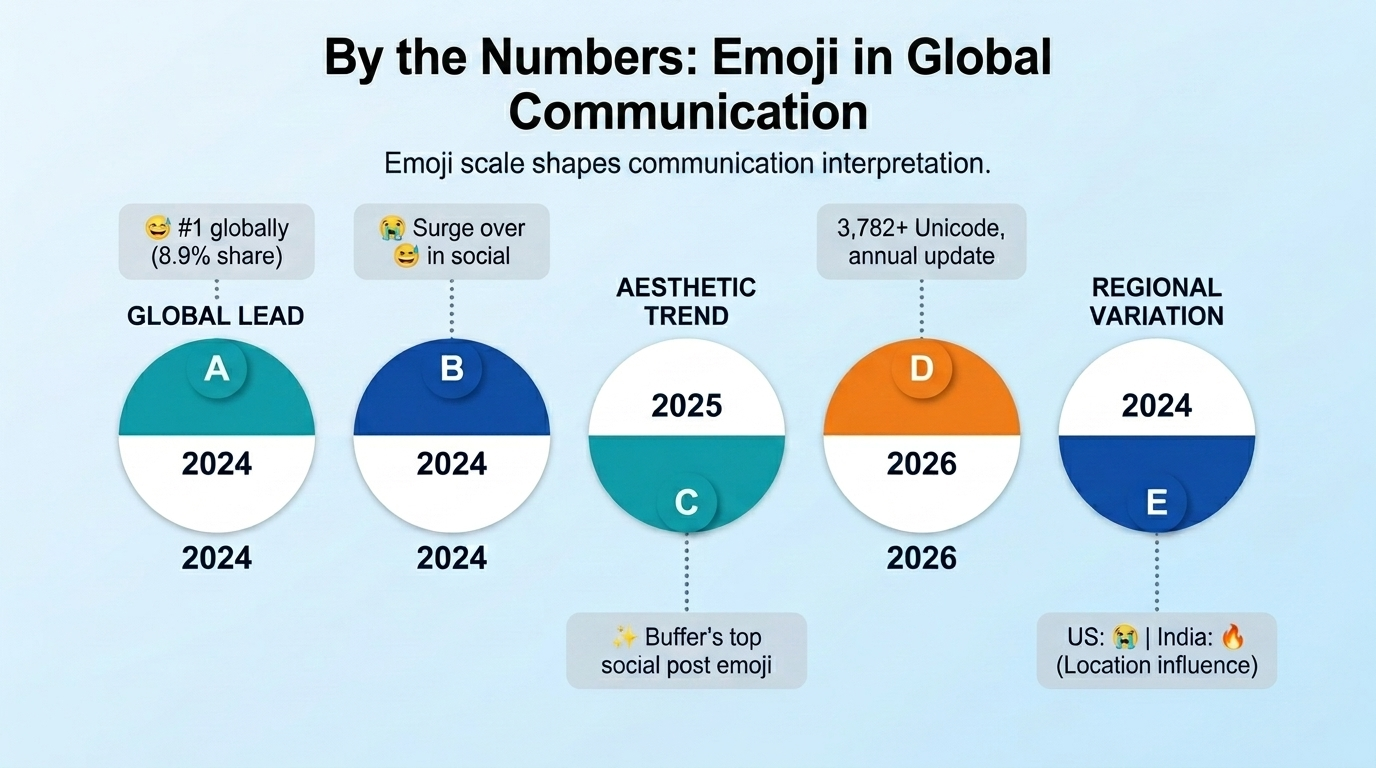
😂 Face with Tears of Joy has been the single most used emoji globally since 2015, accounting for approximately 8.9% of all emoji usage worldwide.
In 2024, 😭 Loudly Crying Face briefly overtook it on social media with approximately 761 million uses from January to November alone.
✨ Sparkles ranked as the most-used emoji in social media posts in 2025 among platforms tracked by Buffer, reflecting its dual role as both a genuine aesthetic marker and a sarcasm signal depending on context.
3,782+ emojis are now included in the Unicode standard as of 2026, with new additions arriving each autumn through the Unicode Consortium's annual release cycle.
Regional preference diverges sharply: the most popular emoji in the United States in 2024 was 😭 Loudly Crying Face, while in India it was 🔥 Fire. Platform culture shapes usage as much as geography does.
Businesses sending high volumes of customer texts typically manage that traffic through a dedicated business SMS and MMS platform.
The Most Used Emojis and What They Actually Mean
😂 Face with Tears of Joy — Laughing so hard you are crying. The most used emoji globally for a decade. Note: Gen Z increasingly views this as a Millennial or Boomer signal; younger users have largely migrated to 💀 for maximum laughter expression.
❤️ Red Heart — Love, affection, deep care. Among the most universally consistent emojis in meaning across generations, cultures, and platforms.
😭 Loudly Crying Face — Can express genuine distress, but is also widely used by Gen Z to mean uncontrollable laughter or emotional overreaction — "I'm literally crying" as an expression of being moved or amused, not actually sad.
🙏 Folded Hands — Commonly mistaken as a high-five. It represents prayer, gratitude, or a plea. In Japanese culture, the gesture means thank you. In Western contexts, it most often signals appreciation or a request.
😍 Smiling Face with Heart-Eyes — Extreme admiration or attraction. One of the most consistent meanings across generations.
🔥 Fire — Something is impressive, exciting, or attractively intense. "That's fire" = that is excellent.
✨ Sparkles — Can signal magic, beauty, or celebration. Increasingly used sarcastically: "Great work ✨" from someone who clearly does not mean it carries a passive-aggressive edge.
💀 Skull — Among older generations: death or danger. Among Gen Z: "I'm dead" = laughing so hard I cannot function. The most significant cross-generational meaning gap in current emoji use.
🥺 Pleading Face — Puppy-dog eyes expressing a request, vulnerability, or cuteness. Widely used across generations with consistent meaning.
👀 Eyes — Watching something unfold with interest or nervousness. Often signals anticipation — dropping a hint that something interesting is happening.
🗿 Moai (Easter Island Statue) — Gen Z usage: deadpan, stoic, zero reaction. "I have no words."
💯 Hundred Points — Complete agreement or endorsement. One of the most consistently positive emojis across generations.
The Generational Divide: Same Symbol, Different Message
The most practically important aspect of emoji meanings in 2026 is not what symbols officially represent — it is what they signal to the specific person receiving them.
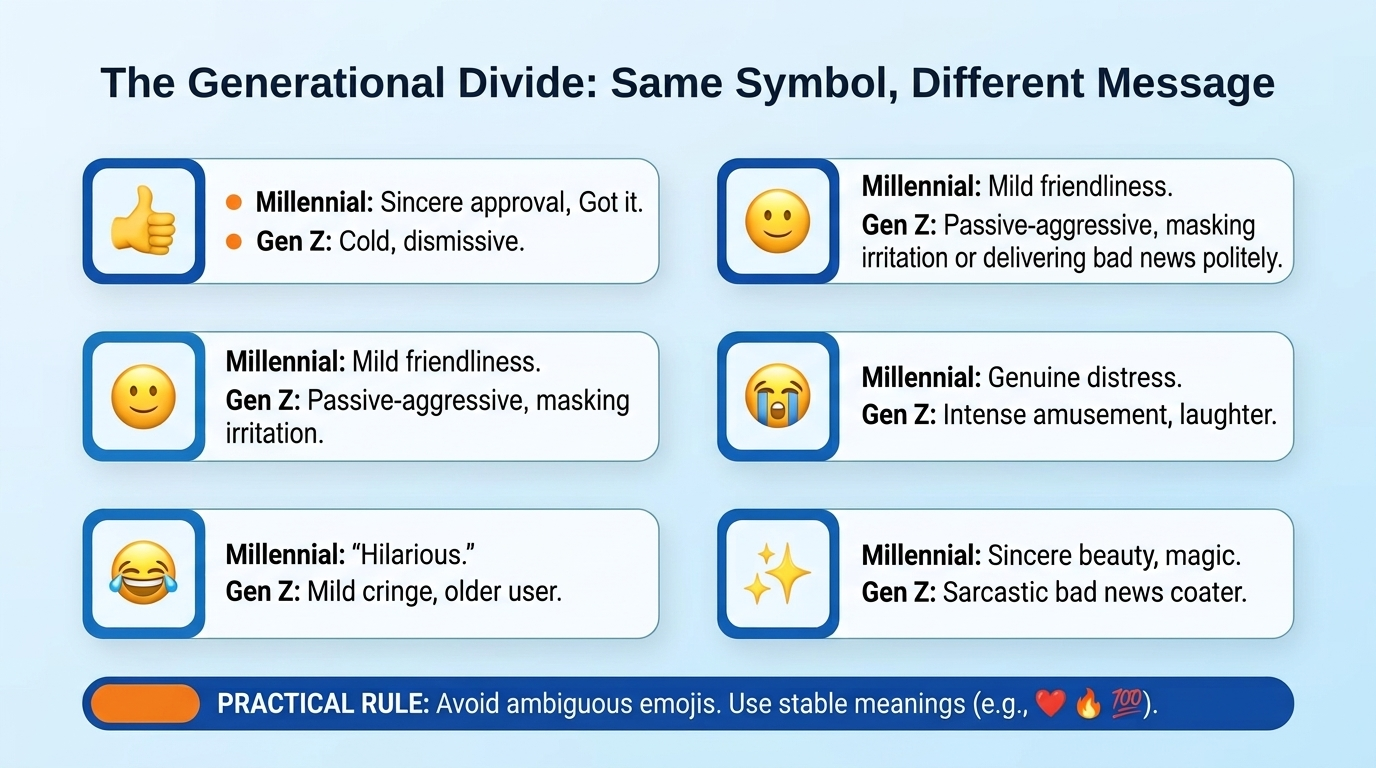
Five emojis carry meanings so divergent between generations that they create real miscommunication risk:
👍 Thumbs Up: Millennials send it as sincere approval — "good work," "got it," "I agree." Gen Z receives it as cold, dismissive, or passive-aggressive.
Sending a thumbs up to a Gen Z colleague as acknowledgment may land as "I don't actually care about this."
🙂 Slightly Smiling Face: Millennials intend it as mild friendliness or neutral positivity. Gen Z reads it as passive-aggressive, masking irritation, or delivering bad news politely. A "We need to talk 🙂" is alarming to a Gen Z reader.
😂 Crying Laughing: Millennials use it as straightforward "this is hilarious." For Gen Z, it has become associated with older users and carries a mild cringe signal — the response to something genuinely funny is more likely 💀 or 😭.
😭 Loudly Crying: Older generations read this as genuine distress. Gen Z deploys it for intense amusement: "😭😭😭" in response to something funny means uncontrollable laughter, not sadness.
✨ Sparkles: Used sincerely to denote magic, beauty, or celebration. Used sarcastically to coat bad news or criticism in false cheer. Context is everything.
The practical rule for businesses managing SMS campaigns: when communicating across generations, favor emojis with stable cross-generational meanings (❤️, 🔥, 💯) over ones with double readings (👍, 🙂, 😂, ✨).
For the full symbol set and version history, see Wikipedia's entry on emoji.
Emojis That Mean Something Different Than You Think
Several common emojis are routinely used in ways that diverge from their official Unicode description:
🙏 Folded Hands — Not a high-five (a persistent misconception). The correct interpretation is prayer, gratitude, or a plea.
The confusion arises because the joined hands can visually suggest two palms clapping from the side, but the Unicode specification and cultural origins are unambiguous: this is a reverential or grateful gesture.
💨 Dashing Away / Wind — Not a fart emoji. Officially represents wind, speed, or something moving fast.
The confusion with flatulence is near-universal in informal Western use; the emoji was not designed for this but is widely deployed that way regardless.
🥜 Peanuts — Beyond its literal meaning, this emoji carries slang associations in Gen Z and internet culture contexts that make it unsuitable for professional communication.
🍆 Eggplant and 🍑 Peach — Officially: a vegetable and a fruit. In practice: almost exclusively used for sexual innuendo across virtually all English-speaking digital contexts.
These two emojis are effectively coded for adult content and carry that signal regardless of the sender's intent.
😏 Smirking Face — Officially "smirking" but carries strong implications of smugness, flirtation, or knowing something the other person does not. The smirk reads as suggestive in many contexts.
New Emojis: Unicode 16.0 and 17.0 Additions
The Unicode Consortium releases new emojis annually each September. Two recent releases have added significant new symbols — though with an important caveat about platform availability.
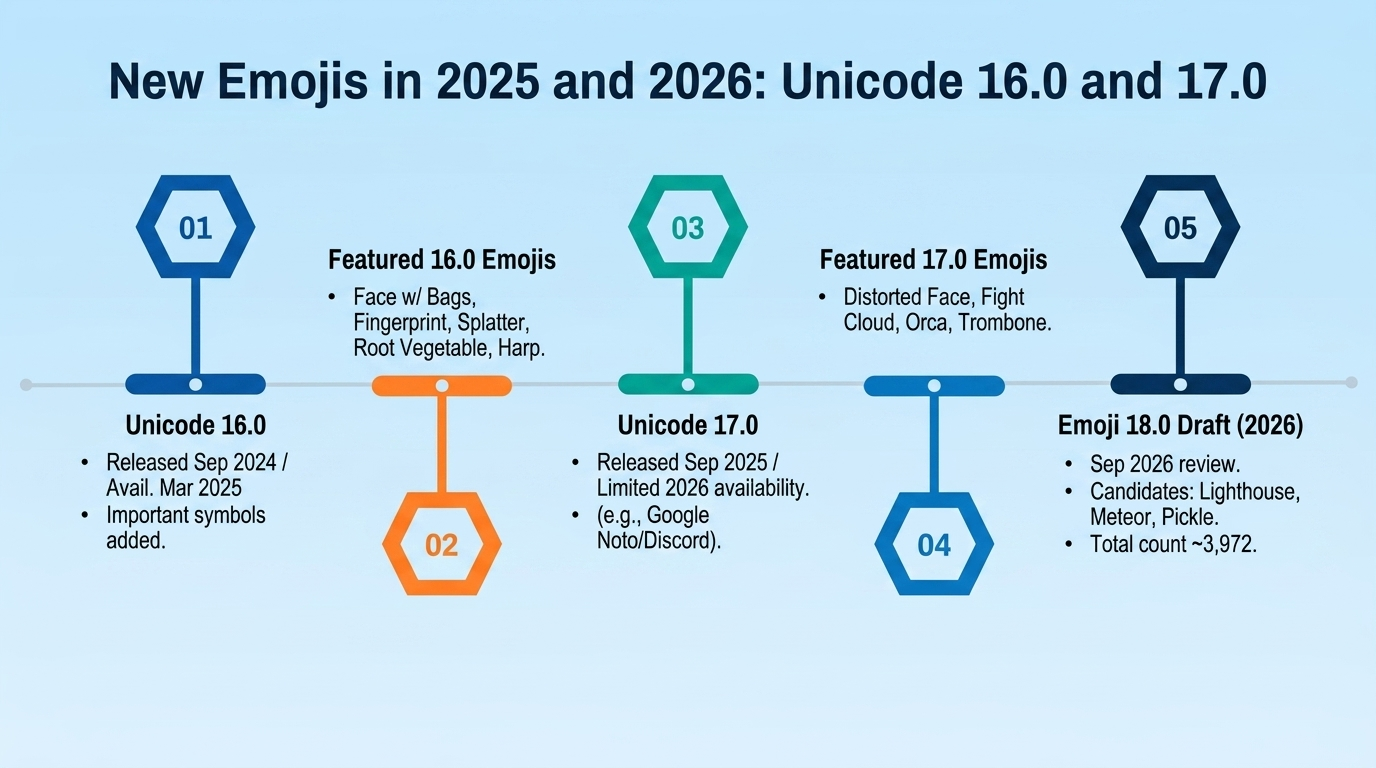
Unicode 16.0 (Released September 2024 — Available since March 2025): Eight new emojis were added: Face with Bags Under Eyes, Fingerprint, Splatter, Root Vegetable, Leafless Tree, Harp, Shovel, and the Flag for Sark.
These became available on iPhone with iOS 18.4 in March 2025 and on Android through Google's updates in the same period.
Unicode 17.0 (Released September 2025 — Limited platform availability in 2026): Seven new emojis were approved: Distorted Face, Fight Cloud, Orca, Hairy Creature, Trombone, Landslide, and Treasure Chest.
As of mid-2026, these are available in Google's Noto font and Discord's Twemoji but have not yet appeared on standard iPhone or Android keyboards. Full details are available on Emojipedia's Unicode 17.0 update.
This creates the "emoji gap" problem: a sender on Discord can use Distorted Face, but a recipient reading the message on a standard iPhone sees an empty box or a question mark instead.
Looking ahead: Unicode's 2026–2027 draft list includes candidates such as a Lighthouse, Meteor, Pickle, and Cracking Face.
If the full draft is approved at the September 2026 review, Emoji version 18.0 will bring the total to approximately 3,972 standard emoji.
“Discover what emojis mean — from the most used symbols to generational misunderstandings, new Unicode 16.0 additions, and business communication tips.”
Emojis in Business and Professional Communication
For businesses using emoji in customer-facing channels — SMS marketing, customer service chat, social media responses, or email subject lines — the stakes of emoji misinterpretation are higher than in personal use.
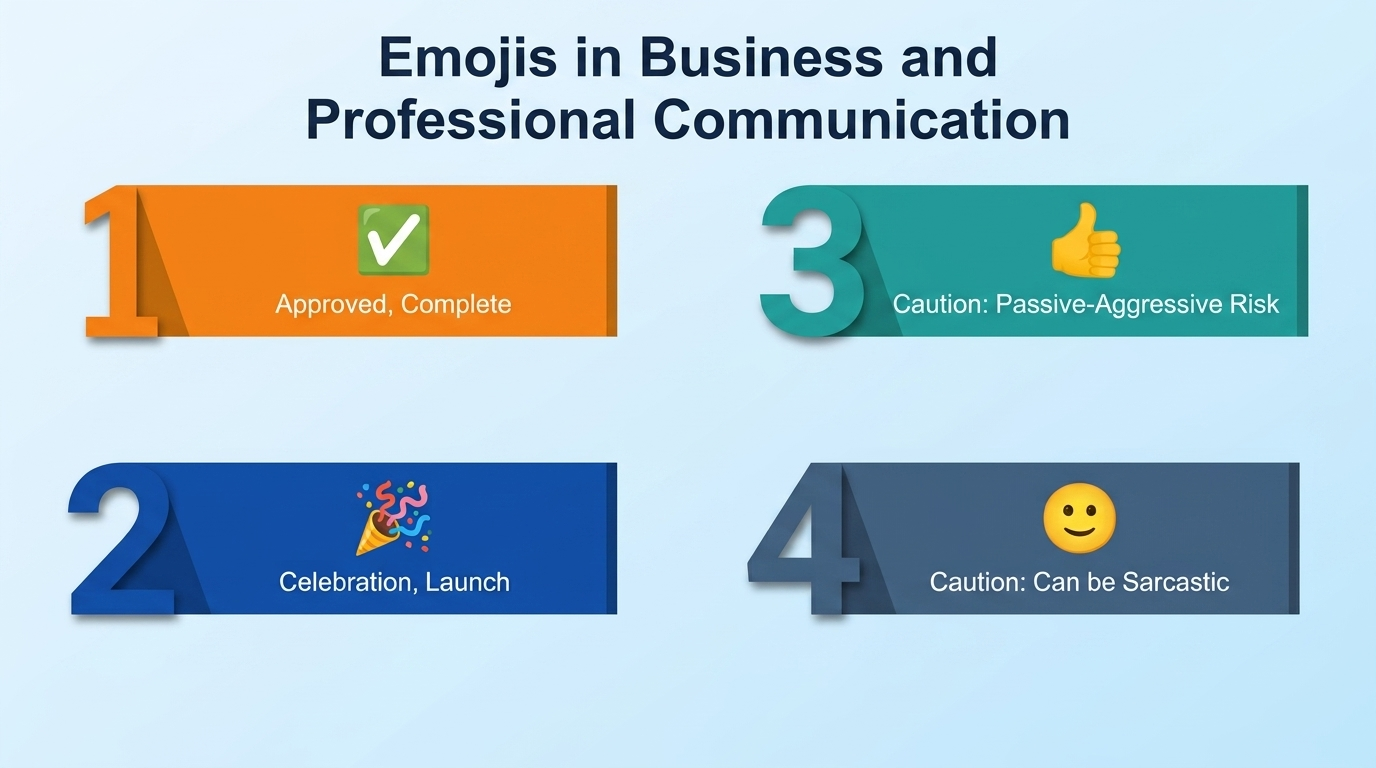
A misread emoji in a promotional message reaches thousands of recipients simultaneously.
High-performing business emojis (consistent meaning, positive association across demographics):
Emojis to use cautiously in business contexts: - 👍 Thumbs Up — passive-aggressive connotation for a significant portion of younger audiences - 🙂 Slight Smile — can read as cold or sarcastic to Gen Z recipients - 😂 Crying Laughing — risks reading as out-of-touch in Gen Z-heavy demographics - ✨ Sparkles — sarcasm risk in contexts where sincerity is expected
Research consistently shows that emoji in SMS marketing subject lines and message bodies increase click-through rates when the emoji matches the tone and is unambiguous in meaning.
Teloz's business SMS platform delivers full Unicode emoji support across all major carrier networks, ensuring your emoji-enhanced customer communications render correctly for every recipient.
Teams coordinating tone across a support or sales inbox often standardize emoji usage inside a shared team chat tool.
- ✅ Check Mark — task complete, confirmed, approved
- 🎉 Party Popper — celebration, launch, milestone
- 📣 Megaphone — announcement, news, alert
- ❤️ Red Heart — warmth, appreciation
- 🔔 Bell — notification, reminder
- 💡 Lightbulb — idea, tip, insight
- 🎁 Gift — offer, promotion, reward
Conclusion
Emoji are not decoration — they are a parallel communication layer that carries tone, emphasis, and cultural signal alongside the words they accompany. When that signal aligns with intent, emoji improve communication clarity and warmth.
When it does not — when a thumbs up reads as dismissal, a skull means laughter, or a new emoji arrives as an empty box — the gap between sender and receiver widens.
The two most important things to know in 2026: emoji meanings are generationally stratified in ways that create genuine miscommunication risk across age-diverse audiences, and new Unicode 17.0 additions are not yet universally available across devices.
Favor emojis with stable cross-generational meanings, check platform availability before deploying new symbols, and treat emoji choices in customer-facing communications with the same care as word choice.


