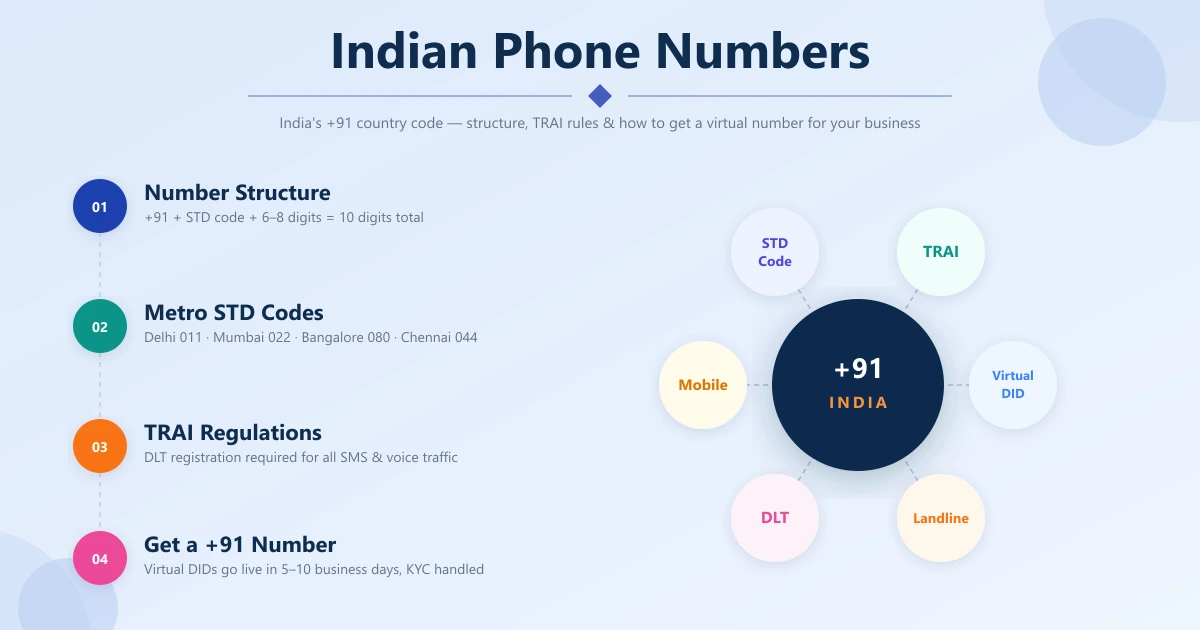
Introduction
Customers in India don't pick up calls from foreign numbers. International area codes get filtered as spam, blocked by Do-Not-Disturb registries, or simply ignored.
The answer is straightforward — get an Indian phone number — but the process of acquiring one as a non-resident business is anything but. India operates one of the most regulated telecom markets in the world, with rules covering caller-ID, registration, telemarketing consent, and exactly the kind of phone number a foreign business can legally use to reach Indian consumers.
This guide walks through how Indian phone numbers actually work, what +91 means, the difference between mobile and landline formats, the TRAI rules that affect every inbound and outbound call, and exactly how a non-resident business gets an Indian number that customers actually answer.
- The +91 country code and the 10-digit structure of Indian phone numbers
- Major metro STD codes — Delhi (11), Mumbai (22), Bangalore (80), Chennai (44), and more
- Mobile vs landline vs virtual number types and their use cases
- TRAI, DLT registration, and the compliance steps foreign businesses must complete
- Why local Indian numbers achieve 3× higher pickup rates than foreign caller IDs
- Step-by-step guide to getting an Indian phone number from outside India
How Indian Phone Numbers Are Structured
An Indian phone number always begins with the country code +91. After that, the number divides into a regional or carrier prefix plus a subscriber number, totaling 10 digits in most modern cases.
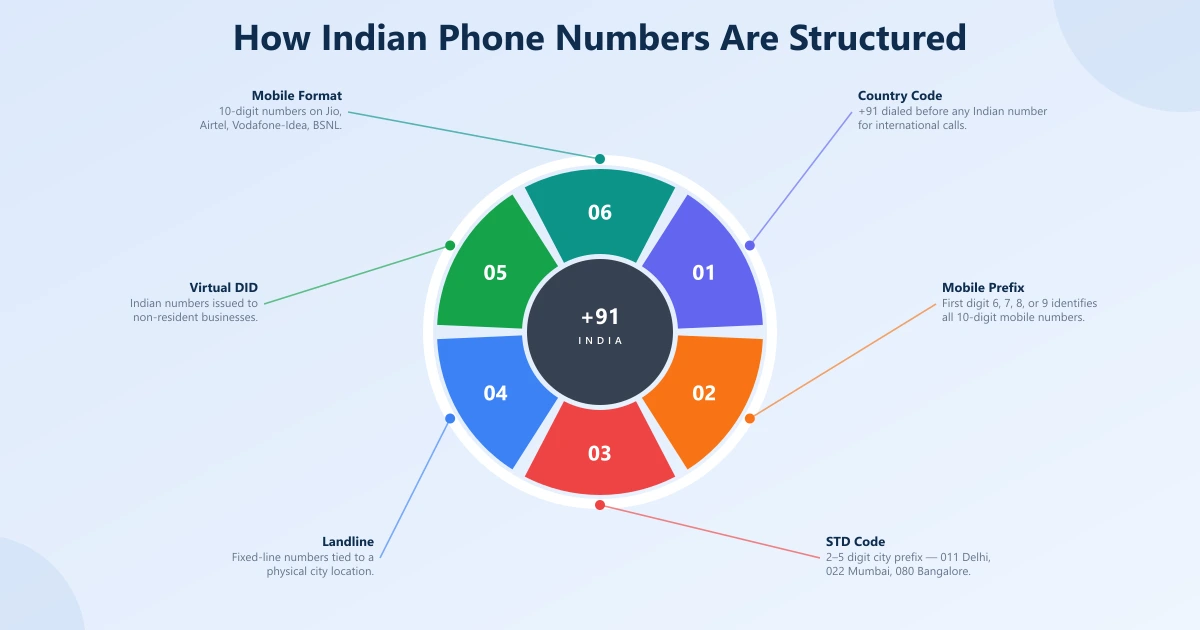
Examples: a Mumbai landline is +91 22 XXXX-XXXX (STD code 22), a Delhi landline is +91 11 XXXX-XXXX (STD code 11), and a typical mobile is +91 9XXXX-XXXXX or +91 8XXXX-XXXXX.
Indian mobile numbers are 10 digits, always starting with 6, 7, 8, or 9 — a uniformity that makes them easy to spot. Indian landlines use Subscriber Trunk Dialing (STD) codes ranging from 2 digits in the largest metros to 4-5 digits in smaller cities.
The TRAI manages the entire numbering plan and updates it as inventory pressure grows.
- +91 — country code for calling India internationally
- 0 — trunk prefix used when dialing within India from a landline
- STD code or mobile prefix — 2-5 digits for landlines, or a 10-digit mobile starting with 6, 7, 8, or 9
- Subscriber number — the unique line identifier
Major Metro Codes and Their Cities
For landline calls into Indian cities, the STD code identifies the specific metro region. Knowing the major codes helps when reading or dialing Indian numbers manually.
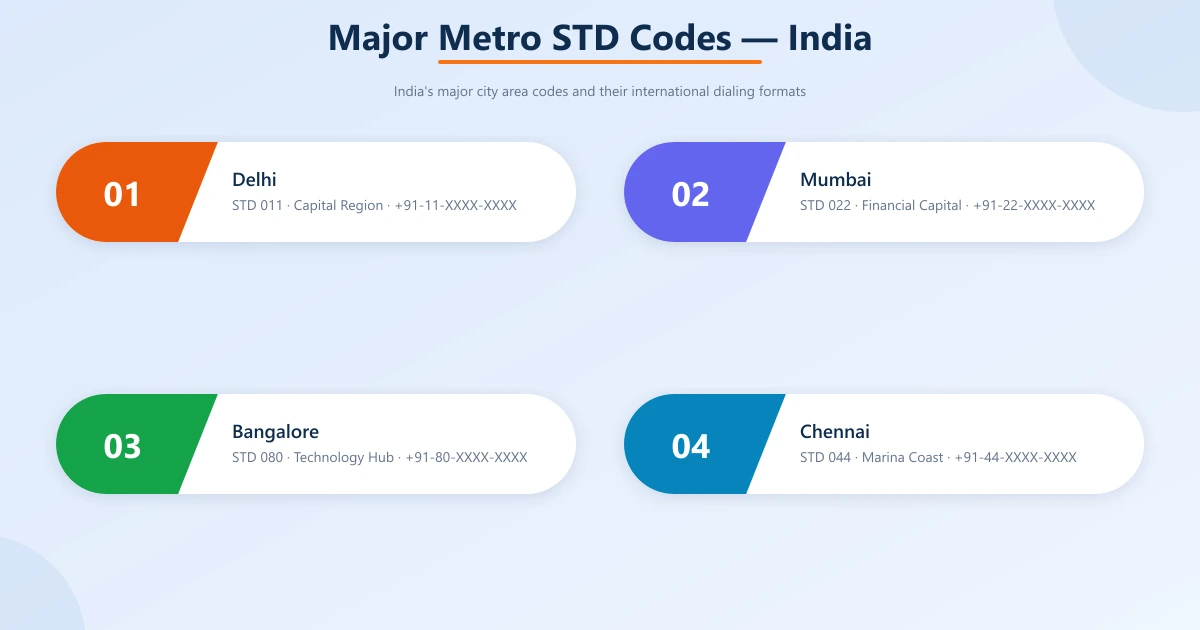
Together, these metros account for over 200 million people and the majority of Indian business activity. Tech companies cluster around Bangalore (80), Hyderabad (40), and Pune (20).
Financial services concentrate in Mumbai (22). Government and policy work centers on Delhi (11).
Manufacturing and logistics span Ahmedabad (79) and Chennai (44).
For a foreign business expanding into India, choosing the right metro STD code can make a noticeable difference in customer recognition. A Bangalore lead is more likely to recognize and answer a +91 80 number than a different metro code, even if the call routes identically.
- 11 — Delhi (and NCR)
- 22 — Mumbai
- 33 — Kolkata
- 44 — Chennai
- 40 — Hyderabad
- 80 — Bangalore
- 79 — Ahmedabad
- 20 — Pune
- 141 — Jaipur
- 172 — Chandigarh
- 522 — Lucknow
Mobile vs Landline vs Virtual: What Each Type Looks Like
Indian phone numbers come in three functional categories. Each has different rules, different costs, and different use cases.
Most foreign businesses use virtual mobile-format numbers for outbound calling and landline-format numbers for inbound customer support.
- Mobile numbers (10 digits starting with 6, 7, 8, or 9) — issued by Reliance Jio, Bharti Airtel, Vodafone Idea, and BSNL; used for personal subscribers, WhatsApp, OTP delivery, and contact center outbound dialing; mandatory KYC at registration (Aadhaar or PAN); most commonly answered by Indian consumers
- Landlines (STD code + subscriber number) — tied to a physical address or business location; used by enterprise offices, government, and customer support centers; lower per-minute termination cost than mobile; caller ID presents the metro region clearly
- Virtual numbers / DIDs — Indian phone numbers issued to non-resident businesses through licensed wholesale providers; route to any SIP endpoint, cloud PBX, or contact center platform; present a real Indian metro identity (mobile or landline-style); subject to TRAI registration before going live
TRAI, DLT, and the Regulations Foreign Businesses Must Follow
The Telecom Regulatory Authority of India (TRAI) sets the rules for every voice and SMS service operating in India. Foreign businesses cannot simply buy an Indian phone number and start dialing — mandatory compliance steps must complete before traffic flows.
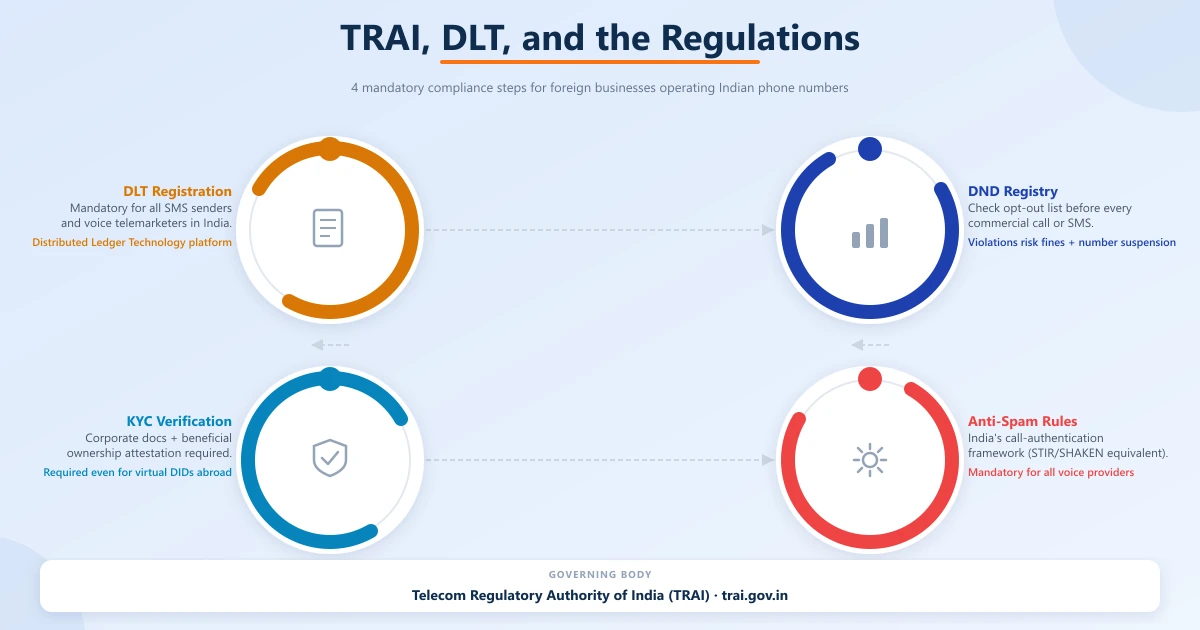
Wholesale VoIP origination providers that handle Indian DID issuance manage these compliance steps as part of standard onboarding.
- DLT (Distributed Ledger Technology) registration — all commercial SMS senders and voice telemarketers must register their entity, message templates, and consent records on India's DLT platform; applies to OTP delivery, customer notifications, and marketing campaigns
- National Do-Not-Disturb (DND) registry — Indian consumers can register their numbers in the DND list; calling or messaging DND-registered numbers without explicit consent is a regulatory violation that can result in fines and number suspension
- KYC for number assignment — any Indian phone number, including virtual numbers issued to foreign businesses, requires KYC verification; wholesale providers handle this on behalf of customers but require corporate documentation, beneficial ownership, and use-case attestation
- Call-authentication and anti-spam rules — India is developing its own call-authentication framework similar to STIR/SHAKEN, focused on telemarketing fraud reduction; compliance is mandatory for voice service providers operating Indian routes
Why a Local Indian Number Improves Answer Rates
Indian consumers answer calls from local Indian numbers far more often than from international numbers. The behavioral data is consistent across industries. TRAI's National Do-Not-Disturb regulations and OS-level spam filtering mean unfamiliar foreign caller IDs rarely reach a recipient's screen at all.
A US-based SaaS company calling Indian leads with a US number typically sees pickup rates of 8-12%. Switching to a local Indian virtual number boosts that to 25-40%. The same effect applies to customer support, recruitment outreach, and B2B sales.
- Trust — a +91 number looks like a normal Indian call, not an international scam
- DND filtering — Indian carriers and OS-level spam filters aggressively block unfamiliar foreign codes
- Reachability cost — Indian carriers do not charge customers extra for inbound calls from local numbers
- Local time recognition — customers know a +91 80 (Bangalore) caller is in their time zone
“A US-based SaaS company calling Indian leads with a US number typically sees pickup rates of 8-12%. Switching to a local Indian virtual number boosts that to 25-40%.”
How to Get an Indian Phone Number from Outside India
Securing an Indian phone number as a non-resident business is straightforward when you work with a wholesale VoIP provider experienced in Indian telecom rules.
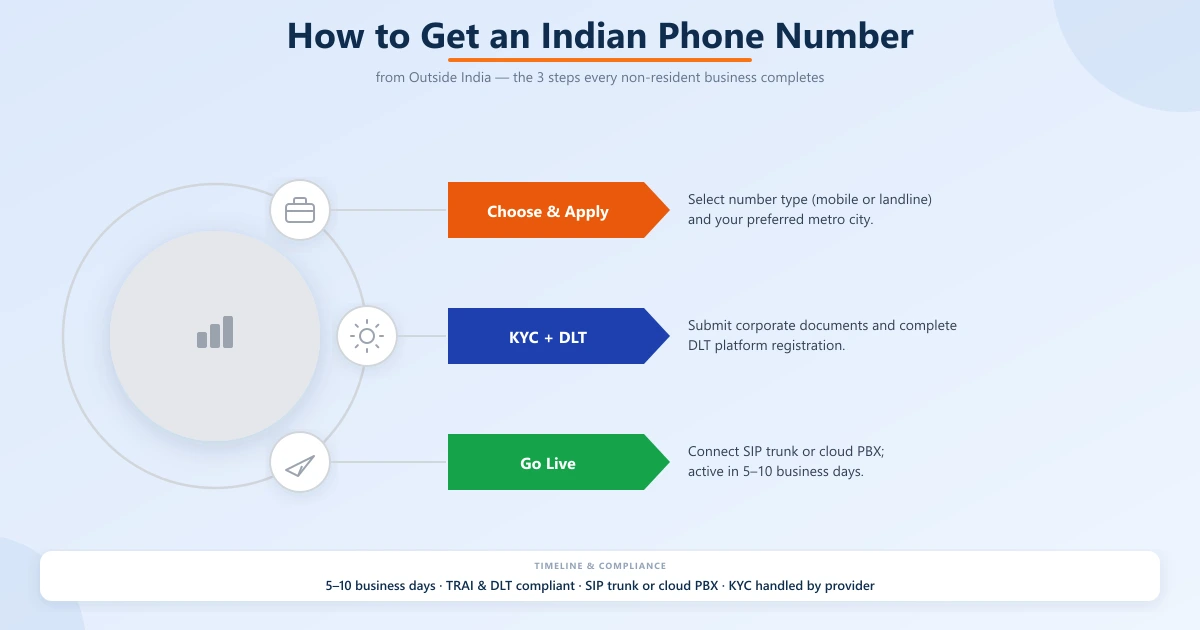
Teloz handles Indian DID provisioning in mobile and landline formats, TRAI and DLT registration support, compliance attestation for OTP, marketing, and customer support use cases, routing to any SIP endpoint or cloud PBX globally, and real-time KPI monitoring (ASR, MOS, PDD) on Indian routes. Teloz delivers Indian phone numbers across Mumbai, Delhi, Bangalore, Chennai, Hyderabad, and other major metros with full compliance support.
See our Indian virtual number page for current availability and pricing.
- Choose your number type — mobile-style for outbound dialing, landline-style for inbound support
- Provide KYC documentation — corporate registration, beneficial ownership, intended use case
- Complete DLT registration — required for any commercial SMS or marketing voice traffic
- Connect your endpoint — SIP trunk, cloud PBX, or contact center platform
- Configure compliance — DND list checking, consent records, call recording where required
- Go live — typically 5-10 business days for first traffic; most wholesale providers handle steps 2-5 as part of onboarding
Conclusion
Indian phone numbers operate under one of the world's most regulated telecom frameworks — and getting one as a non-resident business requires understanding the +91 country code structure, the difference between mobile and landline formats, the TRAI rules that govern caller-ID and consent, and the practical reality that local Indian numbers answer far more often than international ones. Whether you're scaling sales into India, supporting Indian customers from abroad, or running marketing campaigns for the Indian market, the right Indian phone number is the difference between being heard and being ignored.


