Introduction
20 ans dans les télécommunications vous apprennent avant tout une chose : un centre d'appels vit ou meurt en fonction de la rapidité avec laquelle il fait surface, et non en fonction du nombre de lignes qu'il peut transporter.
Les bonnes solutions de centre d'appels VoIP montrent à l'agent qui appelle, pourquoi il appelle et quoi dire ensuite, avant la deuxième sonnerie. Tout le reste est de la plomberie.
Ce guide présente ce que les solutions sérieuses de centres d'appels VoIP offrent réellement en 2026, d'où vient le véritable retour sur investissement et les compromis que les acheteurs ont tendance à négliger jusqu'au renouvellement.
Que vous mettiez en place votre premier service d'assistance de 10 postes ou que vous migriez une opération de 500 agents à partir d'un matériel existant, le cadre ci-dessous s'applique.
- Que sont les solutions de centre d'appels VoIP et pourquoi elles diffèrent des systèmes téléphoniques de base
- Inbound, outbound et blended : de quel modèle votre équipe a réellement besoin
- Fonctionnalités incontournables en 2026 : routage basé sur les compétences, NLP IVR, omnicanal et QA
- Des fonctionnalités d'IA prêtes pour la production : agents vocaux, assistance aux agents, automatisation post-appel
- Là où réside le véritable retour sur investissement : profondeur d'intégration avec CRM, helpdesk et eCommerce
- Comment lire les analyses des centres d'appels à trois niveaux : opérationnel, historique et conversationnel
Que sont les solutions de centre d’appels VoIP ?
A centre de contact cloud est une plate-forme basée sur Internet qui gère le trafic vocal entrant et sortant pour une équipe d'agents, en s'appuyant sur une logique de routage, des files d'attente, des analyses et, de plus en plus, de l'IA.
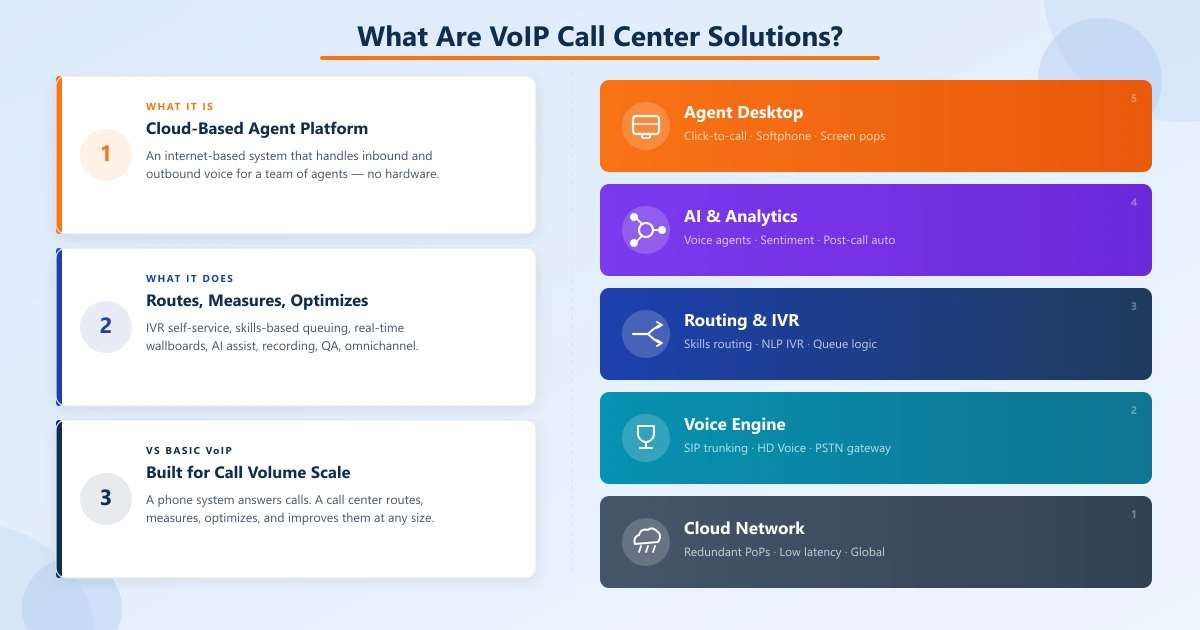
La partie « VoIP » signifie que les appels transitent par Internet au lieu du matériel téléphonique existant. La partie « centre d'appels » signifie que le système est conçu pour une concurrence élevée, une supervision en temps réel et une intégration étroite avec les CRM et les outils de billetterie.
Les déploiements basés sur le cloud ont dépassé le matériel sur site dans toutes les catégories de taille d'entreprise.
Concrètement, vous disposez d'un bureau d'agent avec appel en un clic, d'un routage intelligent, d'un système IVR, d'une visibilité des files d'attente en temps réel, d'un enregistrement, d'une notation des sentiments et d'un panneau mural de superviseur qui fait apparaître les problèmes avant qu'ils n'atteignent le client.
Les plates-formes de centres d'appels cloud modernes fonctionnent entièrement dans le navigateur : pas d'installation de bureau, pas de gymnastique VPN, pas d'attente pour le prochain ticket informatique.
La différence entre un système téléphonique VoIP et un centre d'appels VoIP réside dans l'échelle opérationnelle. Un système téléphonique répond aux appels. Un centre d’appels les achemine, les mesure, les optimise et les améliore.
Inbound, Outbound et Blended : de quoi avez-vous besoin ?
La plupart des acheteurs qui recherchent des solutions de centre d'appels VoIP savent qu'ils veulent un centre d'appels, mais n'ont pas décidé quelle version. Les trois modèles se comportent très différemment dans le logiciel.
L'erreur à éviter : acheter une plateforme entrante d'abord, puis lui demander de composer des appels sortants à grande échelle. Les calculs de numérotation prédictive sont plus difficiles qu'il n'y paraît, et les outils entrants d'abord offrent généralement des taux d'abandon et un rythme inférieurs à la moyenne.
Si le volume sortant est important, confirmez que le numéroteur est natif et non verrouillé.
- Entrant. Optimisé pour le service client, le support et les bureaux de commande. Points forts : routage intelligent, file d'attente basée sur les compétences, rappel en file d'attente, libre-service IVR.
- Sortant. Optimisé pour les équipes de vente, de recouvrement et d'enquête. Points forts : composeurs prédictifs et progressifs, gestion de listes, conformité DNC par Règles TCPA de la FCC, suppression de la messagerie vocale.
- Mélangé. Les agents alternent entre les appels entrants et sortants en fonction de la profondeur de la file d'attente. Utile pour les petites équipes où une seule personne porte les deux casquettes.
Fonctionnalités incontournables du centre d’appels en 2026
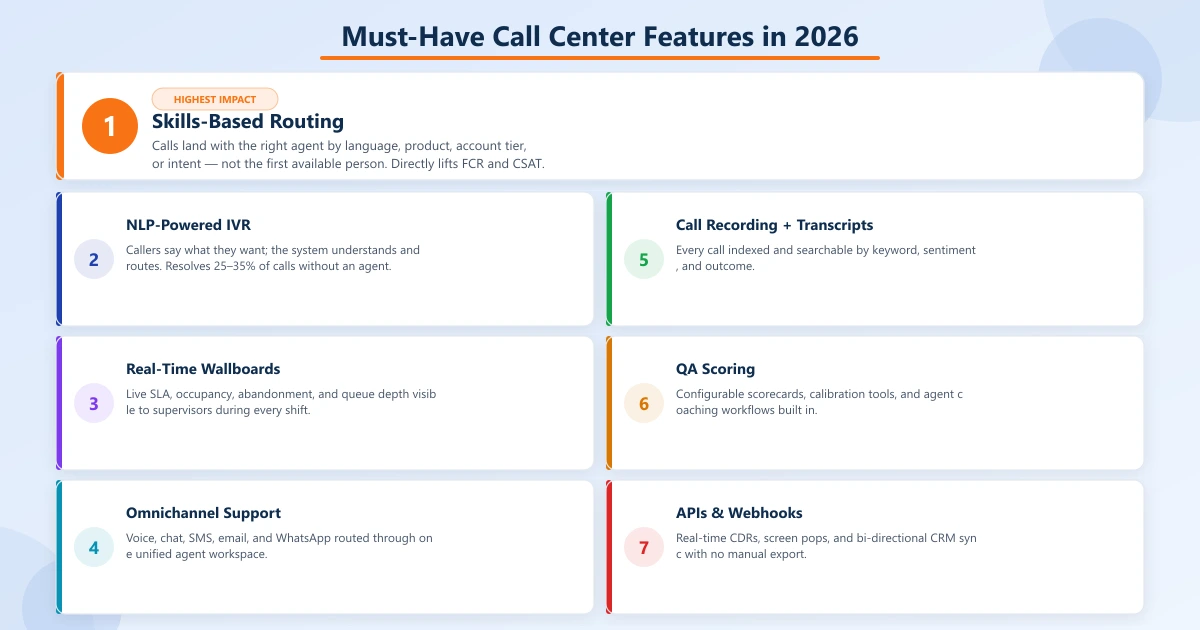
Les listes de fonctionnalités sont longues et pour la plupart identiques. Concentrez votre évaluation sur les capacités qui séparent un logiciel de centre de contact puissant de la VoIP générique avec une file d'attente ajoutée.
Des plateformes construites autour boîte de réception et routage omnicanal surpassent systématiquement les outils monocanal en termes d’efficacité des agents et de CSAT. Voir la définition Gartner CCaaS pour la référence du secteur.
Si l'un d'entre eux nécessite un fournisseur supplémentaire ou une mise à niveau de niveau « Entreprise », votre coût total de possession est supérieur au prix global.
- Routage basé sur les compétences. Les appels atterrissent auprès du bon agent en fonction de la langue, du produit, de la valeur du compte ou de l'intention, et non de la première personne disponible.
- Système IVR alimenté par la PNL. Les appelants disent ce qu’ils veulent ; le système comprend et achemine. Les arbres de menus à eux seuls ne sont plus compétitifs.
- Panneaux muraux en temps réel. SLA en direct, occupation, abandon et profondeur de la file d'attente visibles à tout moment par les superviseurs.
- Prise en charge du centre d'appels omnicanal. La voix, le chat, les SMS, les e-mails, WhatsApp et les réseaux sociaux sont tous acheminés via le même espace de travail d'agent.
- Enregistrement des appels avec transcriptions consultables. Chaque appel est indexé et consultable par mot-clé, sentiment et résultat.
- Notation d’assurance qualité. Cartes de pointage configurables, outils d'étalonnage et flux de travail de coaching des agents.
- API et webhooks. CDR en temps réel, fenêtres contextuelles et synchronisation CRM bidirectionnelle.
L'IA dans le centre d'appels moderne
L’IA dans les solutions de centre d’appels VoIP a dépassé le stade de la démonstration. La valeur profonde n’est pas le remplacement ; c'est la compression.
Un travail de routine qui prenait cinq minutes prend désormais trente secondes. Un travail complexe qui prenait trente minutes est désormais mieux informé car l'agent arrive avec l'IA contextuelle déjà rassemblée.
Choisissez des fonctionnalités de centre d'appels IA qui s'intègrent nativement à la plate-forme, et non des modules tiers qui perdent le contexte à chaque transfert.
Trois catégories d’IA sont prêtes pour la production en 2026 :
- Agents vocaux IA qui gèrent de bout en bout les requêtes entrantes simples : vérifications du solde, planification des rendez-vous, réponses aux FAQ. Correctement réglés, ils résolvent 30 à 40 % du volume entrant sans agent.
- Assistance d'agent en temps réel qui écoute les appels en direct et fait apparaître le bon article de la base de connaissances, la meilleure action suivante ou le script de conformité.
- Automatisation post-appel qui résume l'appel, met à jour le CRM, génère l'e-mail de suivi et note l'interaction pour le contrôle qualité, le tout en moins de 10 secondes après la fin de l'appel.
Profondeur d'intégration : d'où vient réellement le retour sur investissement
Les acheteurs se concentrent sur le prix par siège. Le plus gros levier est la profondeur d’intégration.
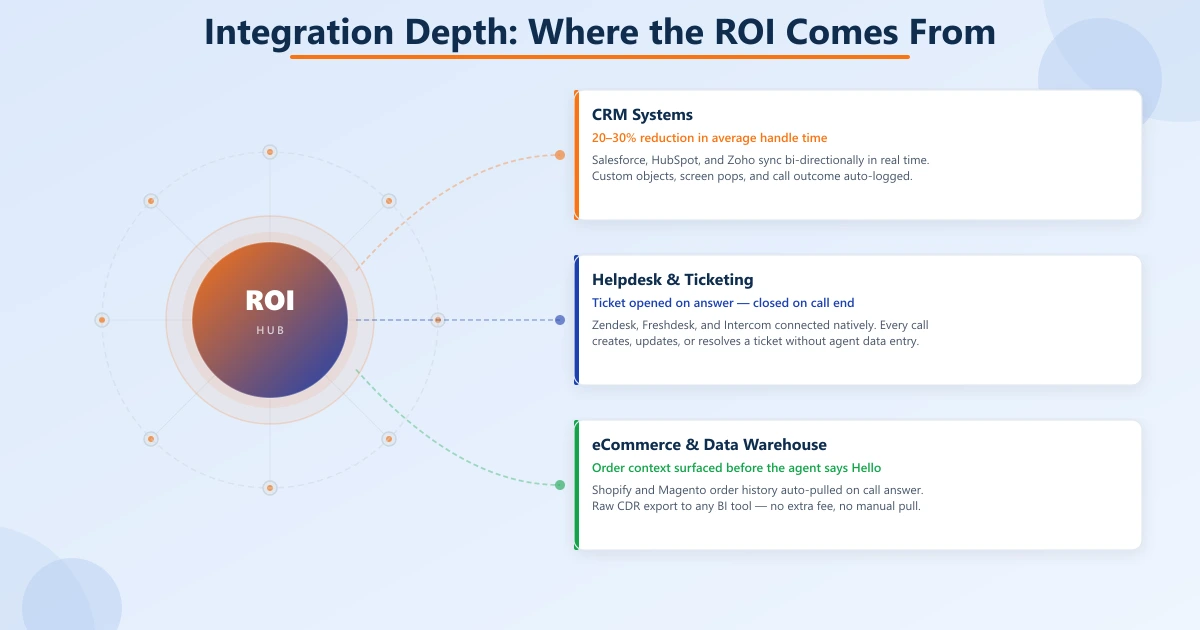
Les solutions de centre d'appels VoIP qui extraient le contexte du client, l'historique des tickets et les commandes récentes sur l'écran de l'agent avant qu'il ne dise « Bonjour » réduisent le temps de traitement moyen de 20 à 30 %, ce qui éclipse toute différence de prix par siège.
Teloz aborde la fourniture de centres de contact du point de vue de l'opérateur et de la plate-forme : la qualité vocale sous-jacente est détenue de bout en bout et l'expérience de l'agent superpose l'IA, l'omnicanal et l'analyse au-dessus d'un réseau que l'entreprise gère elle-même.
Cette combinaison est importante car la profondeur d'intégration est gaspillée si un appel chute à mi-résolution.
Les intégrations les plus importantes :
- CRM (Salesforce, HubSpot, Zoho) — bidirectionnel, en temps réel, y compris des objets personnalisés.
- Helpdesk (Zendesk, Freshdesk, Intercom) : ouvre le ticket lors de la réponse à l'appel, ferme-le à la fin de l'appel.
- Commerce électronique (Shopify, Magento) : l'historique des commandes et l'état des expéditions apparaissent automatiquement.
- Outils WFM pour la prévision et la planification.
- Exportation d’entrepôt de données pour des analyses avancées du centre d’appels.
Modèles de tarification expliqués
Les solutions de centres d'appels VoIP sont proposées sous quatre formes courantes. Vérifiez les plans tarifaires transparents des centres d’appels pour comparer les modèles avant de vous engager.
Surveillez les éléments de campagne en dehors du prix global : modules complémentaires de fonctionnalités d'IA, stockage d'enregistrement, intégrations au-delà de la liste de base, assistance premium et minutes entrantes gratuites.
Le fournisseur avec le prix de siège le plus bas est souvent le plus cher sur un an une fois ceux-ci ajoutés. Pour la plupart des équipes, la tarification par siège simultané avec une grille tarifaire de téléphonie transparente est le modèle le plus propre.
- Par siège simultané. Payez pour le nombre maximum d'agents connectés en même temps. Convivial pour les opérations basées sur des équipes.
- Par utilisateur nommé. Payez pour chaque agent agréé, qu'il soit connecté ou non. Prévisible mais plus coûteux en cas de faible utilisation.
- Par minute ou en fonction de l'utilisation. Téléphonie facturée à la minute, plateforme gratuite ou low-cost. Convivial pour les équipes à faible volume ; peut augmenter de manière imprévisible.
- Forfaits tout compris. Plateforme, minutes vocales et IA, le tout dans un seul numéro. Facile à budgétiser ; moins flexible si l’usage change.
“Les meilleures solutions de centre d'appels VoIP disparaissent dans le travail : les agents ne remarquent plus l'outil car il fait apparaître ce dont ils ont besoin avant de le demander.”
Rapports et analyses des centres d'appels
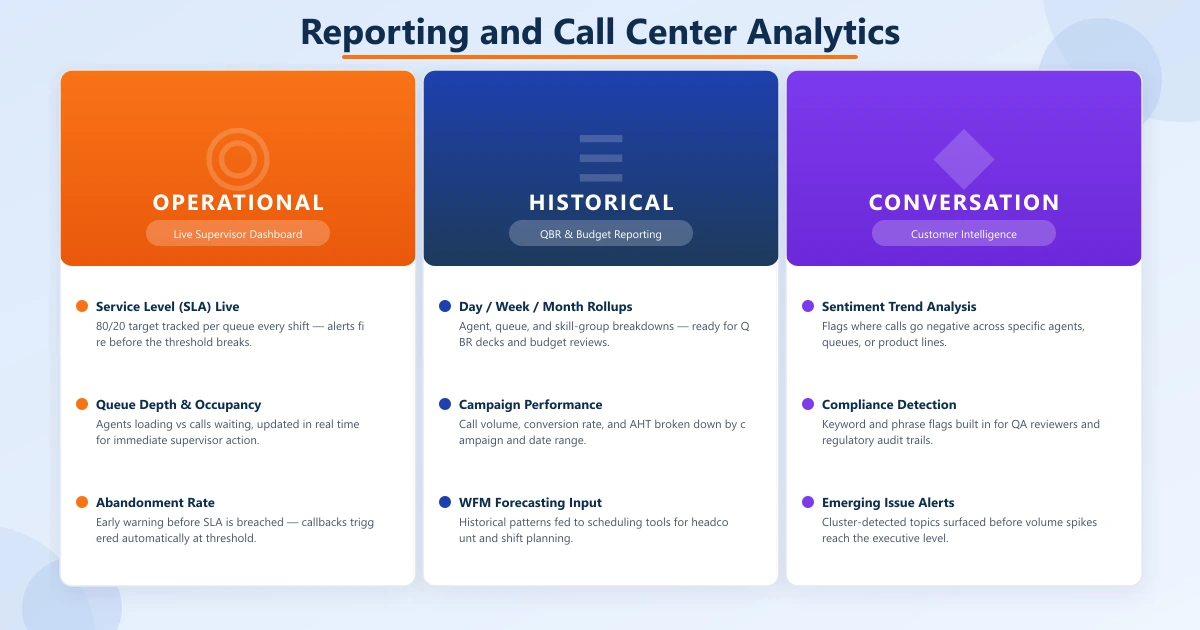
L'analyse des centres d'appels fait la différence entre une file d'attente qui fonctionne à chaud et une file d'attente qui fonctionne efficacement. Les solutions modernes de centres d'appels VoIP fournissent des rapports à trois niveaux de profondeur, et vous devez confirmer que les trois sont disponibles, pas seulement le premier.
Deux questions d'évaluation pratiques : Puis-je exporter des CDR bruts vers mon entrepôt de données sans frais supplémentaires ? Et puis-je créer une métrique personnalisée dans la plateforme sans faire appel à des services professionnels ?
Si la réponse à l’une ou l’autre est « parler aux ventes », prévoyez les frictions. Les solutions de centre d'appels VoIP qui valent la peine d'être conservées permettent l'analyse en libre-service.
- Tableaux de bord opérationnels. Niveau de service, occupation, abandon et profondeur de file d'attente en temps réel. Cela évite aux superviseurs d’avoir des ennuis pendant le quart de travail.
- Reportage historique. Cumuls journaliers, hebdomadaires, mensuels et au niveau de la campagne pour les agents, les files d'attente et les compétences. C’est ce qui alimente vos QBR et vos conversations budgétaires.
- Intelligence conversationnelle. Tendances de sentiment, produits les plus mentionnés, indicateurs de conformité et problèmes émergents. C’est ce qui fait du centre d’appels un moteur d’analyse client pour le reste de l’entreprise.
Conclusion
Les meilleures solutions de centre d'appels VoIP disparaissent dans le travail.
Les agents ne remarquent plus l'outil parce qu'il révèle ce dont ils ont besoin avant de le demander, les superviseurs cessent de lutter contre les incendies parce que les panneaux muraux et les alertes détectent les problèmes plus tôt, et les finances cessent d'examiner la facture parce que chaque ligne est prévisible.
Maîtrisez les bases : routage, SVI, enregistrement, omnicanal. Superposez l'IA là où elle compresse le travail réel. Intégrez en profondeur les systèmes que les agents utilisent déjà. Et choisissez un fournisseur dont le réseau sous-jacent est aussi sérieux que son logiciel.
Découvrez comment Teloz offre des capacités de centre de contact alimentées par l'IA sur Teloz.com.


