Introduction
Turkey bridges two continents — and millions of US residents, businesses, and travelers need to reach it by phone every year.
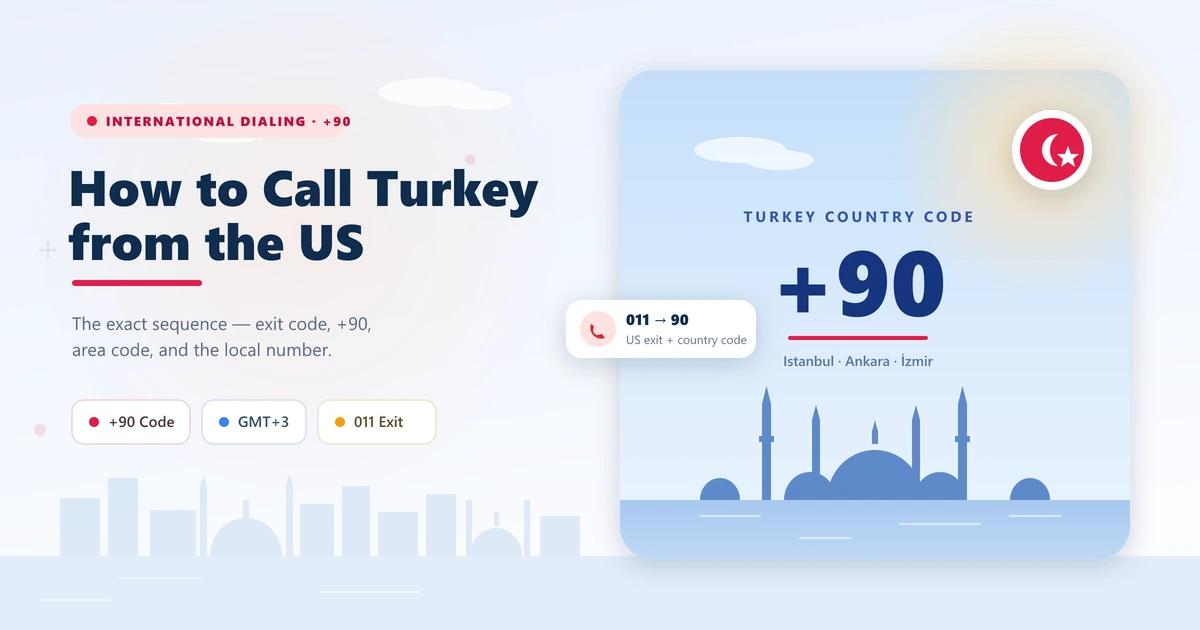
Whether you are calling family in Istanbul, coordinating with a supplier in Ankara, or dialing a hotel in Antalya, the process starts with one fixed sequence: 011 + 90 + city code + local number. Get any digit wrong and the call simply will not connect.
This guide gives you everything you need: the exact dialing steps, a map of Turkey's major city area codes, the cheapest ways to call, the eight-hour time difference, and the cultural cues that matter on a Turkish business call.
- Exact dialing sequence: 011 + 90 + city code + local number
- Turkey's major city area codes including Istanbul, Ankara, Izmir, and Antalya
- Cheapest methods to call Turkey — VoIP, apps, and carrier plans compared
- Turkey time zone UTC+3 and the best calling windows from US time zones
- Business and cultural etiquette tips for Turkish phone calls
The Exact Dialing Sequence to Call Turkey from the US
Calling Turkey from the US follows a fixed four-part sequence that never changes regardless of your carrier or device.
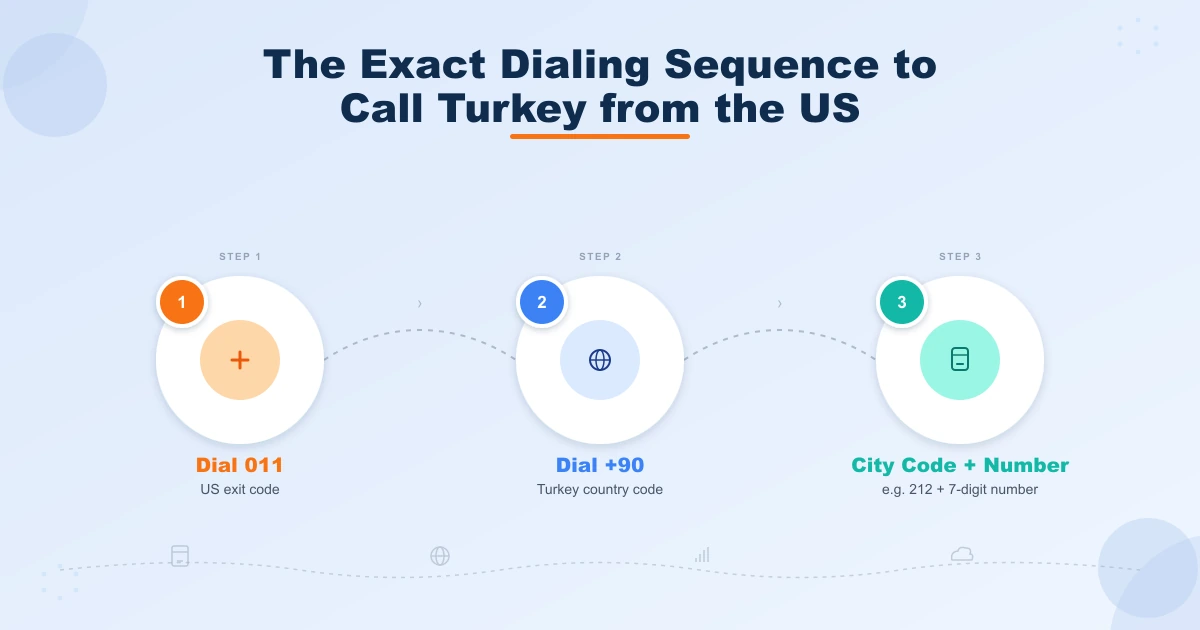
Step 1 — Dial 011 (US international exit code). This prefix tells your carrier you are placing an international call. On a smartphone, you can replace 011 with a + symbol held from the 0 key.
Step 2 — Dial 90 (Turkey country code). Every call to Turkey passes through this country identifier regardless of destination city.
Step 3 — Dial the city area code (without the leading 0). Turkish local numbers include a leading 0 when dialed domestically — drop it when calling from abroad. Istanbul's European side is 212; Istanbul's Asian side is 216; Ankara is 312.
Step 4 — Dial the 7-digit local number. Turkish local numbers are seven digits long. The complete dialed string looks like: 011-90-212-XXXXXXX for an Istanbul call.
Example: To reach a business on Istanbul's European side at local number 555 0100, dial: 011 90 212 555 0100.
For mobile numbers in Turkey, the structure changes slightly — Turkish mobile numbers begin with 5, giving you a 10-digit number after the country code: 011 90 5XX XXX XXXX.
Using a Teloz virtual phone number lets you make all of these calls from a single business line with full call logs, routing controls, and transparent per-minute Turkey rates.
- Exit code: 011 (or + on mobile)
- Country code: 90
- Drop the leading 0 from Turkish area codes
- Local number: 7 digits (landline) or 10 digits starting with 5 (mobile)
- Full example: 011 90 212 XXX XXXX
Turkey Country Code and City Area Codes Explained
Turkey's country code is +90, assigned under the ITU-T E.164 international numbering plan. All calls to Turkey — whether to a landline, mobile, or VoIP number — begin with this prefix.
Turkey uses three-digit area codes for landline numbers, followed by a seven-digit subscriber number. Mobile numbers use a different structure: the prefix 05XX is the domestic format, which drops the leading 0 to become +90 5XX when dialed internationally.
Major city area codes:
Istanbul is unique in having two area codes: 212 for the European side (Beyoglu, Besiktas, Fatih, Sisli) and 216 for the Asian side (Kadikoy, Uskudar, Maltepe). Istanbul is Turkey's largest city and commercial capital.
Ankara, the national capital, uses area code 312. Most government ministries, major banks, and national institutions are reachable through this code.
Izmir, Turkey's third-largest city and a major Aegean port, uses 232. Antalya — the Mediterranean tourism hub — uses 242. Bursa, an industrial and historical center near Istanbul, uses 224.
Knowing the correct area code is essential: dialing 212 instead of 216 (or vice versa for Istanbul) routes your call to a completely different side of the city.
- Istanbul (European side): +90 212
- Istanbul (Asian side): +90 216
- Ankara (Capital): +90 312
- Izmir: +90 232
- Antalya: +90 242
- Bursa: +90 224
- Turkish mobiles: +90 5XX XXX XXXX
Best Ways to Call Turkey Cheaply from the US
International calling costs vary dramatically by method. Standard carrier plans typically charge $1.50–$3.00 per minute to Turkey — a 10-minute call can cost $30 before taxes. Smarter options cut that cost by 80–95%.
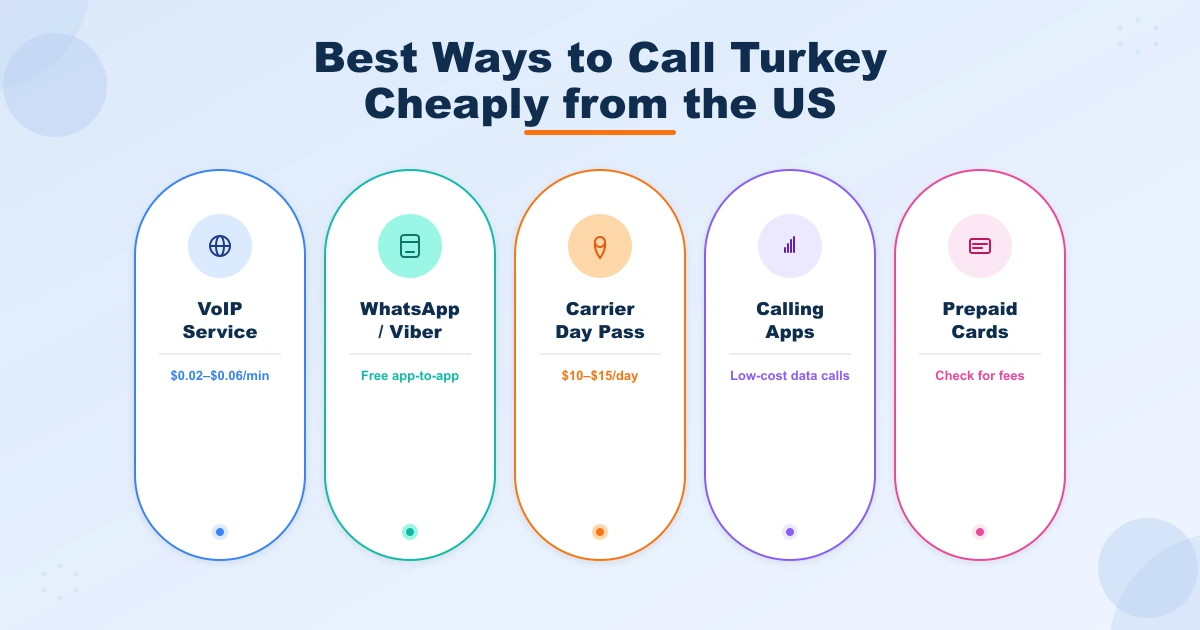
VoIP services offer the lowest per-minute rates to Turkey, typically $0.02–$0.06 per minute for landlines and $0.04–$0.10 for Turkish mobiles.
You need a stable internet connection and a VoIP account — the call quality is generally HD-grade and far better than consumer calling apps over congested networks.
Calling apps (WhatsApp, Viber, FaceTime) are free for app-to-app calls if the recipient also has the app installed and an active internet connection. This works well for personal calls to family or friends.
For business calls — where the recipient may not have the same app — VoIP is more reliable.
International phone plans from major US carriers (AT&T International Day Pass, T-Mobile Magenta, Verizon TravelPass) include Turkey, typically at $10–$15 per day for unlimited calling.
These make sense for short trips but are expensive for regular US-based calling.
Prepaid calling cards marketed for Middle East or international calling often advertise low Turkey rates but carry hidden connection fees of $0.50–$1.50 per call that erase the savings. Read the fine print.
For businesses making regular calls to Turkey, a cloud VoIP platform provides the most predictable cost structure: fixed monthly seat fees plus transparent per-minute Turkey termination rates, no daily pass surprises.
- VoIP services: $0.02–$0.06 per minute to Turkish landlines
- WhatsApp/Viber: free app-to-app, requires app on both sides
- Carrier international plans: $10–$15/day, better for travel
- Prepaid calling cards: check for hidden connection fees
- Business VoIP: fixed monthly rate + transparent Turkey termination
Turkey Time Zone: Best Hours to Call from the US
Turkey operates on Turkey Time (TRT), which is UTC+3 year-round. Turkey abolished daylight saving time in 2016 and now observes a single fixed offset — it does not shift clocks forward or back.
This fixed offset means the time difference between the US and Turkey changes twice per year as US clocks shift for daylight saving:
During US Standard Time (November–March): Turkey is 8 hours ahead of Eastern, 9 hours ahead of Central, 10 hours ahead of Mountain, and 11 hours ahead of Pacific.
During US Daylight Saving Time (March–November): Turkey is 7 hours ahead of Eastern, 8 hours ahead of Central, 9 hours ahead of Mountain, and 10 hours ahead of Pacific.
Best calling windows from the US (during standard business hours in Turkey, 9 AM–6 PM Istanbul) — the target window shifts by an hour depending on the season, so use whichever offset matches the time of year:
From Eastern Time: during US Daylight Saving Time, call 9 AM–11 AM ET to catch 4 PM–6 PM in Istanbul.
During US Standard Time, that same 9–11 AM ET window lands an hour later in Turkey (5 PM–7 PM), past the close of business — call 8 AM–10 AM ET instead to hit the same 4 PM–6 PM Istanbul window.
From Pacific Time: during US Daylight Saving Time, call 6 AM–8 AM PT to catch 4 PM–6 PM in Istanbul.
During US Standard Time, call an hour earlier — 5 AM–7 AM PT — for the same window, since Pacific time runs an hour behind Istanbul's clock at that point in the year.
For after-hours calls where the recipient is available: Turkey evenings (7 PM–10 PM Istanbul) correspond to 11 AM–2 PM ET and 8 AM–11 AM PT during US Standard Time, or 12 PM–3 PM ET and 9 AM–12 PM PT during US Daylight Saving Time — useful for personal calls.
- Turkey Time: UTC+3, fixed year-round (no daylight saving)
- US EST: Turkey is 8 hours ahead
- US EDT: Turkey is 7 hours ahead
- Best window from Eastern: 9–11 AM ET (DST) or 8–10 AM ET (Standard Time)
- Best window from Pacific: 6–8 AM PT (DST) or 5–7 AM PT (Standard Time)
Business Etiquette When Calling Turkey from the US
Turkish business culture places significant weight on relationship-building before transactional discussion.
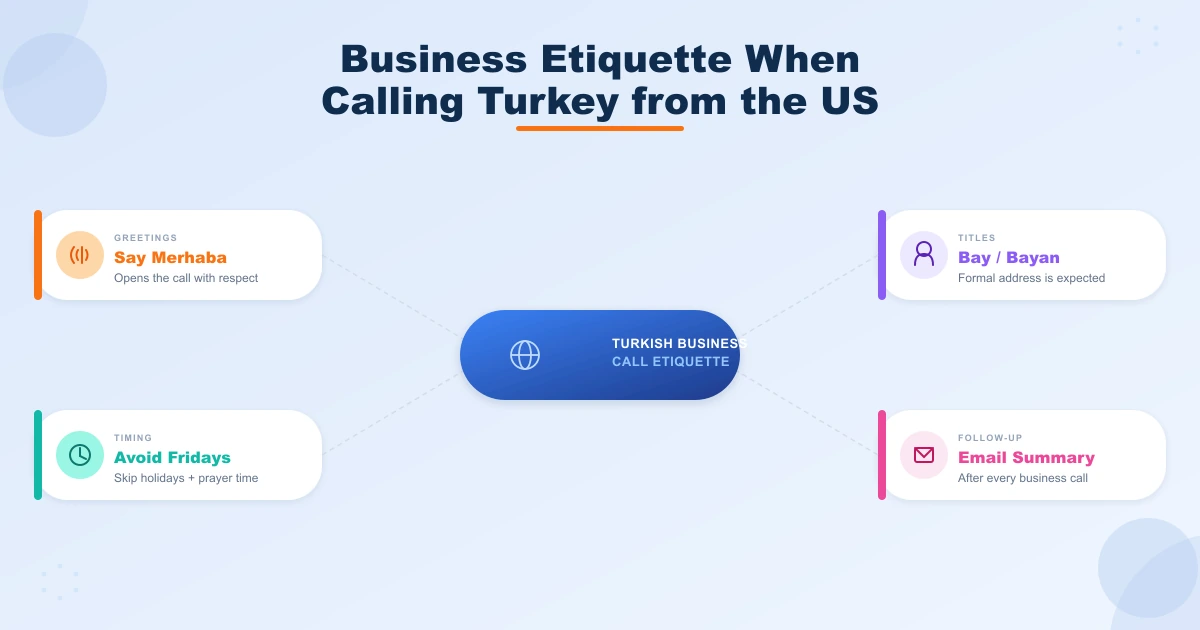
A cold call that opens immediately with a pricing request or contract terms is likely to underperform — Turkish professionals expect a brief exchange of pleasantries and contextual framing before the substantive conversation begins.
Greetings: Begin with 'Merhaba' (Hello) or 'Iyi gunler' (Good day) if you know any Turkish — even a basic greeting in the local language signals respect.
Most Turkish business professionals in Istanbul, Ankara, and Izmir speak proficient English; do not assume otherwise, but opening in Turkish is appreciated.
Titles matter. Address contacts using their professional title — 'Bay' (Mr.) or 'Bayan' (Ms./Mrs.) followed by the first name is standard. Using only a first name on a first call can seem overly casual.
Pace and patience. Turkish business calls tend to move at a measured pace.
Interrupting or rushing toward a conclusion signals impatience and can erode trust. Allow for pauses; silence in a Turkish business context is not an awkward gap — it may indicate the other party is considering your point.
Friday afternoons and religious holidays. Avoid scheduling calls on Friday afternoons (Juma prayer time) and during Ramadan's final days (Eid al-Fitr) or the Islamic Feast of Sacrifice (Eid al-Adha).
During these periods, abbreviated work schedules and observance take priority.
Follow-up in writing. After a phone call, sending a brief email summarizing what was discussed and agreed is standard practice and signals professionalism in the Turkish business context.
- Open with pleasantries before business topics
- Use titles: Bay (Mr.) or Bayan (Ms.) + first name
- Avoid interrupting — pace is measured, silences are normal
- Avoid Friday afternoons and major Islamic holidays
- Follow up calls with a written email summary
“Standard carrier plans charge $1.50–$3.00 per minute to Turkey. VoIP cuts that to $0.02–$0.06 — an 80–95% reduction on every call.”
Why VoIP Is the Smartest Way to Call Turkey from the US
For anyone making more than a handful of calls to Turkey per month, a VoIP platform is the clear choice over carrier plans, calling cards, or consumer apps.
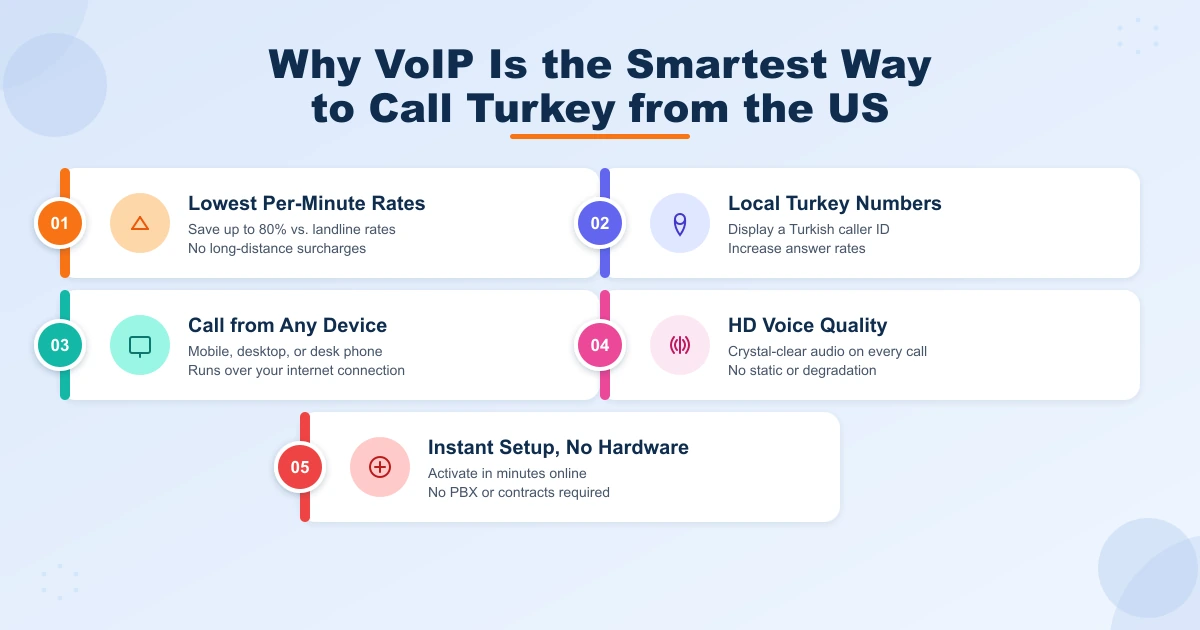
Lowest per-minute costs. VoIP providers route calls over the internet to the destination network, bypassing the premium mark-ups traditional carriers charge for international routes.
Turkey termination rates on business VoIP platforms typically run $0.02–$0.06 per minute to landlines — compare that to $1.50–$3.00 per minute on a standard mobile plan.
Local Turkey numbers. Some VoIP providers can assign you a Turkish DID (Direct Inward Dial) number — a +90 number that rings your US-based device.
Calls from Turkey to your Turkish DID are local calls for them, eliminating the barrier of international call reluctance.
Call from any device, anywhere. A VoIP line is not tied to a physical handset or office location.
Your team in New York, Chicago, or Los Angeles dials Turkey through the same platform interface — desktop app, mobile app, or browser — with identical call quality.
HD voice and call reliability. Consumer calling apps depend on both parties having adequate bandwidth.
Business VoIP platforms prioritize voice traffic and use dedicated media servers in geographically appropriate locations, delivering consistent HD audio regardless of Istanbul network conditions.
Instant setup, no hardware. Activating a VoIP line for Turkey calling takes minutes — no PBX hardware, no contracts, no waiting for a phone company technician.
Teloz's cloud contact center platform includes Turkey calling alongside AI-powered routing, omnichannel inbox, real-time analytics, and CRM integrations — purpose-built for businesses that need reliable international reach.
- Rates from $0.02/min vs $1.50+/min on carrier plans
- Assign a +90 Turkish DID that rings your US device
- Works on any device — no hardware required
- HD voice with business-grade reliability
- Instant activation, transparent per-minute billing
Conclusion
Calling Turkey from the US comes down to one reliable sequence: 011 + 90 + city area code + local number. Istanbul splits across two codes (212 European, 216 Asian), Ankara uses 312, and Turkish mobiles follow the +90 5XX format.
Turkey runs on UTC+3 year-round — a fixed offset that makes scheduling straightforward once you account for the 7–11 hour gap depending on US time zone and season.
For regular callers and businesses, VoIP is the only cost-effective solution: $0.02–$0.06 per minute versus carrier rates that can reach $3.00. Explore how Teloz provides instant Turkey calling with transparent rates and no hardware.


