소개
20 years in telecom teaches you one thing above all else: a call center lives or dies on how fast it surfaces context, not on how many lines it can carry.
The right VoIP call center solutions show the agent who is calling, why they are calling, and what to say next — before the second ring. Everything else is plumbing.
This guide walks through what serious VoIP call center solutions actually deliver in 2026, where the real ROI comes from, and the trade-offs that buyers tend to miss until renewal.
Whether you are standing up your first 10-seat support desk or migrating a 500-agent operation off legacy hardware, the framework below applies.
- What VoIP call center solutions are — and why they differ from basic phone systems
- Inbound, outbound, and blended: which model your team actually needs
- Must-have features in 2026: skills-based routing, NLP IVR, omnichannel, and QA
- AI capabilities that are production-ready: voice agents, agent assist, post-call automation
- Where the real ROI lives: integration depth with CRM, helpdesk, and eCommerce
- How to read call center analytics at three depths: operational, historical, and conversational
What Are VoIP Call Center Solutions?
A cloud contact center solution is an internet-based platform that handles inbound and outbound voice traffic for a team of agents, layered with routing logic, queues, analytics, and — increasingly — AI.
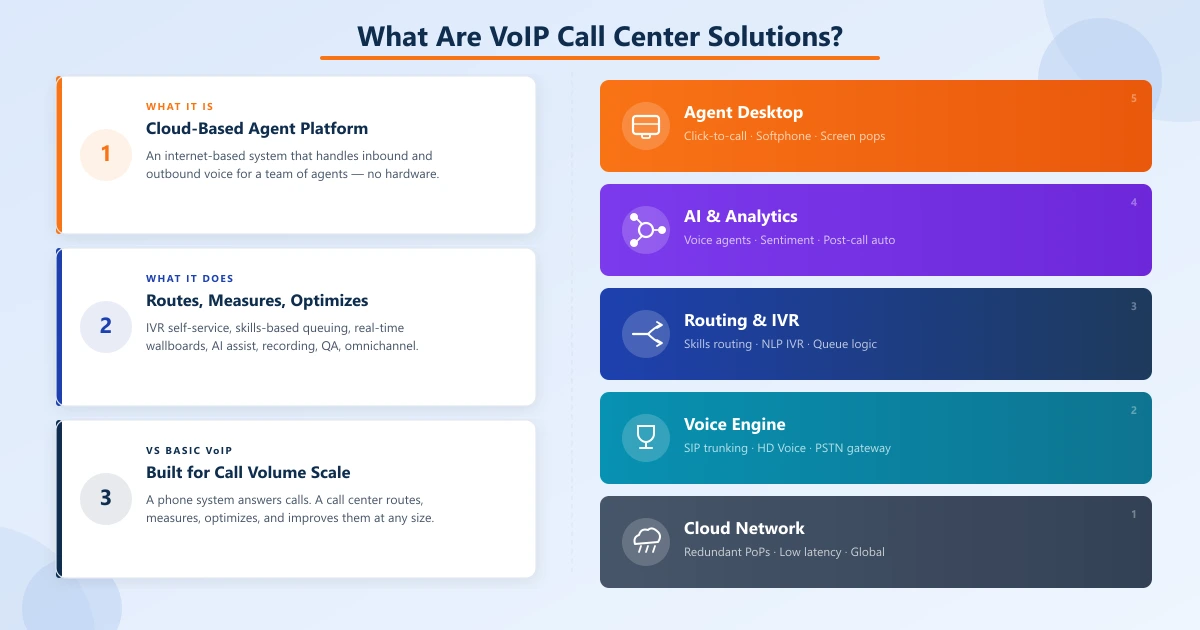
The "VoIP" part means calls travel over the internet instead of legacy telephony hardware. The "call center" part means the system is built for high concurrency, real-time supervision, and tight integration with CRMs and ticketing tools.
Cloud-based deployments have overtaken on-premise hardware in every business size category.
In practical terms, you get an agent desktop with click-to-call, intelligent routing, an IVR system, real-time queue visibility, recording, sentiment scoring, and a supervisor wallboard that surfaces problems before they hit the customer.
Modern cloud call center platforms run entirely in the browser — no desktop installs, no VPN gymnastics, no waiting for the next IT ticket.
The difference between a VoIP phone system and a VoIP call center is operational scale. A phone system answers calls. A call center routes, measures, optimizes, and improves them.
Inbound, Outbound, and Blended — Which Do You Need?
Most buyers shopping for VoIP call center solutions know they want a call center but have not decided which flavor. The three models behave very differently in software.
The mistake to avoid: buying an inbound-first platform and then asking it to dial outbound at scale. Predictive dialing math is harder than it looks, and inbound-first tools usually deliver subpar drop rates and pacing.
If outbound volume matters, confirm the dialer is native, not bolted on.
- Inbound. Optimized for customer service, support, and order desks. Strengths: intelligent routing, skills-based queuing, callback-in-queue, IVR self-service.
- Outbound. Optimized for sales, collections, and survey teams. Strengths: predictive and progressive dialers, list management, DNC compliance per FCC TCPA rules, voicemail drop.
- Blended. Agents flex between inbound and outbound based on queue depth. Useful for smaller teams where one person wears both hats.
Must-Have Call Center Features in 2026
Feature lists are long and mostly the same. Focus your evaluation on the capabilities that separate strong contact center software from generic VoIP with a queue tacked on.
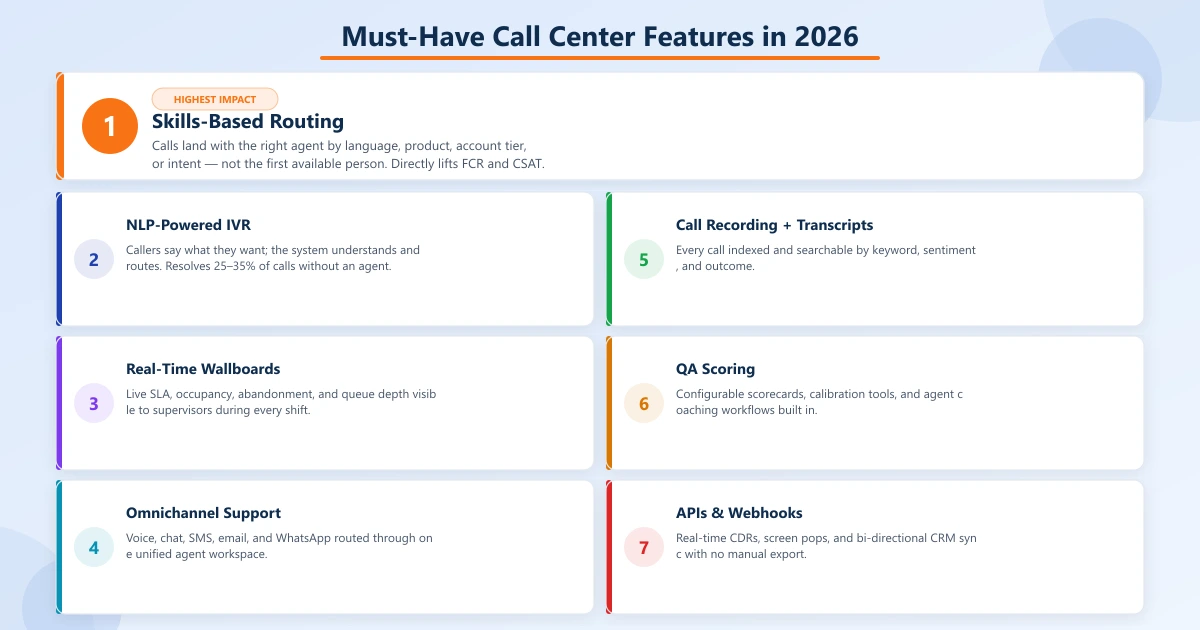
Platforms built around omnichannel inbox and routing consistently outperform single-channel tools in agent efficiency and CSAT. See the Gartner CCaaS definition for the industry benchmark.
If any of these require an additional vendor or an "Enterprise" tier upgrade, your total cost of ownership is higher than the headline price.
- Skills-based routing. Calls land with the right agent based on language, product, account value, or intent — not the first available person.
- NLP-powered IVR system. Callers say what they want; the system understands and routes. Menu trees alone are no longer competitive.
- Real-time wallboards. Live SLA, occupancy, abandonment, and queue depth visible to supervisors at all times.
- Omnichannel call center support. Voice plus chat, SMS, email, WhatsApp, and social all routed through the same agent workspace.
- Call recording with searchable transcripts. Every call indexed and searchable by keyword, sentiment, and outcome.
- Quality assurance scoring. Configurable scorecards, calibration tools, and agent coaching workflows.
- APIs and webhooks. Real-time CDRs, screen pops, and bi-directional CRM sync.
AI in the Modern Call Center
AI inside VoIP call center solutions has moved past the demo stage. The deep value is not replacement; it is compression.
Routine work that took five minutes now takes thirty seconds. Complex work that took thirty minutes is now better-informed because the agent walks in with the context AI already pulled together.
Pick AI call center features that integrate natively with the platform, not third-party bolt-ons that lose context at every handoff.
Three AI categories are production-ready in 2026:
- AI voice agents that handle simple inbound queries end-to-end — balance checks, appointment scheduling, FAQ answers. Properly tuned, they resolve 30–40% of inbound volume without an agent.
- Real-time agent assist that listens to live calls and surfaces the right knowledge base article, next-best action, or compliance script.
- Post-call automation that summarizes the call, updates the CRM, generates the follow-up email, and scores the interaction for QA — all in under 10 seconds after the call ends.
Integration Depth: Where the ROI Actually Comes From
Buyers fixate on per-seat pricing. The bigger lever is integration depth.
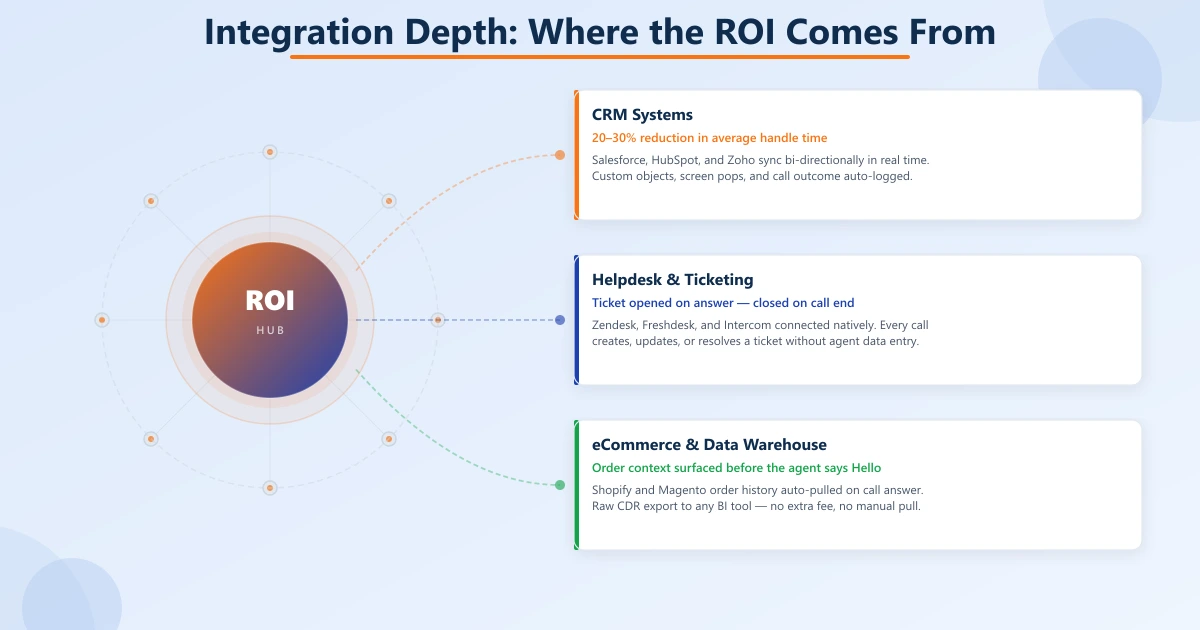
VoIP call center solutions that pull customer context, ticket history, and recent orders into the agent's screen before they say "Hello" reduce average handle time by 20–30% — which dwarfs any seat-price difference.
Teloz approaches contact center delivery from a carrier-and-platform background — the underlying voice quality is owned end-to-end, and the agent experience layers AI, omnichannel, and analytics on top of a network the company runs itself.
That combination matters because integration depth is wasted if a call drops mid-resolution.
The integrations that matter most:
- CRM (Salesforce, HubSpot, Zoho) — bi-directional, real-time, including custom objects.
- Helpdesk (Zendesk, Freshdesk, Intercom) — open ticket on call answer, close on call end.
- eCommerce (Shopify, Magento) — order history and shipment status surfaced automatically.
- WFM tools for forecasting and scheduling.
- Data warehouse export for advanced call center analytics.
Pricing Models Explained
VoIP call center solutions price in four common shapes. Check transparent call center pricing plans to compare models before committing.
Watch for line items outside the headline price: AI feature add-ons, recording storage, integrations beyond the base list, premium support, and toll-free inbound minutes.
The provider with the lowest seat price is often the most expensive over a year once these are added. For most teams, per-concurrent-seat pricing with a transparent telephony rate deck is the cleanest model.
- Per concurrent seat. Pay for the maximum number of agents logged in at once. Friendly for shift-based operations.
- Per named user. Pay for every licensed agent, whether they are logged in or not. Predictable but more expensive at low utilization.
- Per-minute or usage-based. Telephony billed per minute, platform free or low-cost. Friendly for low-volume teams; can spike unpredictably.
- All-in bundles. Platform plus voice minutes plus AI all in one number. Easy to budget; less flexible if usage changes.
“The best VoIP call center solutions disappear into the work — agents stop noticing the tool because it surfaces what they need before they ask.”
Reporting and Call Center Analytics
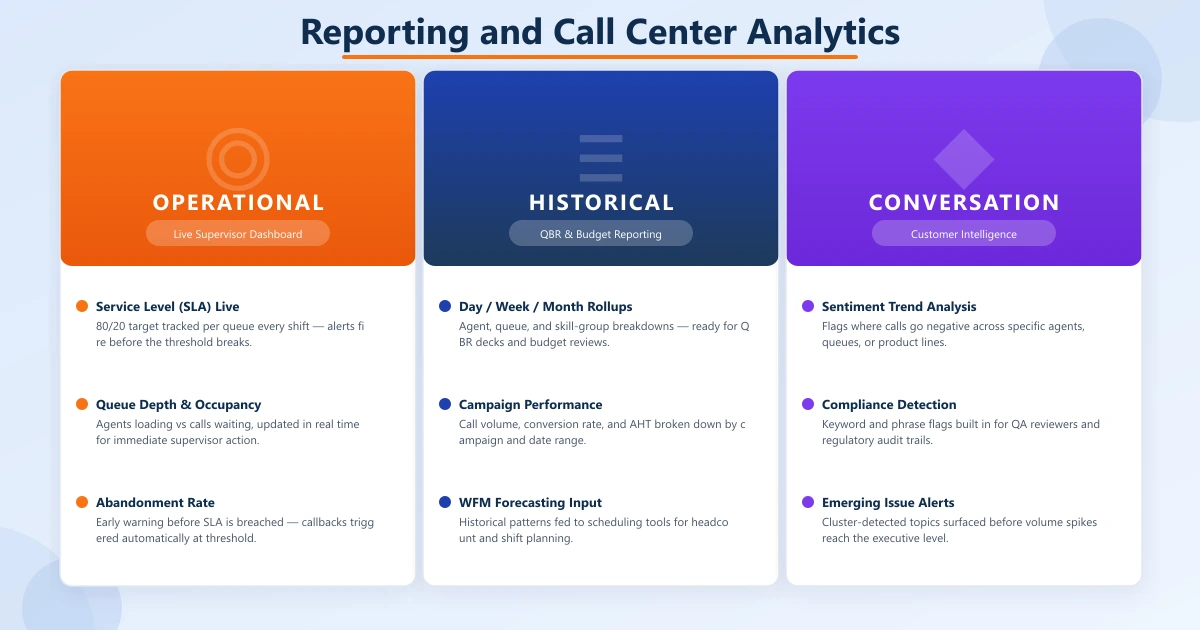
Call center analytics is the difference between a queue that runs hot and a queue that runs efficient. Modern VoIP call center solutions ship reporting at three depths, and you should confirm all three are available — not just the first.
Two practical evaluation questions: Can I export raw CDRs to my data warehouse with no extra fee? And can I build a custom metric in the platform without engaging professional services?
If the answer to either is "talk to sales," budget for friction. The VoIP call center solutions worth keeping make analytics self-serve.
- Operational dashboards. Real-time service level, occupancy, abandonment, and queue depth. These keep supervisors out of trouble during the shift.
- Historical reporting. Day, week, month, and campaign-level rollups for agents, queues, and skills. This is what feeds your QBRs and budget conversations.
- Conversation intelligence. Sentiment trends, top-mentioned products, compliance flags, and emerging issues. This is what turns the call center into a customer insight engine for the rest of the business.
결론
The best VoIP call center solutions disappear into the work.
Agents stop noticing the tool because it surfaces what they need before they ask, supervisors stop firefighting because wallboards and alerts catch problems early, and finance stops scrutinizing the invoice because every line is predictable.
Get the basics right — routing, IVR, recording, omnichannel. Layer AI where it compresses real work. Integrate deeply with the systems agents already use. And choose a provider whose underlying network is as serious as their software.
See how Teloz delivers AI-powered contact center capability at teloz.com.


