Introduction
What makes a phone number feel like it truly belongs somewhere? In Toronto, the answer has been the same since 1947: those three digits — 416.
Long before caller ID skepticism and VoIP platforms reshaped how people communicate, the 416 area code was already doing something simple and powerful — telling the person on the other end that this call is from the city.
More than a routing prefix, the 416 area code has become a symbol of Toronto's identity: a shorthand for belonging that residents, businesses, and newcomers recognize instantly.
Whether you're establishing a local Toronto presence, running a remote team, or simply holding onto a tie to Canada's largest city, this guide covers everything you need to know.
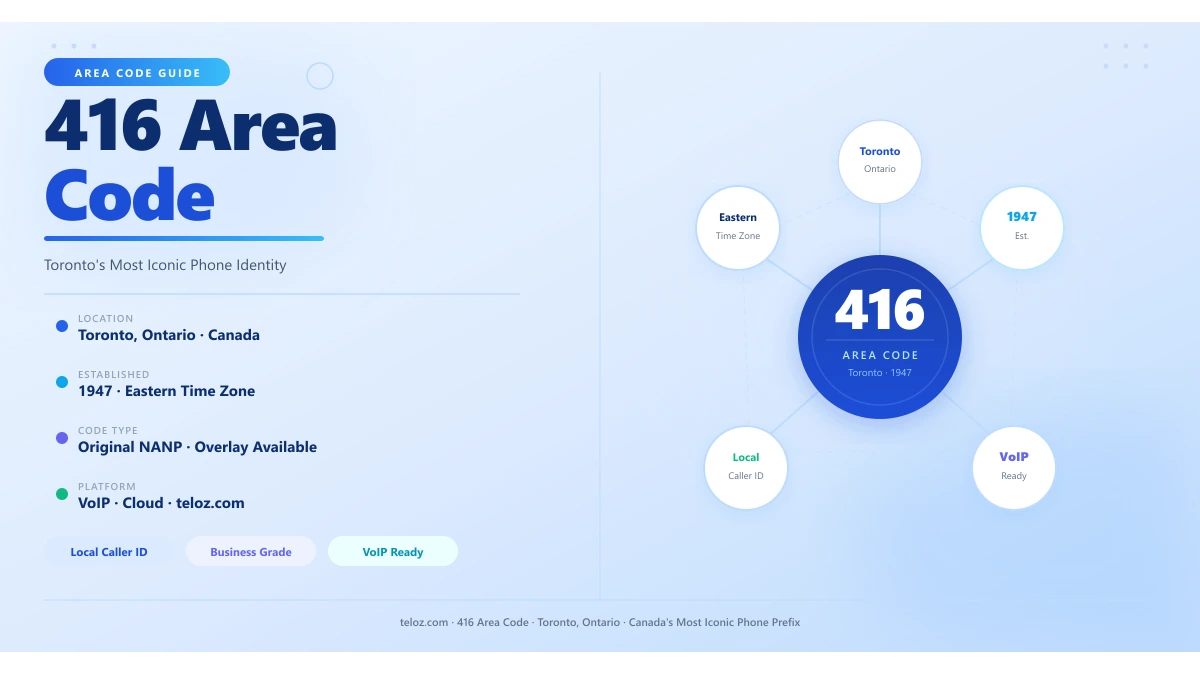
- 416 is the NANP prefix assigned exclusively to the City of Toronto, Ontario — one of Canada's nine original area codes, established in 1947.
- The 416 area code location covers all six former municipalities of Toronto, running from Steeles Avenue in the north to Lake Ontario in the south.
- Three overlay codes share the same geographic area: 647 (2001), 437 (2013), and 942 (2025) — but 416 retains unmatched local prestige.
- Toronto customers are 4” more likely to answer a call from a familiar 416 number than from an out-of-province caller.
- VoIP providers let businesses obtain a 416 phone number from anywhere — no local Toronto address required.
What Is the 416 Area Code?
Area code 416 is the telephone prefix assigned to the City of Toronto, Ontario, Canada under the North American Numbering Plan (NANPA).
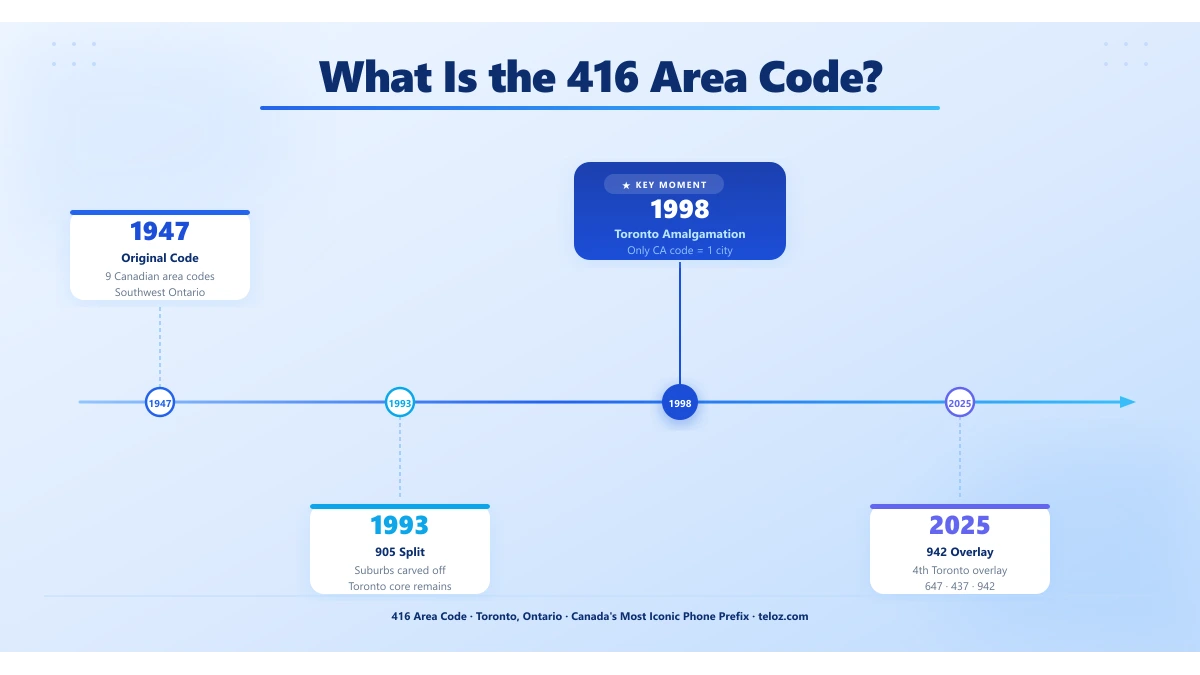
Established in 1947 as one of the nine original Canadian area codes, it is among the oldest and most recognized phone prefixes in North America.
In its early decades, the 416 area code location covered a wide stretch of southwestern Ontario — extending to Hamilton, London, and Windsor.
As Ontario's population surged, the territory was split repeatedly: area code 519 was carved off in 1953, and area code 905 followed in 1993, leaving 416 focused on Toronto's core.
The defining moment came in 1998, when six former municipalities were amalgamated into a single City of Toronto.
From that point, the 416 region code became the only area code in Canada serving a single rate centre and a single city — a distinction that has only deepened its cultural weight.
Three overlay codes have since been added: 647 in 2001, 437 in 2013, and 942 in 2025. But for residents and businesses, a 416 Toronto Ontario phone number still carries an authenticity the newer overlays have yet to match.
Learn more about area codes 416, 647, 437, and 942 on Wikipedia. The standard format is (416) XXX-XXXX, operating in the Eastern Time Zone.
What Does the 416 Area Code Cover?
The 416 area code location is uniquely focused: it covers the City of Toronto alone.
Its boundaries run roughly north to Steeles Avenue, south to Lake Ontario, east to Victoria Park Avenue, and west through Etobicoke to the Humber River — encompassing what were once six separate municipalities.
Here's a look at Toronto's key districts and former boroughs under the Toronto area code, with 2026 population estimates:
| District / Former Borough | ~2026 Pop. | Known For |
|---|---|---|
| Downtown Toronto | 310,000 | Financial District, Entertainment District |
| North York | 660,000 | Yonge—Sheppard corridor, Yorkdale |
| Scarborough | 630,000 | Diverse communities, University of Toronto Scarborough |
| Etobicoke | 370,000 | Pearson Airport, Humber College, waterfront |
| East York | 120,000 | Residential neighbourhoods, parks |
| York | 145,000 | Bloor West Village, historic streets |
Toronto's total population is approximately 2.9 million in 2026, with the broader Greater Toronto Area (GTA) exceeding 7 million. A single 416 phone number reaches one of the most economically active urban markets in North America.
Who Uses the 416 Area Code?
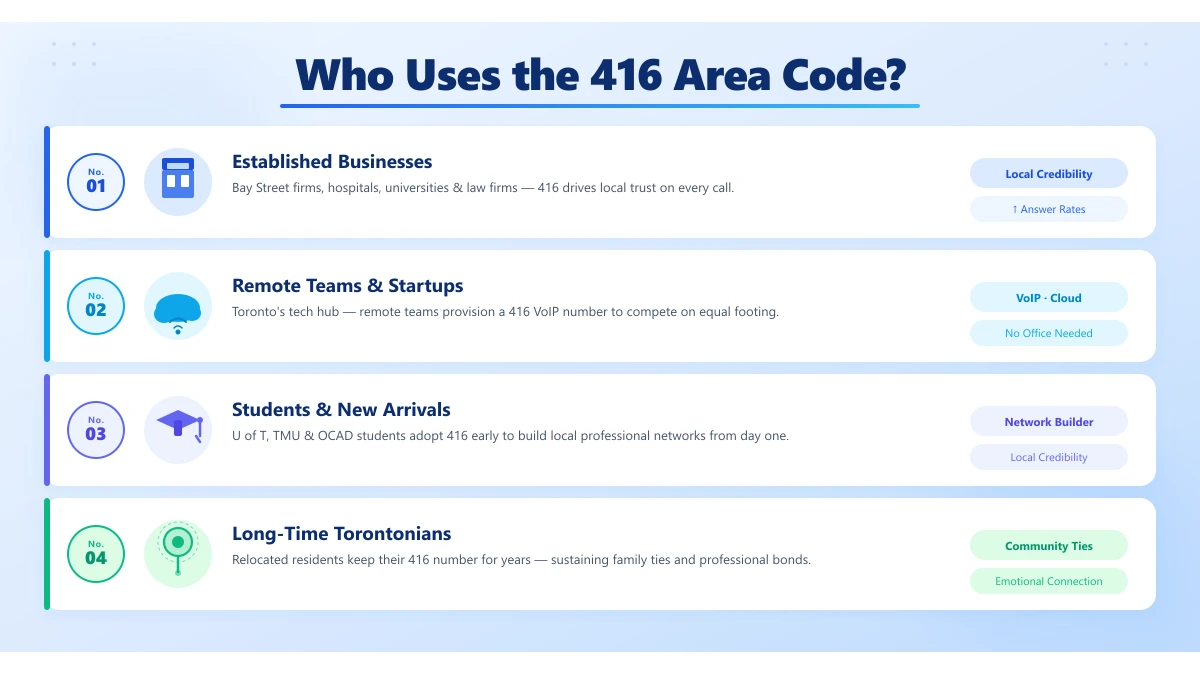
A wide cross-section of people carry a 416 phone number, all connected by a meaningful tie to Toronto.
Established Businesses
From Bay Street financial firms to Queen West boutiques, businesses across every sector recognize that a Toronto area code drives customer trust. When a familiar local prefix appears on caller ID, answer rates climb and conversations open warmer. Major institutions — hospitals, universities, and law firms — embed 416 numbers throughout their customer communications to reinforce local credibility.
Remote Teams and Startups
Toronto is Canada's technology and startup hub. Companies running hybrid or fully remote teams frequently provision a 416 number through a VoIP phone service for Toronto businesses to project a credible local presence — competing for Toronto clients on equal footing with locally headquartered rivals, without a physical office.
Students and New Arrivals
Toronto attracts students to the University of Toronto, Toronto Metropolitan University, and OCAD. Many adopt a 416 Toronto Ontario phone number early to integrate into professional networks and build local credibility from day one.
Long-Time Torontonians
Residents who relocate often hold onto their 416 number for years — sustaining family ties, professional relationships, and an emotional connection that no new prefix can replicate.
How to Get a 416 Area Code Phone Number
Claiming a 416 phone number is straightforward, with several routes available.
Traditional Carrier
Canadian carriers like Rogers, Bell, and Telus can assign area code 416 numbers, though availability is increasingly limited. A local Ontario billing address is typically required.
VoIP Provider
The most flexible option. VoIP platforms let you obtain a 416 area code number from anywhere — no local address, no hardware, and often no long-term contract. You browse online phone numbers for your business, select one that fits your brand, and activate it on your existing phone, laptop, or contact center system within minutes.
Virtual Numbers for Business
For businesses running omnichannel operations, pairing a 416 phone number with a cloud contact center solution — intelligent call routing, voicemail-to-email, auto-attendants, and analytics — delivers far more value than a standard SIM.
Porting an Existing Number
If your current number already falls within the 416 area code location, porting to a new provider is clean and keeps your digits intact. Numbers from outside the 416 region code need a fresh assignment. Reputable providers manage the entire porting process with minimal downtime.
Key Benefits of a 416 Phone Number for Business
The business case for a 416 area code extends well beyond prestige — it produces measurable outcomes.
Higher Answer Rates
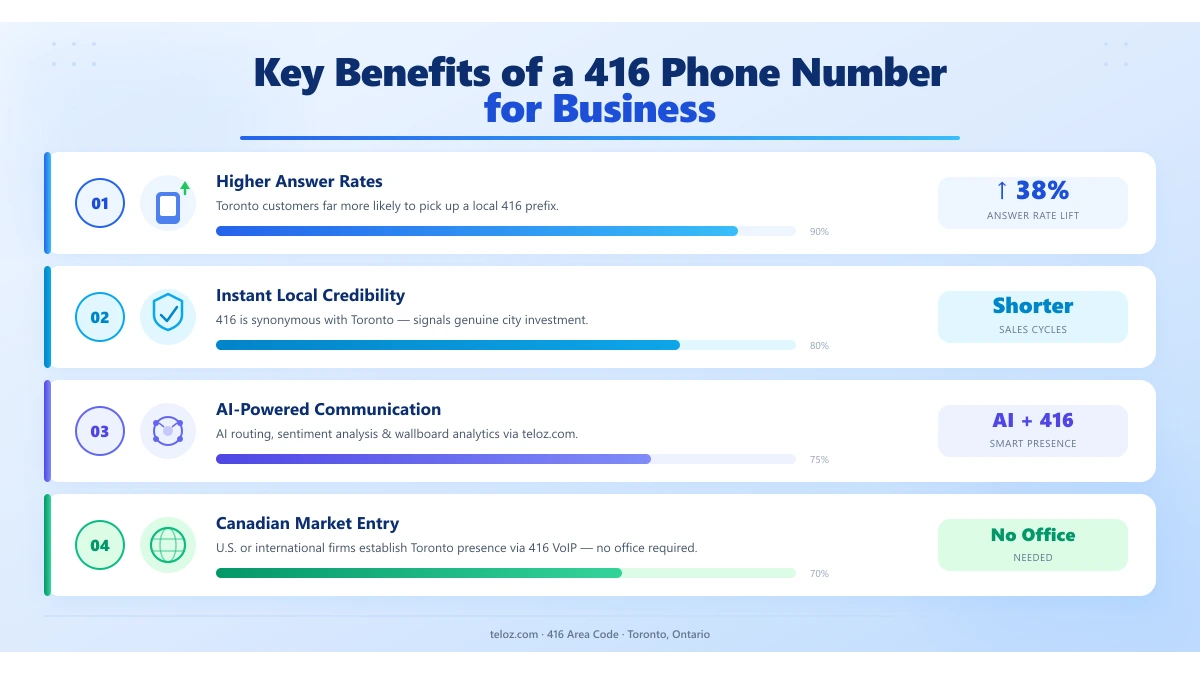
Toronto customers are far more likely to pick up calls from a familiar local prefix than from an unknown out-of-province number. That single advantage directly improves sales connect rates and customer support resolution speed.
Instant Local Credibility
The 416 region code is synonymous with Toronto. It signals that your business is invested in the city — not a distant brand approximating local presence. That trust shortens sales cycles and deepens customer loyalty.
AI-Powered Local Communication
Modern platforms pair 416 numbers with enterprise capabilities: AI-powered conversational voicebot routing, sentiment analysis, real-time wallboard analytics, and omnichannel messaging. Teloz combines conversational AI directly with a local 416 area code presence — giving Toronto businesses genuine local warmth backed by intelligent contact center technology. See how it works at teloz.com.
Canadian Market Entry
For U.S.-based or international businesses targeting Canada, a 416 phone number provisioned through an omnichannel contact center platform is the fastest way to establish a credible Toronto footprint — no Canadian office or local hire required. To reduce unwanted calls, register your number with Canada's National Do Not Call List at lnnte-dncl.gc.ca.
“The 416 area code has become a cultural marker for Toronto — a shorthand for belonging that residents, businesses, and newcomers recognize instantly.”
Staying Safe: Scams That Spoof the 416 Area Code
The strong recognition of 416 in Toronto makes it a target for spoofing. Knowing the tactics keeps you protected.
Common Patterns
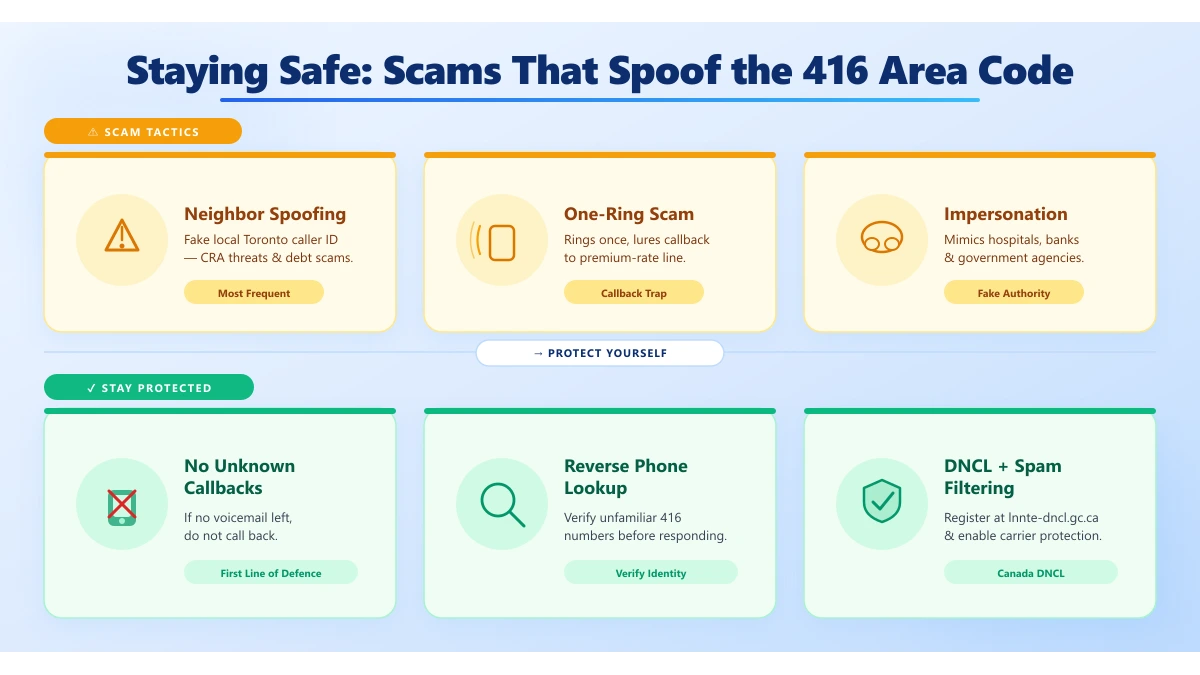
Neighbor spoofing is most frequent: fraudsters fake a local Toronto caller ID, then deliver fake CRA threats, bogus debt notices, or prize claims. One-ring scams use a spoofed 416 number to prompt a callback to a premium-rate line. Impersonation calls mimic Toronto hospitals, banks, or government agencies.
How to Stay Protected
Never return calls to unknown 416 numbers that left no voicemail. Run unfamiliar numbers through a reverse phone lookup before calling back. Enable your carrier's spam protection — Canadian carriers now flag many suspected spoofed calls automatically. The risk comes entirely from spoofing. Businesses that provision numbers through verified VoIP platforms are identifiable, compliant, and traceable.
Conclusion
The 416 area code is Toronto's most enduring communication identity. Since 1947, it has carried the city's voice through decades of growth, amalgamation, and technological change — and in 2026, it still opens doors that newer prefixes cannot.
A 416 phone number signals to every caller that you are genuinely part of Canada's largest city.
Whether you are building a business, entering the Canadian market, or holding onto a connection to home, this code delivers authenticity no overlay number can replicate.
See how Teloz makes it easy to claim a 416 number and power it with AI contact center tools at teloz.com.


